Everyone's applying with an agent. Here's how we hand you the engaged humans.
One-click easy-apply and AI auto-apply agents have buried the signal at the top of every hiring funnel. Nexus gives you an inbound backlog pre-filtered for humans who actually engaged. It's a filter only a two-sided ATS can build.
The top of every hiring funnel is drowning. One-click easy-apply, and increasingly AI agents that apply on a candidate's behalf, mean a job post can land hundreds of applications within hours of going live, mostly from people (and bots) who will never think about your company again. The signal (the handful of people who genuinely want the job) is buried under the noise.
Recruiters feel this as a tax. Every auto-applied resume still has to be opened, skimmed, and dispositioned. The more junk arrives, the more likely a real candidate gets a rushed no. The tools built for the old funnel, where applying took real effort, quietly assume that effort is still there. In 2026, it isn't.
An inbound application doesn't tell you if a human or an LLM applied. The Nexus LLM-proof gate proves not only that it is a human, but that they are engaged and genuinely interested in your specific role.
What we built
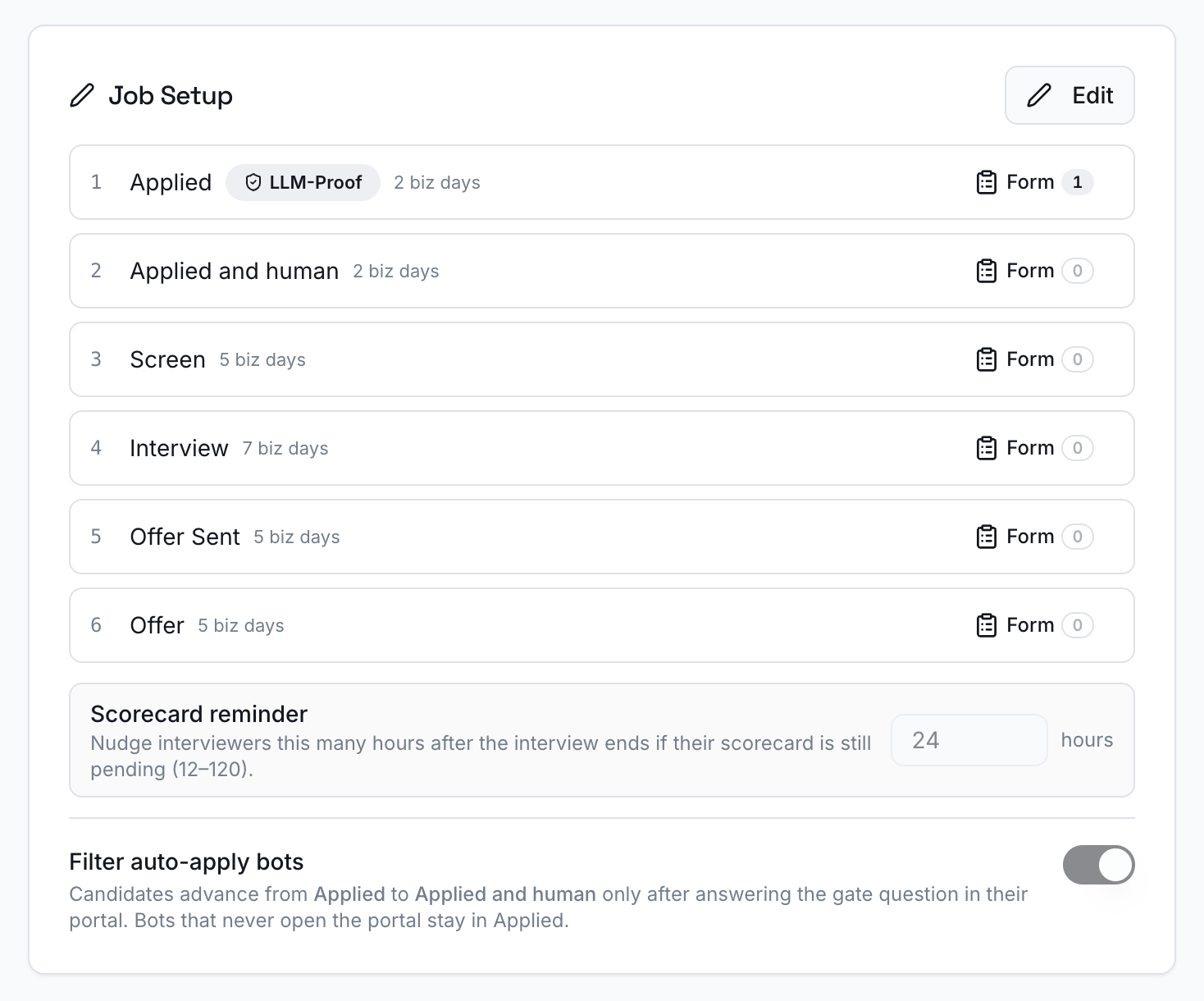
Nexus ships with an LLM-Proof gate. Every new job starts with two stages instead of one: Applied, and Applied and human. All applications land in Applied. To reach Applied and human, candidates have to open their portal and answer post-application questions. By default, it's a single line about why the role interests them, but you can make it your own and/or configure additional post-application LLM-proof gate questions.
That's the whole mechanic. It costs a real person about fifteen seconds, but it costs an auto-apply agent (that fires off the application and never opens the portal) everything: the bot never clears the LLM-proof gate. Neither does the human who applied to two hundred roles in an afternoon and couldn't tell you which one you are.
Human, and engaged
The subtle part is what the gate actually proves. A “prove you're human” check proves a human is on the other end. Our gate proves something more useful: the candidate came back, opened the portal, and wrote a sentence. That's an engaged human genuinely interested in your role. The pool your team reviews can be limited to candidates that reached the 'Applied and human' stage, which is pre-filtered for people who actually want to be there.
And your team never manages any of it. Applied and human is added automatically and reviewed like any other stage. The filter runs on by default, with a per-job switch to turn it off when you'd rather cast wide.
The candidate never sees the trick
This matters for the candidate as much as the recruiter: none of it is visible to them. They don't see two stages, they don't see the word “gate,” and they don't hit a robotic “prove you're human” wall. They apply, they get their portal, and there's a question waiting. From their side it's just a warm, low-friction first step. The mechanic that filters the noise stays completely invisible, which is exactly how it should be.

Why no other ATS can copy this in an afternoon
Here's the honest, structural point. The gate isn't a spam filter we bolted on. It works only because Nexus is two-sided: every candidate gets a real portal the moment they apply, and the gate is a step inside it. An ATS that treats the candidate as a row in a database, with no surface to return to, has nowhere to put a gate like this. You can't ask someone to come back and engage if there's nowhere to come back to.
That's the thesis Nexus has always run on. The candidate portal isn't a nicety, it's the wedge. Filtering the LLM auto-apply avalanche down to engaged humans is one more thing it makes possible that a one-sided ATS structurally can't.