Outgrew the sheet. Not ready for Greenhouse.
There's a tier of company that used to not exist: too serious for spreadsheets, too AI-SaaS-native for a six-month Greenhouse rollout. The ATS market hasn't caught up.
Most of the companies we're talking to recognize the same moment. The hiring sheet has fourteen tabs. There's an unread comment from someone who left in February. Two recruiters edited the same row on Tuesday and the loser's version is somewhere in version history. Someone built a Loom on how to use it. The Loom is now out of date.
They know they've outgrown the spreadsheet. They look at Greenhouse, sit through a demo, see the six-month implementation timeline and the contracted seat minimum, and quietly close the tab. Then they go back to the spreadsheet for another quarter.
That gap, between "a sheet isn't working anymore" and "we're ready to be a Greenhouse customer," used to be narrow. It isn't anymore. There's a whole tier of company sitting in it, and the ATS market hasn't built for them.
If you're sitting on a hiring sheet with fourteen tabs, wondering if Ashby is overkill, you're the customer we built this for.
What Nexus actually is
Before the market argument, the product. Nexus is two real interfaces, not one. The hiring team gets a pipeline that moves without someone nudging every handoff. The candidate gets their own live portal, and the moment they apply they can see exactly where they stand. The internal side, scorecards and debrief notes and the reasons behind a no, stays physically separate from anything the candidate can reach, so the team writes candidly without a leak ever being one bad query away.
Why this tier exists now: the AI-SaaS-native buyer
The companies showing up in this gap aren't legacy small businesses. They're modern, technical, often growing fast. Their existing software stack is Linear, Notion, Vercel, Stripe, Slack, Cursor. They sign up to tools without talking to a salesperson. They expect a product to work in the first ten minutes or they bounce. Implementation is a word that means "this tool is going to be a project, not a tool."
Every category they touch has been rebuilt around that expectation. Payments, infrastructure, design, docs, support, observability. The new tier of buyer in each of those markets is a product-led, self-serve customer who doesn't tolerate the older motion.
Hiring software is one of the last categories that hasn't been rebuilt for them. The choices are still spreadsheet or enterprise rollout. Nothing in between fits.
Why Greenhouse, Ashby, and Lever aren't the answer for this tier
Greenhouse, Ashby, and Lever are serious products built for serious hiring teams. We're not arguing they're bad. We're arguing they're the wrong shape for this buyer.
An enterprise-sales motion means a discovery call, a demo, a procurement back-and-forth, a security review, and an implementation engagement. That's months of elapsed time before a single candidate moves through the system. For a 40-person company hiring its next five engineers, the implementation period is longer than the hiring cycle it was meant to fix.
The product itself was designed for hiring teams with dedicated recruiting ops headcount. Configurable everything, deep workflow surface area, governance for fifteen-person interview panels. None of that maps to the team that's hiring six people this quarter with a founder, a recruiter, and a hiring manager who context-switches in for interviews.
The buyer in our tier doesn't want a less-configured version of one of those. They want something shaped differently from the ground up: opinionated, fast to set up, self-serve, with the parts they actually need.
This story has played out before
The CRM market went through exactly this. Salesforce was the only serious answer for years. You bought it, hired a consultancy to implement it, trained your team for months, and accepted that this was just what professional sales tooling cost.
Then HubSpot came in below it. Not by being a dress-down Salesforce, but by being a different shape altogether. Self-serve. Free tier. Product-led. Built for the company that needed a real CRM but couldn't justify a six-month rollout. Within a few years, HubSpot wasn't "Salesforce for small teams." It was its own category, with its own customer, eating an enormous market that Salesforce had decided didn't exist.
The same pattern has repeated in category after category. The incumbent didn't lose ground to a feature-for-feature competitor. They lost ground to a product with a different motion, built for a customer they hadn't been listening to.
And it isn't only the bottom of the market the incumbents are losing. The largest hiring teams in the world, Meta and Google and Amazon, don't run on Greenhouse either; they built their own years ago. The middle that Greenhouse was built for is squeezed from both ends: the giants need the system to bend to how they hire, the new tier needs it invisible and self-serve, and the off-the-shelf product can be neither.
The ATS market is overdue for the same shift. Nexus is what it looks like when you build for this tier from day one.
What the first ten minutes actually look like
We didn't wait for a customer to tell us. We ran it ourselves, cold: a brand-new company, no demo account, no pre-seeded data, no special setup, timing every step from signup to a real candidate sitting in the hiring pipeline.
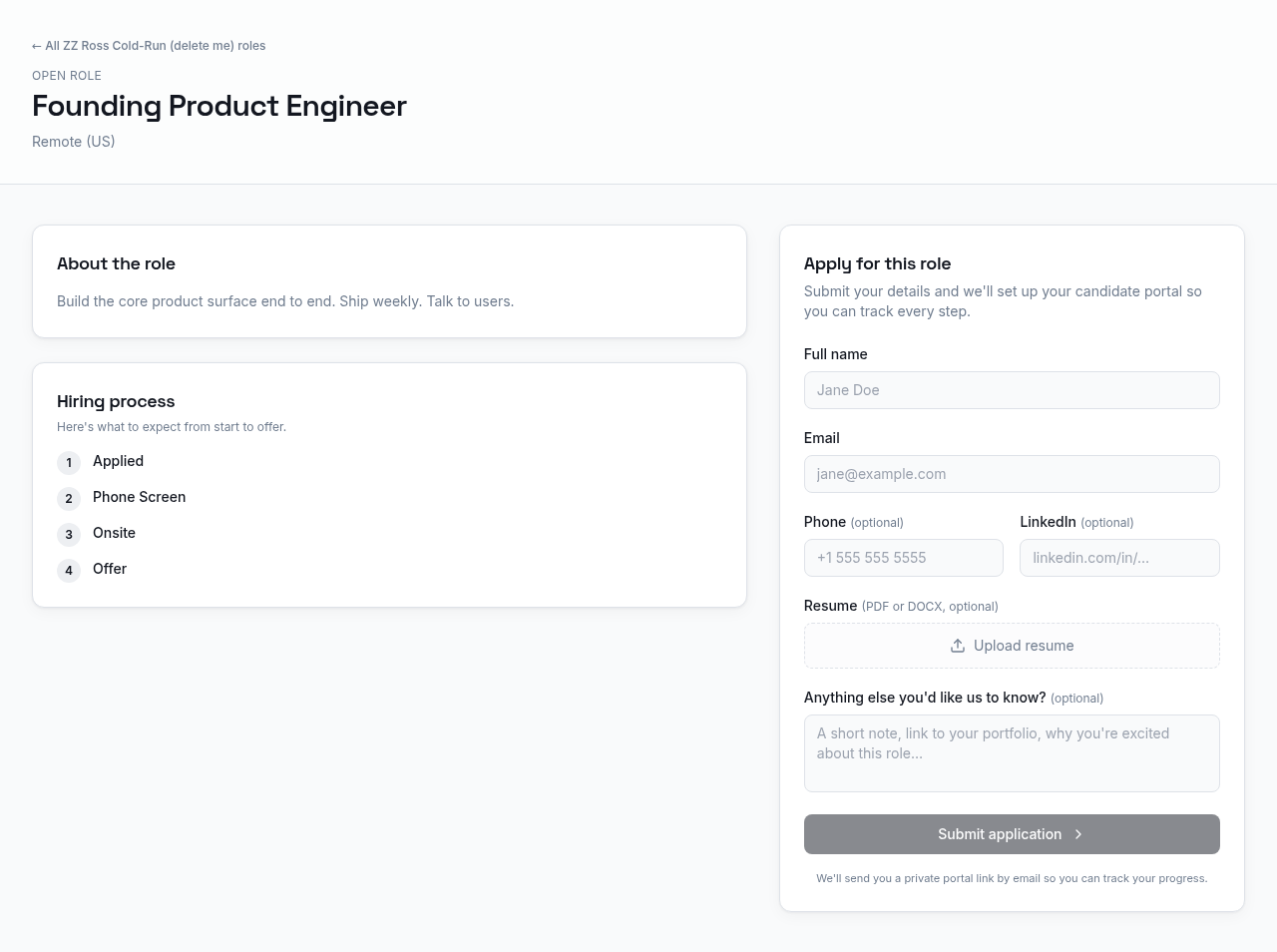
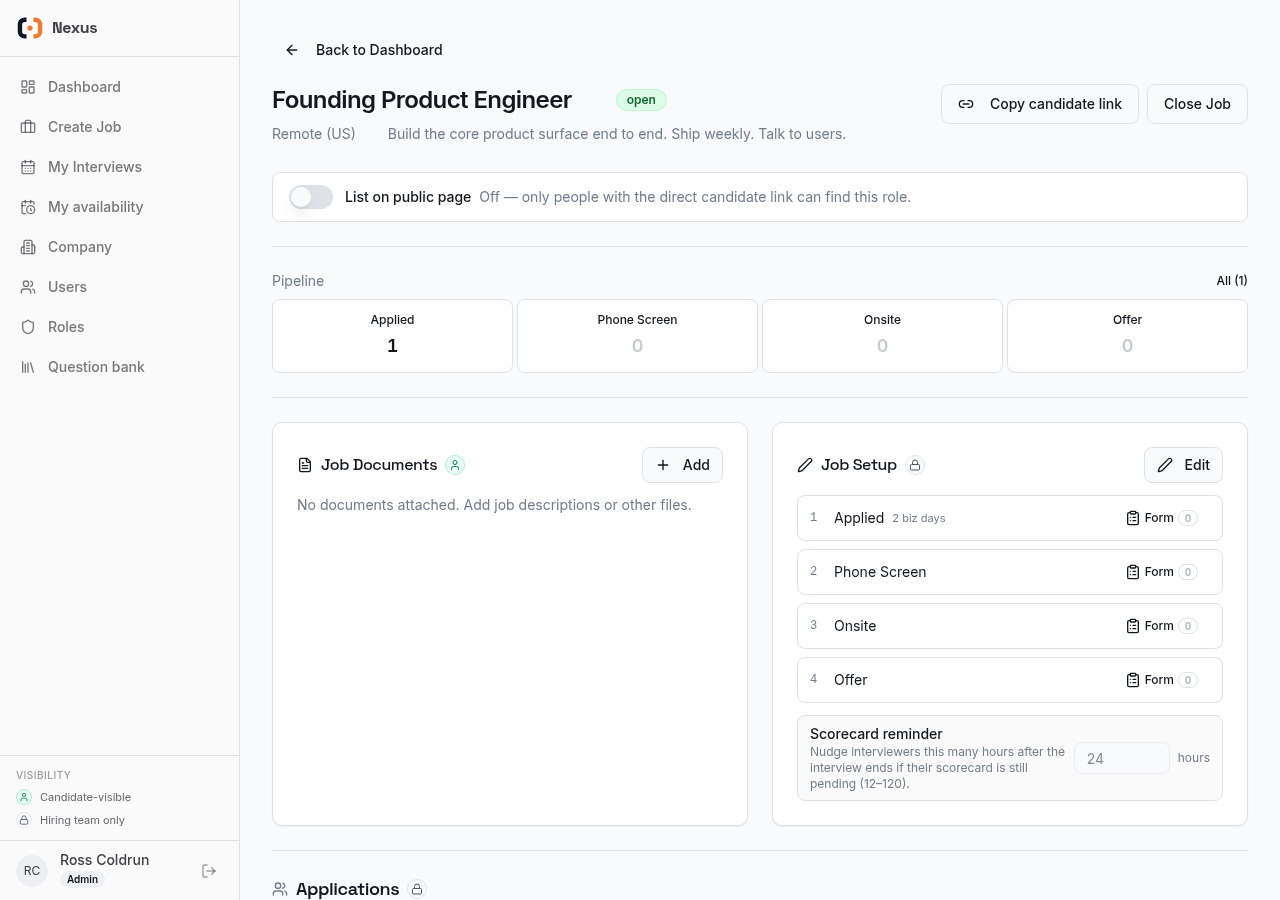
Creating the workspace is one screen: company name, your name, work email, a password. There's no email-verification wall and no "we'll be in touch." You're inside the product the moment you submit. Posting the first role is one form: a title, a description, and a pipeline that already comes filled with sensible default stages you can rename or reorder. Flip the role open, copy the candidate link, and it's live.
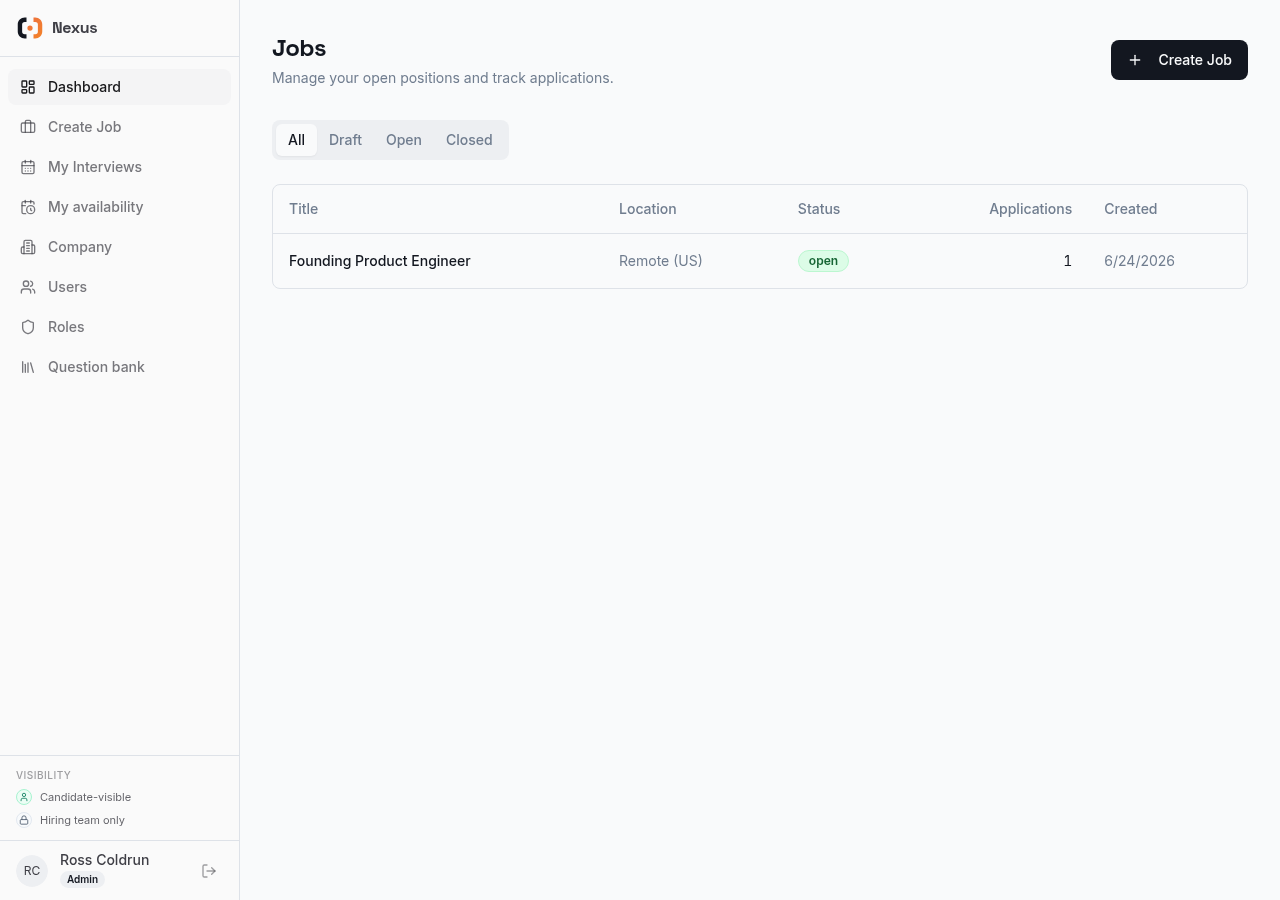
Then a candidate applies, and this is the part that matters: their application appears in the hiring pipeline the instant they hit submit. No sync, no nightly import, no "give it a few minutes." The recruiter sees the new applicant sitting in the Applied column, and the candidate gets a private portal link to track their own progress, both in the same moment.
On timing: every step the product is responsible for returned in about three seconds or less. Account creation, the slowest of them, took roughly three. The only thing standing between a cold signup and a live role collecting applicants is how long it takes you to type a job description. No implementation project. No onboarding call. No contract. Hold that next to the six-month rollout the tier above is quoting.
Two honest notes, because the edges matter. Nexus is in private beta right now, so creating a workspace needs an invite, a deliberate gate while we onboard a few teams at a time, not a technical limit. And a freshly opened role goes live behind a direct link you share, with a one-click toggle to list it on a public page when you want it indexed. Minutes to set up, self-serve the whole way; we'd rather show you exactly where the edges are than pretend a product has none.
Where Nexus fits
Nexus is built for the company that has outgrown the spreadsheet and is years away from being a Greenhouse customer. Opinionated defaults so you can start in minutes. A real candidate portal so candidates aren't living in the dark. A pipeline that moves without someone manually nudging every handoff. Stage-gated content so the work attached to each stage stops being someone's job to remember.
There's a calmer version of hiring hiding under the admin. The team stops carrying the process in their heads. The candidate stops guessing in the dark. The information moves on its own instead of becoming someone's anxiety to manage. That's the thing we're actually building: not another system to feed, but room to breathe while the work still gets done.