The industry answered the AI flood with more AI. We built an ATS that handles the deluge humanely.
Hiring has quietly turned into an AI arms race: candidates apply with AI, employers filter with AI, and the signal drains out of the middle. The category's reflex is to add more AI at every step. We believe the steps themselves are broken. Nexus is the humane ATS, and this is the bet underneath it.
Hiring has turned into an arms race, and almost nobody chose it. Candidates lean on AI to write, tailor, and fire off applications by the hundred. Employers answer with AI to parse, score, and filter the flood back down. The volume climbs, the signal drains away, and everyone in hiring feels it: more applications than ever, less certainty than ever about which of them mean anything.
The industry's answer has been remarkably consistent: add more AI. AI sourcing, AI screening, AI note-takers, AI scoring the AI-written resumes. It looks like progress, and underneath it's a tell. You only need that much AI to prop up a workflow that was broken before the bots showed up.
Most of the AI in any ATS today exists to rescue a workflow that is one long chain of email-heavy manual handoffs. Turns out if you fundamentally redesign the age-old ATS, you need a lot fewer AI bandaids.
The arms race is a symptom. The age-old ATS model is the disease.
Think about what a one-sided ATS is under the hood. An NDA goes out by email. A signed copy comes back by email. Someone forwards it, someone schedules a call, someone chases a scorecard, someone remembers to tell the candidate what's next, or forgets. Every one is a manual handoff, a place the process stalls until a person unsticks it. The category spent two years asking which of those steps it could hand to a model. The better question is why the step needs a human babysitting it at all.
What we did instead
Nexus was built as a 2-sided ATS from day one. For each handoff, we asked how it could be fixed for the people standing in it, not painted over with AI. The candidate gets a real portal the moment they apply, so nobody is forwarding them anything. Each stage hands over its own information and next steps automatically, so no one has to remember to. The recruiter goes back to the judgment calls only a person can make. Remove the manual touch at each handoff and you remove the reason to throw AI at it. We landed on a lighter AI footprint than the incumbents, not by holding back, but because less was left to rescue.
A light AI footprint is the proof the model works. You only post a guard at every step when every step keeps breaking.
This is what we mean by humane
Humane is a plain description of what hiring feels like once the handoffs stop costing people. The candidate gets attention and a place to stand, not a resume vanishing into a queue. The recruiter gets time back and cleaner signal, not a day spent dispositioning noise. Hiring is a human act, and Nexus is built to keep it one: the humane ATS, an ATS for humans, at a moment when the rest of the category is drowning them in AI.
It holds up in the agentic era, because of where we put the AI
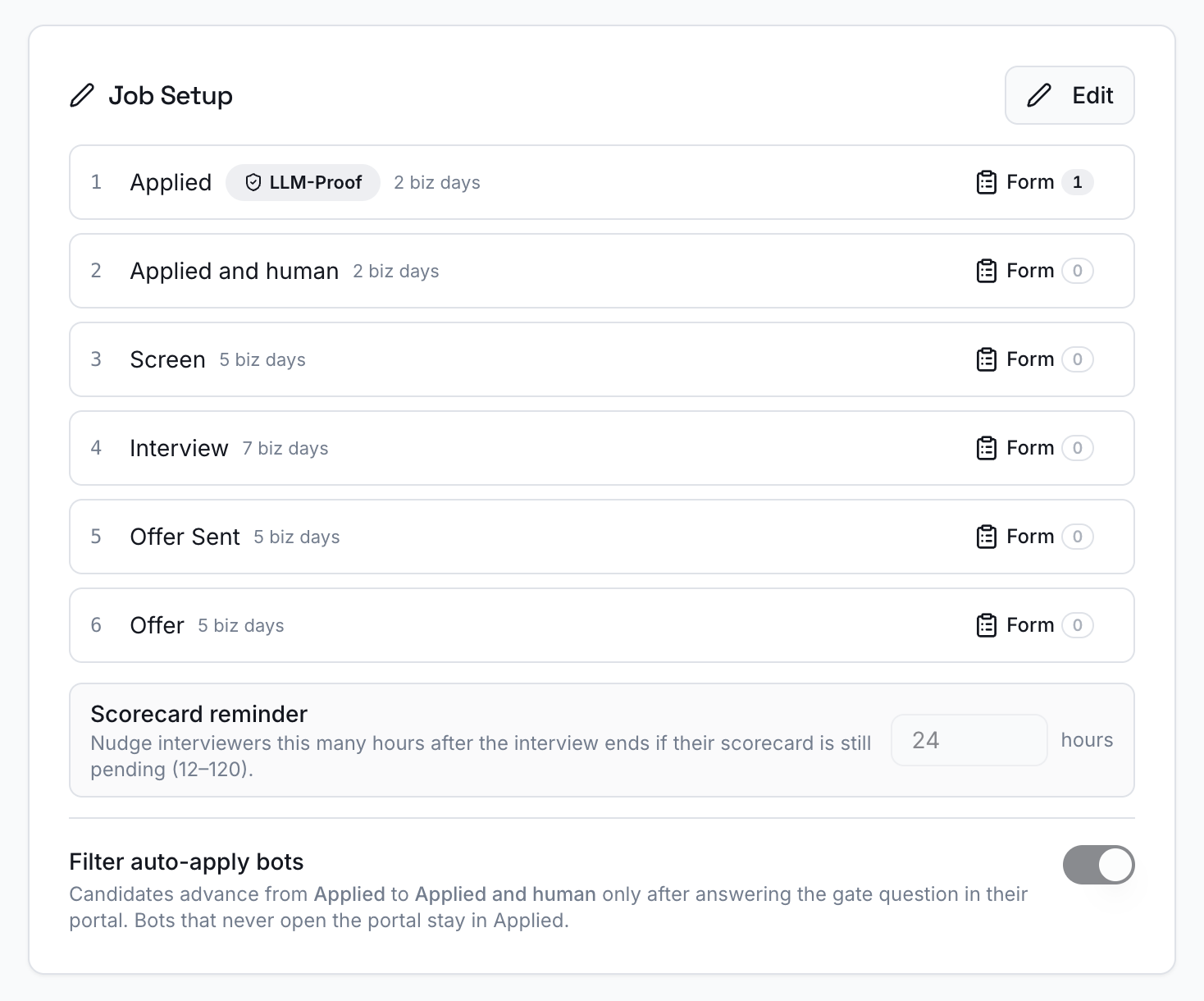
The obvious objection: isn't a light-AI ATS exactly what the agentic era runs over? It would be, if we'd gone light everywhere. We didn't. We went heavy at the one layer that matters, the infrastructure. The LLM-Proof gate absorbs the flood of auto-generated and agent-submitted applications at the top of the funnel, so a real person's attention only lands on the applicants who engaged. A public agent and MCP API lets external agents read the pipeline directly, on purpose. That groundwork is what keeps the day-to-day human. The market assumed an old ATS needs heavy AI everywhere to catch up. Nexus is the counterexample: rethink the decades-old core, and far fewer workflows need AI at all.
The proof, today
None of this is a roadmap promise. It's how the product already works.
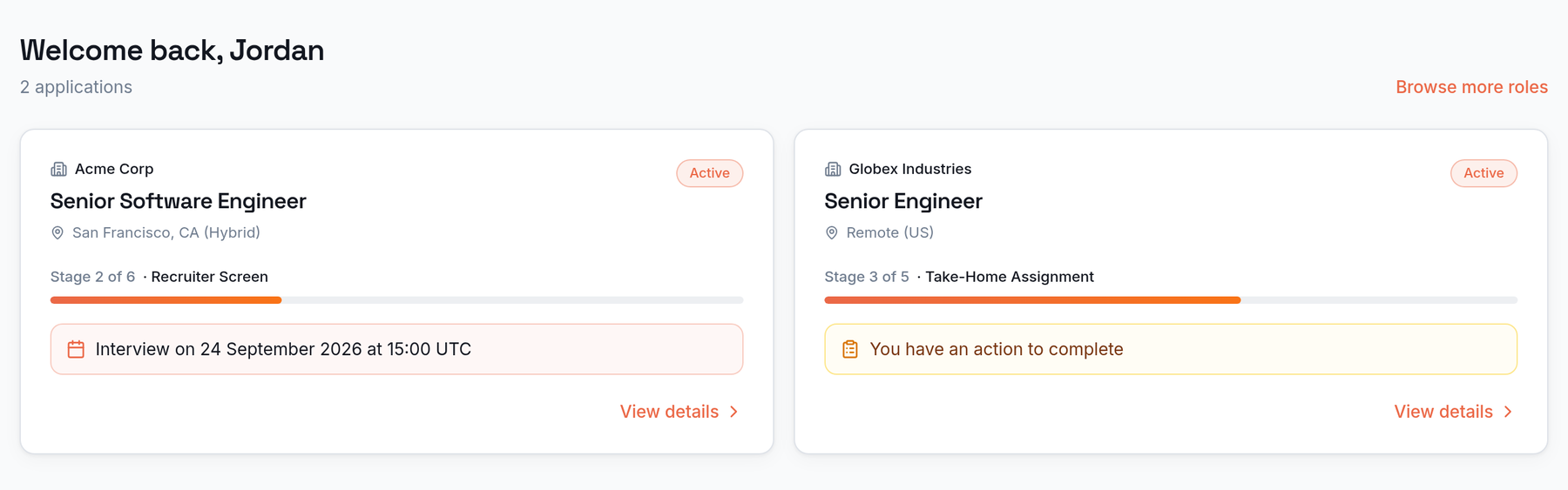
A two-sided portal, so every candidate has a living home for their application, not a resume dropped into a queue.
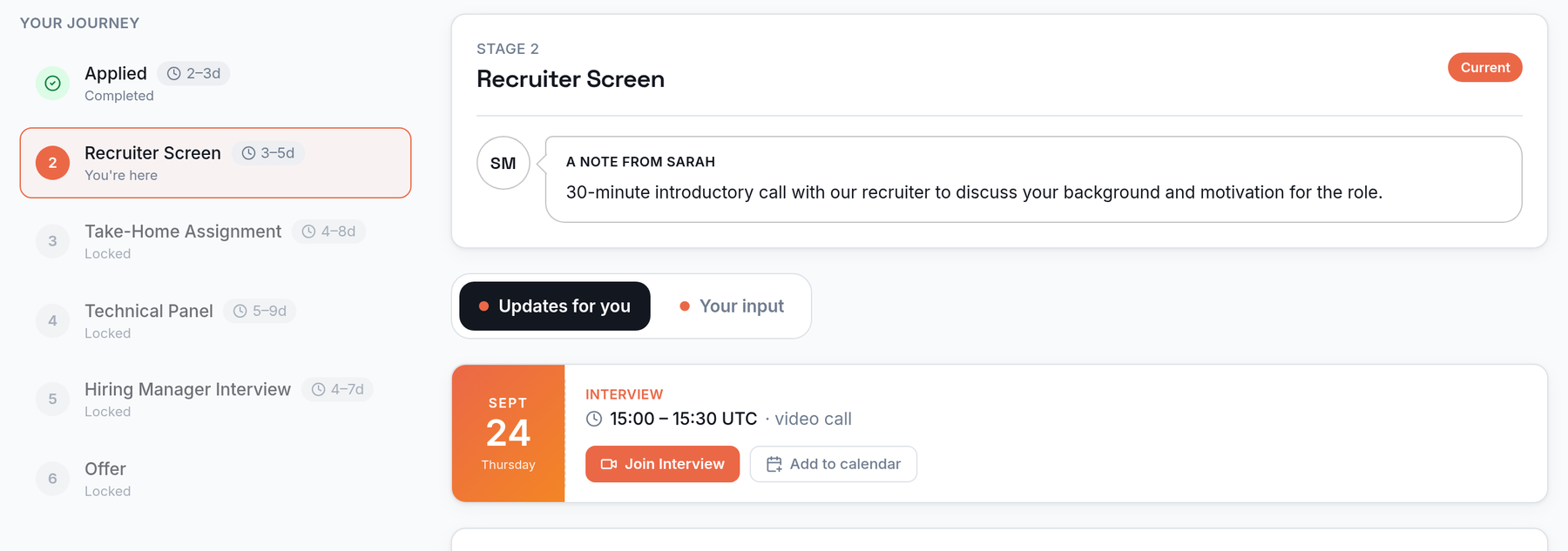
Stage-gated content, so each stage's information and next steps unlock in the portal the instant the candidate reaches it, no waiting on an email someone forgot to send.
The LLM-Proof gate, so the recruiter's attention lands on the people who came back and engaged, not on whoever's bot was fastest.
Where AI still belongs
We use AI deliberately, on a small surface, always in service of a person in the loop. Smoothing an interview reschedule. Drafting a routine message. Summarizing a long thread where a summary saves real time. The test for every new AI feature is one question: does it serve a human in the loop, or patch a workflow we should have fixed at the root? The first kind ships. The second kind means we missed something upstream.
What we're not saying
We are not anti-AI, and we won't let this read that way. The target is the broken workflow and the escalation it forces, never the technology. We use AI on purpose, just in fewer places than the vendor next door. And we are not looking down on anyone who came shopping for AI. Most were told it was the only path, because for the workflow everyone else sells, it very nearly is.
One last honest note, the same one we end most of these on. We're early. Most of what we've seen is demos and trials, and we're not going to dress that up into numbers we haven't earned. What we have is the workflow, the conviction that it's right, and a flag worth planting: hiring doesn't get better by adding more AI to a broken process. It gets better when you fix the process, and let people do the part that was always theirs.