Nexus vs Ashby: the two-sided, candidate-first alternative
Ashby is a mature all-in-one recruiting suite with deep analytics, native AI, and an official agent API. Nexus takes a narrower shape: a live two-sided candidate portal and a human-filter gate for the era of AI-written applications.
Ashby is a mature all-in-one recruiting platform — ATS, scheduling, sourcing CRM, and analytics — used by companies like OpenAI and Shopify, with SOC 2 Type 2, native HRIS syncs, deep custom reporting, native AI screening, and an official Model Context Protocol server for agents. Nexus is an early, two-sided ATS: every candidate gets a live, persistent portal, and a human-filter gate keeps auto-applied bots and agents out of the real pipeline. Pick Ashby for scale, analytics, and integration depth; pick Nexus for a candidate-first, two-sided experience. (Comparison as of September 2026.)
Where Ashby's shape shows
Ashby is a strong, well-maintained suite, and on scale, analytics, security, and AI depth it is genuinely ahead of an early product like Nexus. A few things are worth knowing if you're weighing it, each dated to our September 2026 research.
- Pricing scales on total company headcount, not recruiting-team seats, so contract cost rises for large organizations even when hiring volume is low (procurement data and user commentary, as of August 2026).
- No dedicated native mobile app is documented; user reviews note hiring managers use the web version on a phone instead (as of April 2026).
- Reviewers describe a steep admin onboarding ramp — nested permissions and modular report builders create an extended ramp-up period (as of April 2026).
- On the entry Foundations plan, Single Sign-On ($100/mo), the AI Notetaker, and Advanced Scheduling are unbundled paid add-ons rather than included (as of July 2026).
- Standard scorecards use fixed numeric scales (such as a 1–4 scale), which reviewers note limits custom qualitative assessment formats (as of April 2026).
Nexus vs Ashby, feature by feature
| Feature | Nexus | Ashby |
|---|---|---|
| Two-sided candidate portal (a persistent place for the candidate) | yes | Careers pages, self-scheduling, surveys |
| Stage-gated candidate content | yes | — |
| Top-of-funnel defense against auto-applied bots and agents | yes | reCAPTCHA + SEON fraud detection |
| Candidate self-scheduling | yes | yes |
| Native HRIS integrations | — | BambooHR, Rippling native; Workday, HiBob, Personio via webhook |
| Native AI screening / interviewing | —* | AI application review + async AI interviews |
| Public agent / MCP API | yes† | Official MCP server + RPC API |
| Security certifications | — | SOC 2 Type 2, SOC 1 Type 2 |
| Public pricing | Free during early access | Foundations from $400/mo; Plus & Enterprise gated |
- *
- By design, not a gap. Rather than pointing AI at the résumé pile — which just pits AI screeners against AI-written applications — Nexus filters auto-generated submissions at the top with its LLM-Proof gate, a human-filter step that lets a real person review only the ones that clear it.
- †
- Read-only in Phase 1: a token-scoped, org-scoped REST API plus an MCP server (Claude-compatible) that lets an external agent read jobs, applications, and pipeline stages. Agents see only the human-verified pipeline, never the auto-applied bot flood the LLM-Proof gate holds back. Write actions are a deliberate later phase.
What Nexus brings to the table
Every candidate gets a home, not a status email
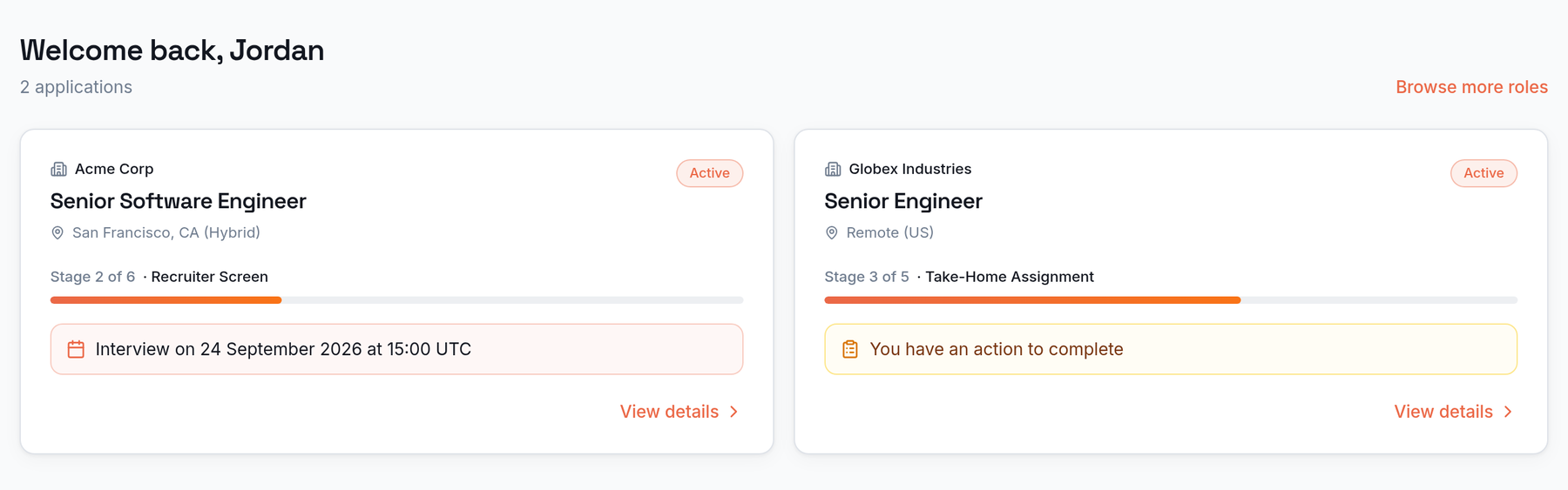
Most ATSes give the candidate status emails and a careers-page link. Nexus gives every applicant a live, persistent portal: each application's current stage, the next action, interview details, and documents in one place they can return to any time, not an inbox they have to search.
A gate built for the AI-application era
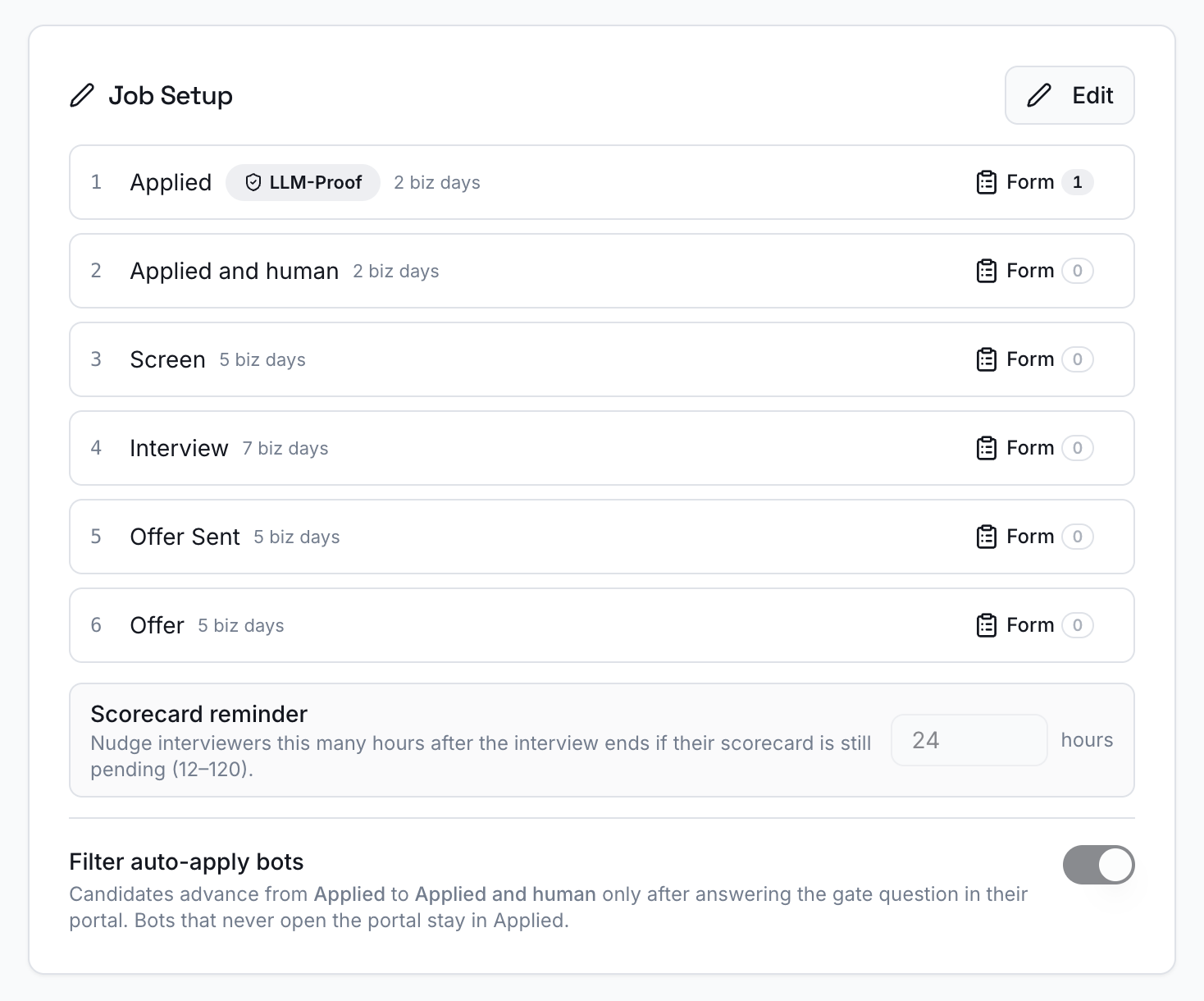
A per-job human-filter gate keeps auto-applied bot and agent submissions out of the real pipeline. Applications land in "Applied" and only advance to "Applied and human" once a real person opens their portal and answers one question, so reviewers spend their time on submissions that cleared the gate.
One application, fully alive
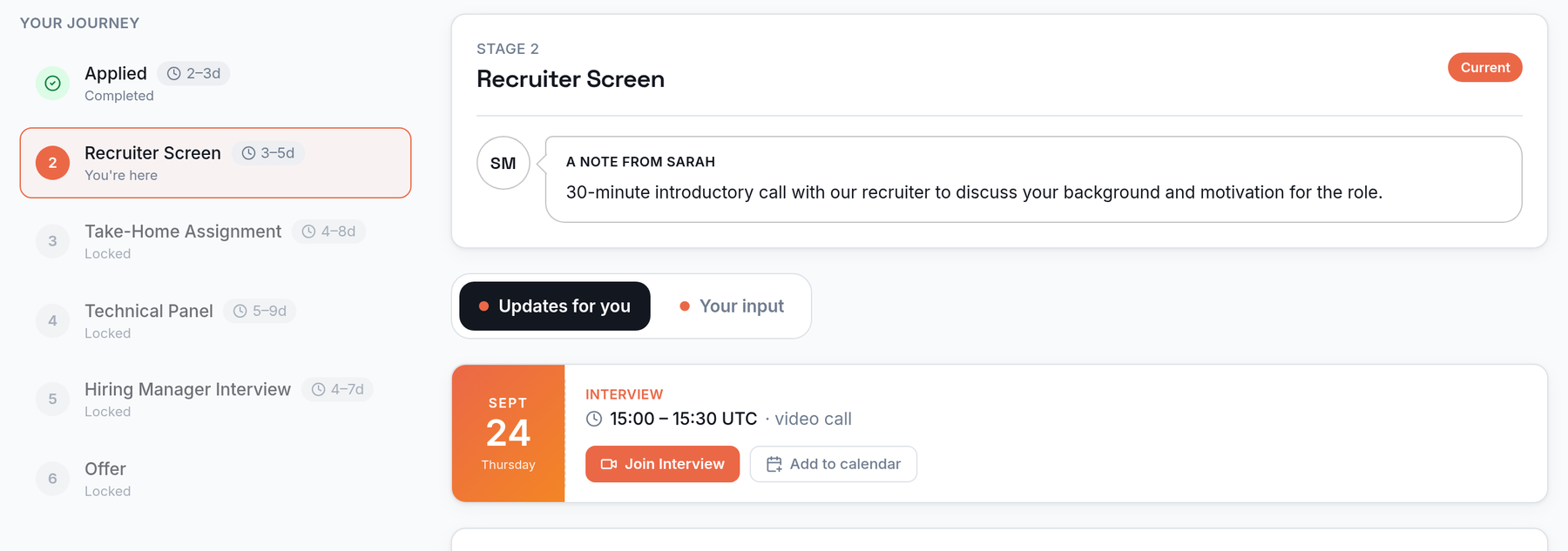
Inside a single application, the candidate sees exactly which stage they're in and what's next, a note from the recruiter, and per-stage documents as they become relevant. Scheduled interviews carry a join link and add-to-calendar, and an "Updates for you" / "Your input" split keeps what they need to read apart from what they need to do.
When Nexus is the better fit
- Candidate experience is the priority and you want every candidate to have a live, persistent portal, not a careers page plus status emails.
- Your top-of-funnel pain is the flood of AI-written, auto-applied submissions, and you want them structurally gated rather than only risk-scored.
- You want a lightweight, modern two-sided ATS instead of a large suite to configure.
When Ashby is the better fit
- You need deep native recruiting analytics and a custom BI report builder.
- Native HRIS breadth (BambooHR, Rippling, Workday) and enterprise security certifications (SOC 2 Type 2) are hard requirements today.
- You want native AI screening and async AI interviews, plus an official MCP / agent API in the product.
- You're scaling an outbound sourcing CRM alongside the ATS.
Frequently asked questions
Is Nexus a good Ashby alternative?
If you're optimizing for candidate experience and filtering the flood of AI-written applications, yes. Nexus gives every candidate a live, persistent portal and gates auto-applied bots and agents at the top of the funnel with its human-filter gate. Ashby remains the stronger choice if you need deep recruiting analytics, native HRIS breadth, enterprise security certifications, native AI screening, or an in-product agent API today.
Does Ashby give every candidate a portal like Nexus?
Ashby's candidate experience runs through hosted careers pages, self-scheduling links, async AI interviews, candidate-experience surveys, and native e-signature. Nexus is two-sided by design: each candidate gets their own live, persistent portal that holds their current stage, all role and stage documents, the interview join link, and a place to ask pre-interview questions, joined to the hiring team at the handoff.
How does Ashby handle auto-applied bots and AI agents?
Ashby uses Google reCAPTCHA on its application endpoints and an integration with fraud-prevention provider SEON to score applicant identity risk (as of August 2025). Nexus takes a structural approach instead: a per-job human-filter gate routes applicants through an 'Applied' → 'Applied and human' step that keeps auto-applied bot and agent submissions out of the real pipeline.
Does Ashby expose an agent or MCP API?
Yes. As of August 2026 Ashby operates an official Model Context Protocol (MCP) server, alongside an RPC-style HTTP API and HMAC-signed webhooks, letting external LLM tools read pipeline state and take recruiting actions. This in-product agent surface is a genuine Ashby strength.
How much does Ashby cost?
Ashby publishes entry pricing: the Foundations plan (up to 100 employees) starts at $400/mo, with third-party research tracking $300–$900/mo by headcount. The Plus and Enterprise tiers are gated and custom-quoted, and there is no free tier or unassisted trial (as of April 2026). Pricing scales on total company headcount rather than recruiting seats. Nexus is free during early access.