Nexus vs FairShot: a two-sided ATS vs an AI assessment layer
FairShot is an AI candidate-assessment layer — adaptive voice interviews that score applicants and plug into your ATS. Nexus is the ATS itself: a live two-sided candidate portal and a human-filter gate for the era of AI-written applications.
FairShot is an early-stage AI candidate-assessment platform from London (founded August 2025): adaptive 20–30 minute voice interviews that score applicants against custom rubrics with transcript-cited evidence, under webcam proctoring, SOC 2 Type II certified and plugging into 50+ ATSes. It is an evaluation layer, not an ATS — final decisions stay with recruiters. Nexus is the ATS itself: every candidate gets a live, persistent two-sided portal, and a human-filter gate keeps auto-applied bots and agents out of the pipeline. Pick FairShot to assess candidates in depth; pick Nexus to run candidate-first, multi-stage hiring. (Comparison as of March 2026.)
Where FairShot's shape shows
FairShot is a focused, credential-strong assessment product — SOC 2 Type II, transcript-only bias controls, and cohort adverse-impact reporting — and on deep candidate assessment it does something Nexus doesn't. A few things are worth knowing if you're weighing the two, each dated to our March 2026 research.
- It's an assessment layer, not a system of record. FairShot is explicitly an evaluation step between application and a human decision; you still run an ATS alongside it, and FairShot plugs into one (as of March 2026).
- The candidate surface is a one-time, proctored voice assessment accessed via a post-apply link, not a persistent per-application portal showing live stage, next step, stage documents, and an interview join link (as of March 2026).
- Early-stage company: incorporated August 2025, with a directory-reported team size of 5 as of November 2025 (as of March 2026).
- No public API documentation, developer sandbox, or MCP / agent surface is disclosed (as of March 2026).
- Pricing is gated behind "Book a demo"; no public tiers, figures, or volume packages are listed (as of March 2026).
- Independent third-party reviews (G2, Capterra, Reddit) weren't found in public search records; the quoted 94% completion rate and 4.8/5 candidate satisfaction are vendor-reported, not independently audited (as of March 2026).
Nexus vs FairShot, feature by feature
| Feature | Nexus | FairShot |
|---|---|---|
| Full ATS / system of record | yes | Assessment layer; plugs into your ATS |
| Two-sided candidate portal (a persistent place for the candidate) | yes | Post-apply browser assessment session; no persistent per-application portal |
| Stage-gated candidate content | yes | — |
| Top-of-funnel defense against auto-applied bots and agents | yes | Live voice + webcam/full-screen proctoring to deter bots |
| Candidate self-scheduling | yes | On-demand assessment (no human-interview scheduling) |
| Native HRIS integrations | — | 50+ ATS/HRIS integrations (Workday, SAP, iCIMS, Greenhouse, Cornerstone, Taleo) |
| Native AI screening / interviewing | —* | Adaptive voice interviews + transcript scoring vs custom rubrics |
| Public agent / MCP API | yes† | — |
| Security certifications | — | SOC 2 Type II; ISO 27001 in progress; GDPR, EU AI Act, NYC LL144 |
| Public pricing | Free during early access | Gated (book-a-demo; no public tiers) |
- *
- By design, not a gap. Rather than pointing AI at the résumé pile — which just pits AI screeners against AI-written applications — Nexus filters auto-generated submissions at the top with its LLM-Proof gate, a human-filter step that lets a real person review only the ones that clear it.
- †
- Read-only in Phase 1: a token-scoped, org-scoped REST API plus an MCP server (Claude-compatible) that lets an external agent read jobs, applications, and pipeline stages. Agents see only the human-verified pipeline, never the auto-applied bot flood the LLM-Proof gate holds back. Write actions are a deliberate later phase.
What Nexus brings to the table
Every candidate gets a home, not a status email
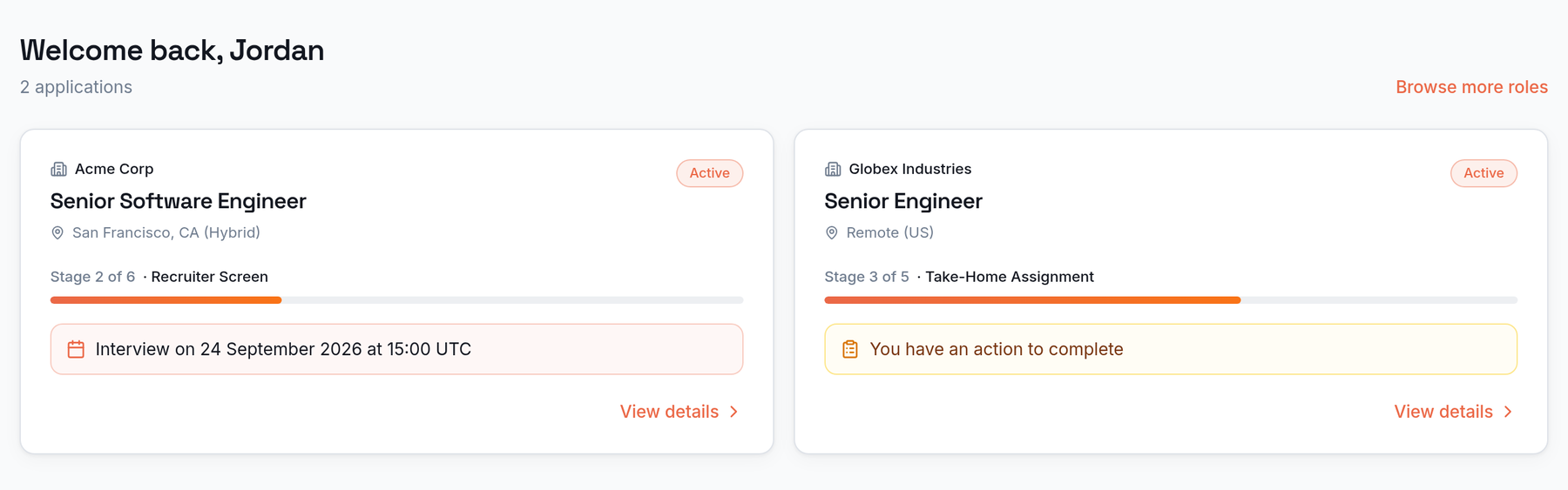
Most ATSes give the candidate status emails and a careers-page link. Nexus gives every applicant a live, persistent portal: each application's current stage, the next action, interview details, and documents in one place they can return to any time, not an inbox they have to search.
A gate built for the AI-application era
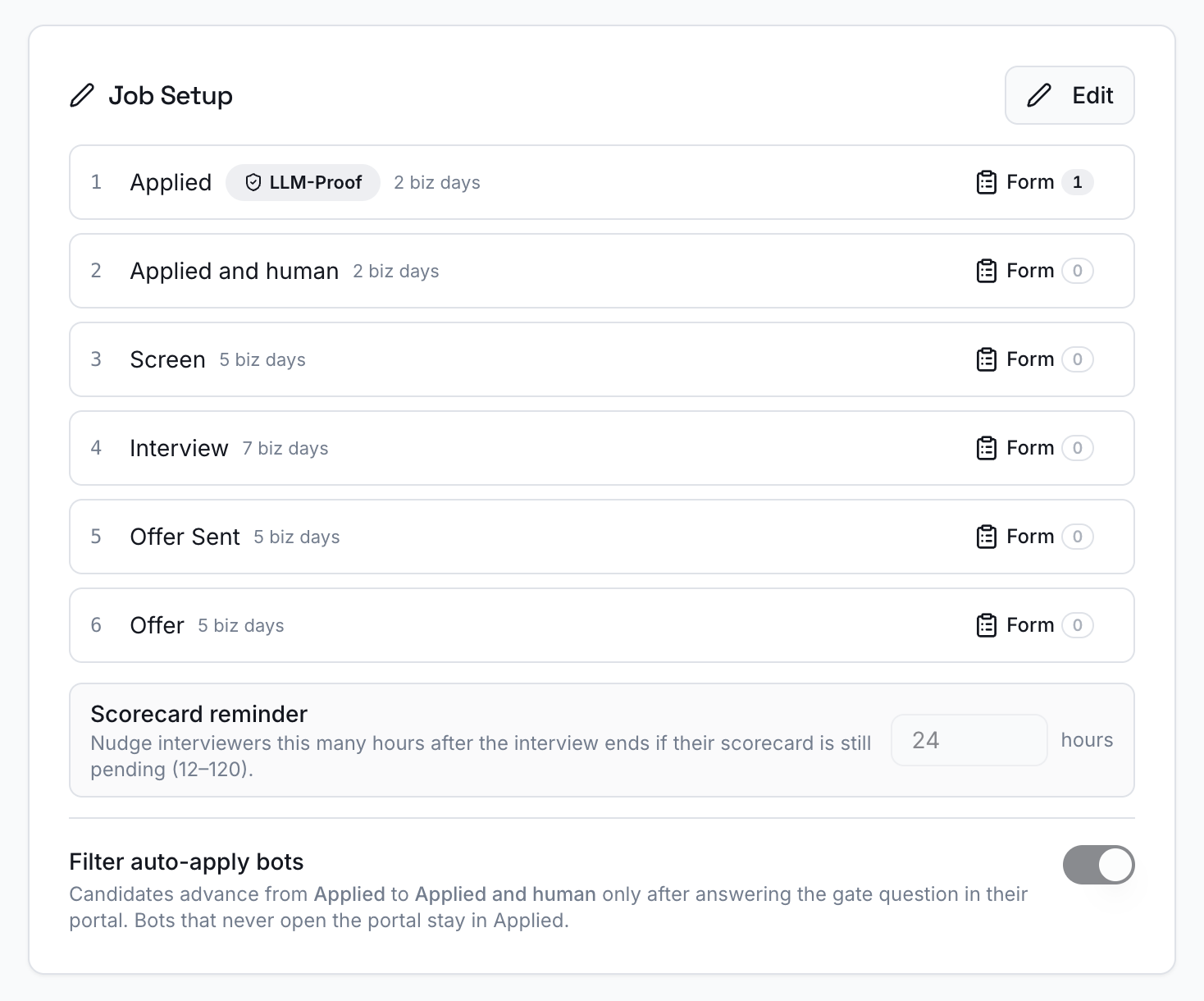
A per-job human-filter gate keeps auto-applied bot and agent submissions out of the real pipeline. Applications land in "Applied" and only advance to "Applied and human" once a real person opens their portal and answers one question, so reviewers spend their time on submissions that cleared the gate.
One application, fully alive
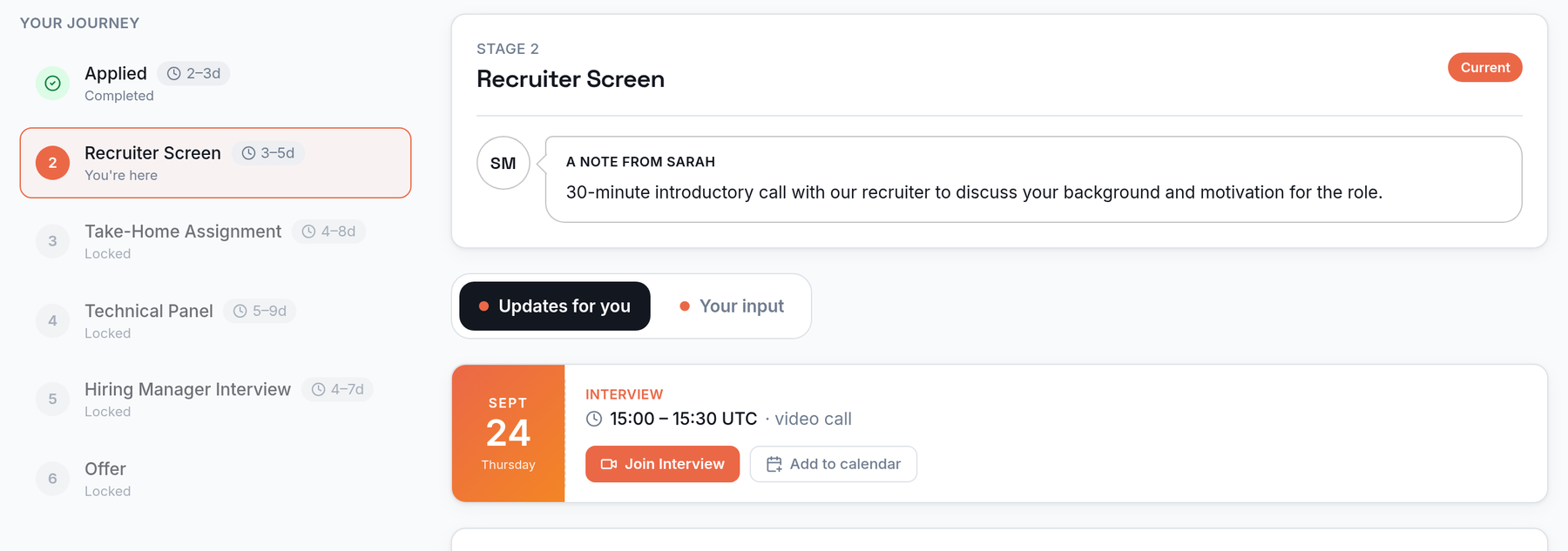
Inside a single application, the candidate sees exactly which stage they're in and what's next, a note from the recruiter, and per-stage documents as they become relevant. Scheduled interviews carry a join link and add-to-calendar, and an "Updates for you" / "Your input" split keeps what they need to read apart from what they need to do.
When Nexus is the better fit
- You need an actual ATS and system of record to run multi-stage hiring end to end, not an assessment that bolts onto one.
- Candidate experience is the priority and you want every applicant to have a live, two-way portal of their own — current stage, next step, documents, and interview join link in one place — not a one-time assessment session.
- Your top-of-funnel pain is the flood of AI-written, auto-applied submissions, and you want a human-filter gate that keeps them out of the pipeline.
- You want stage-gated content that surfaces the right documents at the right stage, and org-controlled transition emails in your own voice.
When FairShot is the better fit
- You want deep, structured skills assessment — adaptive voice interviews that probe technical finance, valuation, paper LBOs, or consulting case studies and score transcripts against custom rubrics (as of March 2026).
- You're processing very high applicant volume and want automated first-round interviews at scale, with proctoring and anti-cheat controls.
- You need SOC 2 Type II today and alignment with NYC Local Law 144 and the EU AI Act for high-risk hiring AI (as of March 2026).
- You already run an ATS — Workday, Greenhouse, iCIMS, Cornerstone — and want an assessment layer to plug into it rather than a new system of record.
Frequently asked questions
Is Nexus a good FairShot alternative?
They solve different problems, so it depends on what you need. FairShot is an AI candidate-assessment platform: adaptive 20–30 minute voice interviews that score applicants against custom rubrics with transcript-cited evidence, under webcam proctoring, SOC 2 Type II certified and designed to plug into your existing ATS (as of March 2026). It is an evaluation layer, not a system of record. Nexus is the ATS itself — a two-sided applicant tracking system where every candidate gets a live, persistent portal and a human-filter gate keeps auto-applied bots and agents out of the pipeline. If you need an ATS to run candidate-first, multi-stage hiring, Nexus is the fit; if you need to assess candidates in depth and already have an ATS, FairShot is a different layer that can sit alongside one.
Is FairShot an ATS?
No. FairShot describes itself as an assessment and evaluation layer that sits between the initial application and a human recruiter's decision, not an autonomous hiring-decision engine or a system of record; final progression stays with human recruiters, and it integrates with over 50 applicant tracking systems rather than replacing one (as of March 2026). Nexus is a full two-sided ATS: it runs the pipeline end to end, with a hiring-team portal and a persistent per-candidate portal joined at the handoff.
Does FairShot have a two-sided candidate portal like Nexus?
Not in the same shape. FairShot's candidate surface is a one-time assessment session: candidates open a web-browser link after applying and complete a 20–30 minute voice interview under full-screen and webcam proctoring (as of March 2026). No persistent, per-application portal — showing live pipeline stage, next step, stage documents, and an interview join link — is documented. Nexus is two-sided by design: each candidate gets their own live portal holding their current stage, next step, documents, and interview join link, joined to the hiring team at the handoff, on every account.
How does FairShot handle AI-written or auto-applied applications?
FairShot addresses automated screening and agentic bot submissions in-session: it requires candidates to perform real-time spoken reasoning aloud in response to adaptive questions and dynamic visual exhibits, while under full-screen and webcam proctoring (as of March 2026). That's a live-assessment integrity model — it works once a candidate is already in the interview. Nexus takes a different, earlier approach: a per-job human-filter gate holds applications in "Applied" until a real person opens their portal and answers a question, so auto-applied bots and agents that never open the portal stay out of the real pipeline before any assessment step.
Does FairShot expose an agent or MCP API?
Not publicly. FairShot does not publish API documentation, endpoint specifications, developer guides, a public sandbox, or any Model Context Protocol (MCP) server in its public materials as of March 2026. Nexus exposes a public agent/MCP API, read-only in Phase 1: a token-scoped REST API plus a Claude-compatible MCP server that lets an agent read jobs, applications, and pipeline stages, and by design agents see only the human-verified pipeline, never the bot flood the gate holds back.
How much does FairShot cost?
FairShot does not publish pricing tables, license costs, or subscription tiers on its website; pricing is gated behind "Book a demo" forms that require prospective enterprise customers to contact sales, and no named plans, usage thresholds, volume tiers, or add-on fees are listed (as of March 2026). Nexus is free during early access.