Nexus vs Guide: the two-sided ATS vs an interview-coordination layer
Guide is an interview-coordination and candidate-experience platform that layers on top of Greenhouse or Ashby, strong on AI scheduling, interviewer load balancing, and a polished candidate interview portal. Nexus is the ATS itself: a live two-sided candidate portal across the whole pipeline and a human-filter gate for the era of AI-written applications.
Guide is an interview-coordination and candidate-experience platform. Its Aria AI agent automates panel scheduling, interviewer swaps, and load balancing; candidates get a polished portal with schedules, interviewer bios, and prep; and Survey Response Escrow holds feedback until a decision is recorded. It carries SOC 2 Type II, GDPR, and CCPA, and integrates natively with Greenhouse and Ashby. It layers on top of your ATS rather than being one, and does nothing at the top of the funnel — no job posting, resume parsing, or application intake. Nexus is the ATS itself: every candidate gets a live, persistent portal across the whole pipeline, and a human-filter gate keeps auto-applied bots and agents out. Pick Guide to automate interview logistics on Greenhouse or Ashby; pick Nexus for a candidate-first ATS with built-in bot defense. (Comparison as of October 2026.)
Where Guide's shape shows
Guide is a focused, well-regarded coordination and candidate-experience tool, and on panel scheduling, interviewer load balancing, and the candidate interview portal it is genuinely strong — stronger on scheduling automation than most ATSes. The thing to understand before comparing is that it's a layer on top of an ATS, not an ATS. A few points worth knowing, each dated to our October 2026 research.
- It's an interview-coordination and candidate-experience layer, not an applicant tracking system: it operates on top of Greenhouse or Ashby rather than running the application pipeline itself (as of October 2026).
- It does nothing at the top of the funnel — no job board syndication, no inbound resume parsing or screening, no outbound sourcing database; those stay with the connected ATS or other tools (as of October 2026).
- The candidate portal is rich but coordination-scoped — interview schedule, panel bios, prep materials, self-scheduling, and post-interview surveys — not a persistent per-application portal showing live pipeline stage, next step, and stage-gated documents across the whole process (as of October 2026).
- No native top-of-funnel bot defense, application rate-limiting, or candidate fraud prevention is built in; its automation begins only after a candidate is already advanced into interview stages (as of October 2026).
- Native ATS integration is limited to Greenhouse and Ashby; Lever, Workday, BambooHR, HiBob, and Personio are not natively integrated (as of October 2026).
- No open public REST API or developer portal, and no external Model Context Protocol (MCP) server for third-party agents — Guide consumes the host ATS's APIs rather than exposing its own (as of October 2026).
- Pricing is quote-gated and billed as an annual flat rate on total company headcount (FTEs), not per-recruiter seats; third-party benchmarks report a baseline around $10,000/year, so a large organization with low hiring volume can pay an elevated relative cost (as of October 2026).
- No dedicated native mobile apps — it ships as a responsive web app plus a browser extension (as of October 2026).
Nexus vs Guide, feature by feature
| Feature | Nexus | Guide |
|---|---|---|
| Two-sided candidate portal (a persistent place for the candidate) | yes | Candidate interview portal (schedule, panel bios, prep, self-scheduling, surveys); polished but coordination-scoped, layered on Greenhouse/Ashby |
| Stage-gated candidate content | yes | — |
| Top-of-funnel defense against auto-applied bots and agents | yes | None (top-of-funnel handled by the connected ATS) |
| Candidate self-scheduling | yes | yes |
| Native HRIS integrations | — | Native ATS: Greenhouse, Ashby only (no native HRIS: Workday, BambooHR, HiBob, Personio) |
| Native AI screening / interviewing | —* | — |
| Public agent / MCP API | yes† | No public API or MCP (consumes host ATS APIs) |
| Security certifications | — | SOC 2 Type II, GDPR, CCPA |
| Public pricing | Free during early access | Quote-gated, FTE-based (reported ~$10k/yr baseline) |
| AI scheduling agent & panel coordination (Aria: auto-swaps, load balancing) | — | yes |
| Interviewer training paths (shadow → certified) | — | yes |
| Candidate survey escrow (feedback held until decision recorded) | — | yes |
- *
- By design, not a gap. Rather than pointing AI at the résumé pile — which just pits AI screeners against AI-written applications — Nexus filters auto-generated submissions at the top with its LLM-Proof gate, a human-filter step that lets a real person review only the ones that clear it.
- †
- Read-only in Phase 1: a token-scoped, org-scoped REST API plus an MCP server (Claude-compatible) that lets an external agent read jobs, applications, and pipeline stages. Agents see only the human-verified pipeline, never the auto-applied bot flood the LLM-Proof gate holds back. Write actions are a deliberate later phase.
What Nexus brings to the table
Every candidate gets a home, not a status email
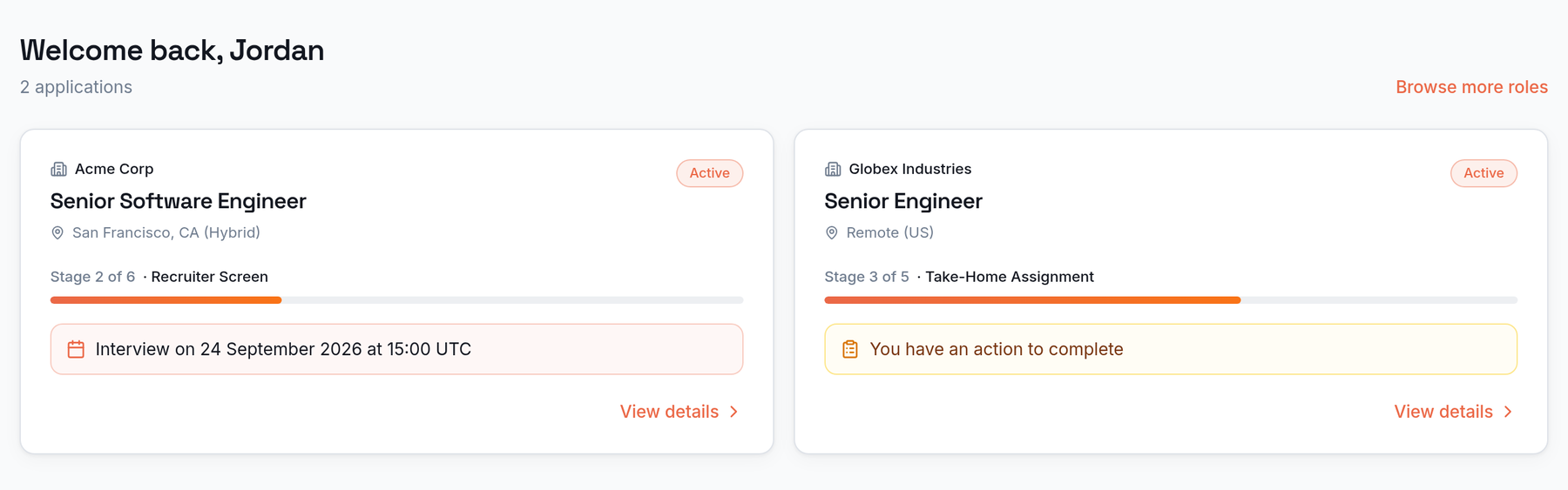
Most ATSes give the candidate status emails and a careers-page link. Nexus gives every applicant a live, persistent portal: each application's current stage, the next action, interview details, and documents in one place they can return to any time, not an inbox they have to search.
A gate built for the AI-application era
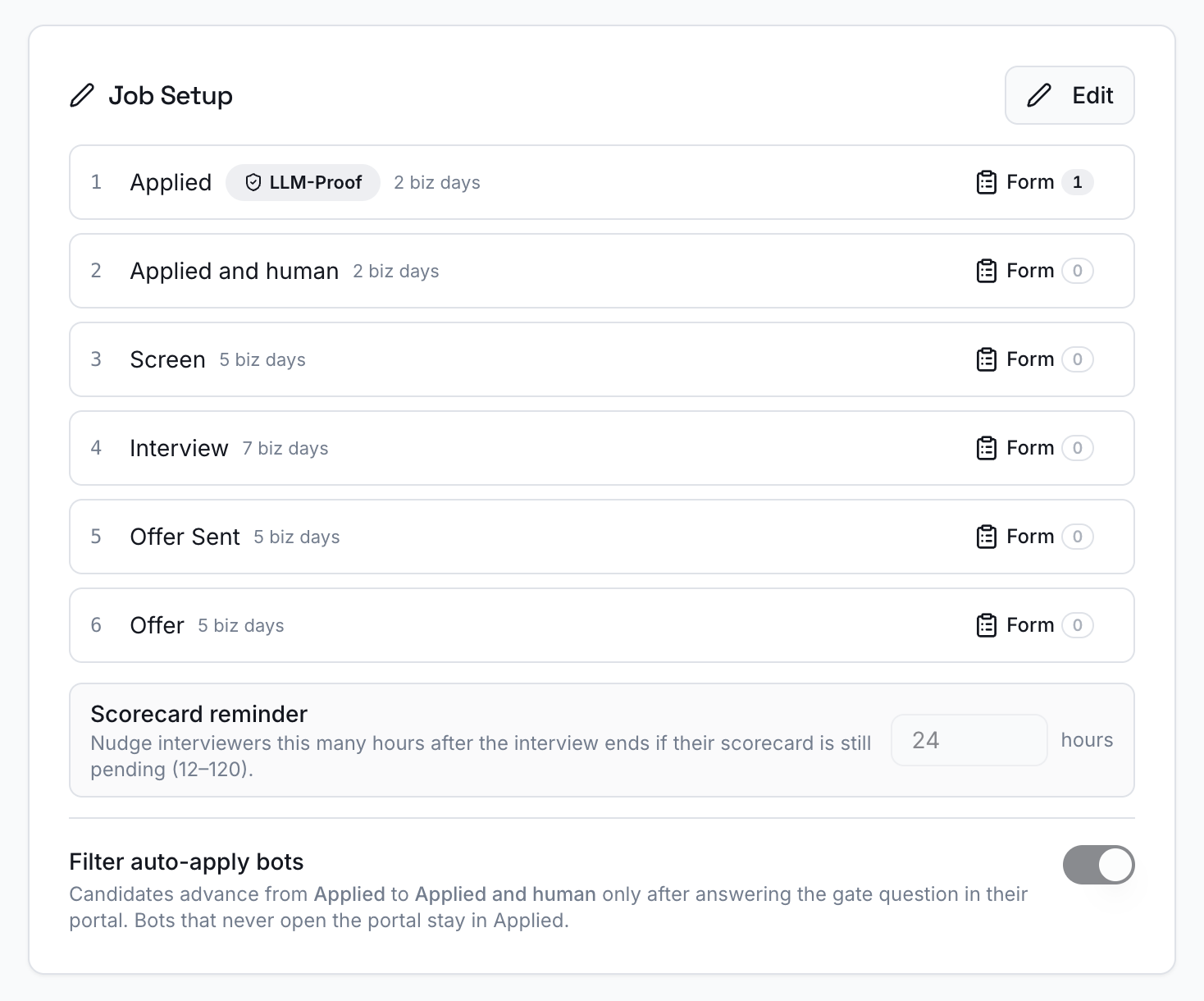
A per-job human-filter gate keeps auto-applied bot and agent submissions out of the real pipeline. Applications land in "Applied" and only advance to "Applied and human" once a real person opens their portal and answers one question, so reviewers spend their time on submissions that cleared the gate.
One application, fully alive
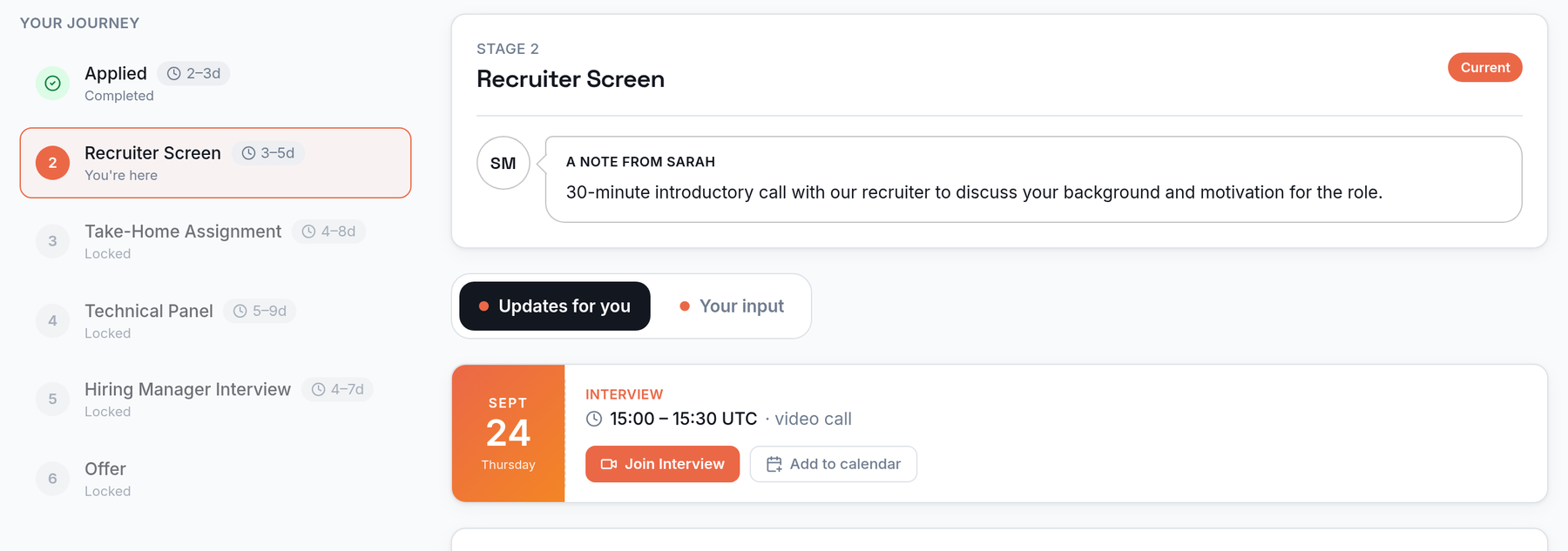
Inside a single application, the candidate sees exactly which stage they're in and what's next, a note from the recruiter, and per-stage documents as they become relevant. Scheduled interviews carry a join link and add-to-calendar, and an "Updates for you" / "Your input" split keeps what they need to read apart from what they need to do.
When Nexus is the better fit
- You want an applicant tracking system, not a coordination layer to bolt onto one — a single place that runs the whole pipeline from apply to offer.
- Candidate experience is the priority and you want every applicant to have a live, two-way portal of their own across the whole process — current stage, next step, stage-gated documents, and interview join link — not a portal scoped to interview logistics.
- Your top-of-funnel pain is the flood of AI-written, auto-applied submissions, and you want a human-filter gate that keeps them out of the pipeline.
- You're early-stage and want a candidate-first ATS that's free during early access, without a sales call to see pricing or a headcount-based contract.
When Guide is the better fit
- You already run Greenhouse or Ashby and want to automate the interview logistics on top of it rather than switch systems.
- Interview scheduling is your bottleneck: multi-interviewer panels, many time zones, and high interview volume that a lean coordinator team can't keep up with by hand.
- You want an AI scheduling agent (Aria) that handles panel coordination, automatic interviewer swaps, and load balancing in copilot or autopilot mode.
- You need SOC 2 Type II, GDPR, and CCPA today, and you want a structured interviewer-training program plus candidate surveys with bias-resistant response escrow.
Frequently asked questions
Is Nexus a good Guide alternative?
It depends on what you need. Guide is an interview-coordination and candidate-experience platform that sits on top of Greenhouse or Ashby: its Aria AI agent automates panel scheduling, interviewer swaps, and load balancing, candidates get a polished portal with schedules, interviewer bios, and prep, and Survey Response Escrow holds feedback until a decision is recorded, all with SOC 2 Type II, GDPR, and CCPA (as of October 2026). Nexus is the ATS itself — a two-sided system built around the candidate, where every applicant gets a live, persistent portal across the whole pipeline and a human-filter gate keeps auto-applied bots and agents out of the real pipeline. If you want to automate interview logistics on an ATS you already run, Guide is the better fit; if you want a candidate-first ATS with built-in top-of-funnel bot defense, Nexus is.
Is Guide an ATS?
No. Guide is an interview-coordination and candidate-experience platform that layers on top of an applicant tracking system rather than replacing it; it integrates natively with Greenhouse and Ashby and automates the interview coordination around them (as of October 2026). It does nothing at the top of the funnel — no job board syndication, no resume parsing or screening, no application intake — so those duties stay with the connected ATS. Nexus is the ATS: it runs the whole pipeline from application to offer, with a live candidate portal and a human-filter gate built in.
Does Guide have a two-sided candidate portal like Nexus?
Not in the same shape. Guide gives candidates a genuinely polished portal — the interview schedule, interviewer names and bios, prep materials, self-scheduling against live availability, and post-interview surveys protected by Survey Response Escrow (as of October 2026). That portal is scoped to interview coordination and sits on top of an external ATS, rather than being a persistent per-application view of pipeline stage, next step, and stage-gated documents across the whole process. Nexus is two-sided by design: every candidate gets their own live portal holding their current stage, next step, stage documents, and interview join link, joined to the hiring team at the handoff, on every account.
How does Guide handle AI-written or auto-applied applications?
It doesn't — that's not what it's built for. Guide automates scheduling and interviewer operations once candidates are already reviewed and advanced into interview stages in the primary ATS, and its product provides no public application forms, resume intake parsers, candidate filtering, or top-of-funnel bot defense (as of October 2026). Nexus takes the opposite approach at the top of the funnel: a per-job human-filter gate holds applications in "Applied" until a real person opens their portal and answers a question, so auto-applied bots and agents that never open the portal stay out of the real pipeline.
Does Guide expose an agent or MCP API?
No. Guide does not publish an open public REST API or developer portal, and it does not expose an external Model Context Protocol (MCP) server or agent-facing API tools for third-party large language models; it deploys its own internal Aria scheduling agent and otherwise operates as a consumer of the host ATS's APIs (Greenhouse Harvest and Ashby) rather than exposing its own (as of October 2026). Nexus exposes a public agent/MCP API, read-only in Phase 1: a token-scoped REST API plus a Claude-compatible MCP server that lets an agent read jobs, applications, and pipeline stages, and by design agents see only the human-verified pipeline, never the bot flood the gate holds back.
How much does Guide cost?
Guide does not publish pricing on its website; all pricing is gated behind a sales consultation (as of October 2026). Licensing is an annual flat rate based on total company headcount (full-time employees) rather than per-recruiter seats, so every tier includes recruiters, coordinators, and interviewers with no incremental seat fees, and core packages bundle the Candidate Portal, Guide Messenger, Candidate Surveys, and Aria without add-on fees. Third-party benchmarks report a baseline around $10,000 per year; because pricing tracks total workforce, a large organization with low hiring volume can pay an elevated relative cost (as of October 2026). Nexus is free during early access.