Nexus vs Juicebox: the two-sided ATS vs AI sourcing
Juicebox (PeopleGPT) is an AI talent-sourcing platform, not an ATS: it finds and cold-emails passive candidates. Nexus is built around the candidate handoff, with a live two-sided portal and a human-filter gate for the era of AI-written applications.
Juicebox (originally PeopleGPT) is an AI recruiting and talent-sourcing platform out of San Francisco, built around a large-language-model search engine over 800M+ public profiles. It's an outbound tool: natural-language candidate search, contact enrichment, multi-step email sequences, and continuous 24/7 sourcing agents, with SOC 2 Type II, a REST API, and native sync into 41 ATS and 21 CRM systems. It is not an ATS, though: there's no inbound applicant pipeline, no candidate portal (candidates receive cold emails and never log in), and no top-of-funnel gate against AI-written applications. Nexus takes a different shape: every candidate gets a live, two-way portal, and a human-filter gate keeps auto-applied bot and agent submissions out of the pipeline. Pick Juicebox to source and reach passive candidates; pick Nexus to run the hiring pipeline and the candidate experience, and the two can even sit side by side. (Comparison as of September 2026, based on Juicebox sources dated March–May 2026.)
Where Juicebox's shape shows
Juicebox is a well-funded, fast-growing sourcing tool that leads clearly on finding and reaching passive candidates. The thing to know is that it's a different category from an ATS, so a few gaps matter if you're buying to run a hiring pipeline. Each point is dated to our research (Juicebox sources as of March–May 2026).
- It's outbound sourcing, not an ATS. Juicebox is engineered specifically for outbound sourcing rather than inbound application management; it ships no inbound applicant pipeline, no per-role application limits, and no candidate identity/fraud verification (as of March 2026).
- One-way candidate contact. Candidates never log into Juicebox; they receive AI-personalized emails in their own inbox. There's no candidate portal joined to a hiring pipeline (as of March 2026).
- No top-of-funnel bot/agent gate. Because Juicebox is outbound-only, it makes no public disclosures about screening inbound applicant floods or detecting fraudulent submissions (as of March 2026).
- Two-way ATS/CRM sync is Enterprise-only. The Starter ($139/seat/mo) and Pro ($199/seat/mo) tiers exclude the ATS/CRM integrations; they require a custom Enterprise plan (as of March 2026).
- Continuous autonomous sourcing (Juicebox Agents) is a $199/seat/mo add-on on top of the base seat (as of March 2026).
- No native LinkedIn InMail dispatch; outreach happens over direct email or CSV export (as of March 2026).
- No public Model Context Protocol (MCP) server; the Juicebox Agents run inside the web app, and public developer materials don't disclose a public MCP endpoint (as of May 2026).
- Users on third-party forums report automated compliance warnings or account restrictions from professional networks when running the browser-extension overlay alongside automated sourcing (as of late 2025).
Nexus vs Juicebox, feature by feature
| Feature | Nexus | Juicebox |
|---|---|---|
| Two-sided candidate portal (a persistent place for the candidate) | yes | One-way: AI-personalized cold email; candidates never log in |
| Stage-gated candidate content | yes | — |
| Top-of-funnel defense against auto-applied bots and agents | yes | — (outbound sourcing; no inbound applications to gate) |
| Candidate self-scheduling | yes | — |
| Outbound sourcing CRM | — | 800M+ profiles across 30+ sources, PeopleGPT NL search, continuous 24/7 sourcing agents |
| Native HRIS integrations | — | Native sync: Workday + 41 ATS / 21 CRM connectors (Enterprise tier) |
| Native AI screening / interviewing | —* | Autopilot mass evaluation (up to 5,000 sourced profiles) + match scoring |
| Public agent / MCP API | yes† | REST API (bearer token) + in-app Juicebox Agents; no public MCP surface |
| Security certifications | — | SOC 2 Type II |
| Public pricing | Free during early access | Free tier; Starter $139, Pro $199/seat/mo; agents +$199/seat/mo; ATS sync Enterprise-only |
- *
- By design, not a gap. Rather than pointing AI at the résumé pile — which just pits AI screeners against AI-written applications — Nexus filters auto-generated submissions at the top with its LLM-Proof gate, a human-filter step that lets a real person review only the ones that clear it.
- †
- Read-only in Phase 1: a token-scoped, org-scoped REST API plus an MCP server (Claude-compatible) that lets an external agent read jobs, applications, and pipeline stages. Agents see only the human-verified pipeline, never the auto-applied bot flood the LLM-Proof gate holds back. Write actions are a deliberate later phase.
What Nexus brings to the table
Every candidate gets a home, not a status email
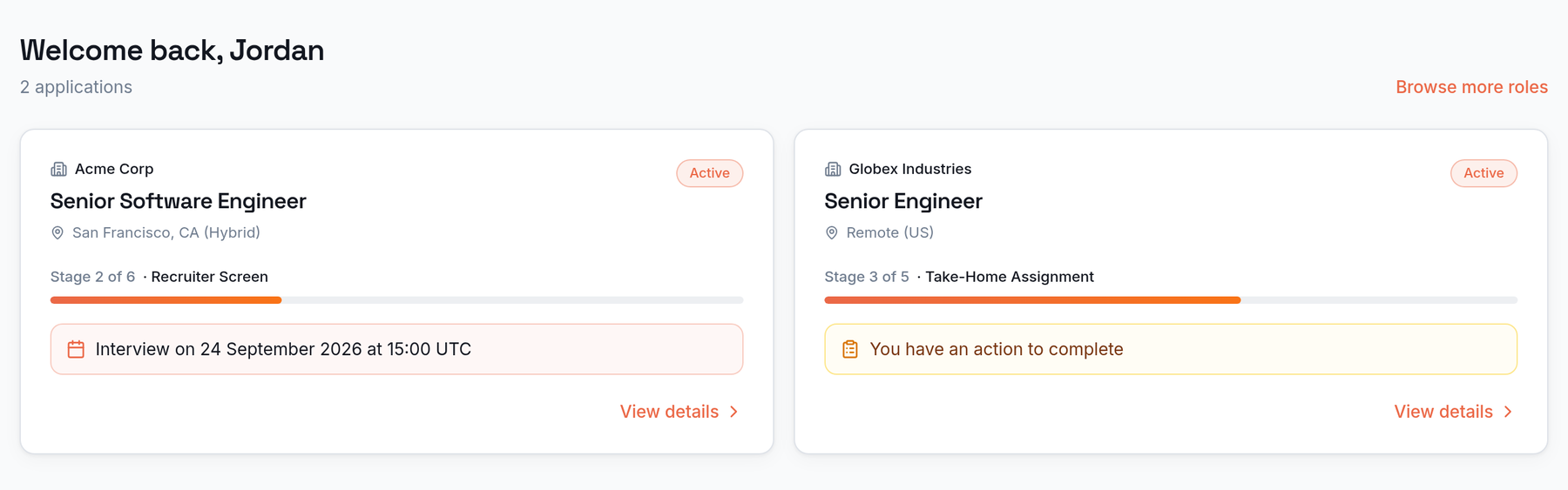
Most ATSes give the candidate status emails and a careers-page link. Nexus gives every applicant a live, persistent portal: each application's current stage, the next action, interview details, and documents in one place they can return to any time, not an inbox they have to search.
A gate built for the AI-application era
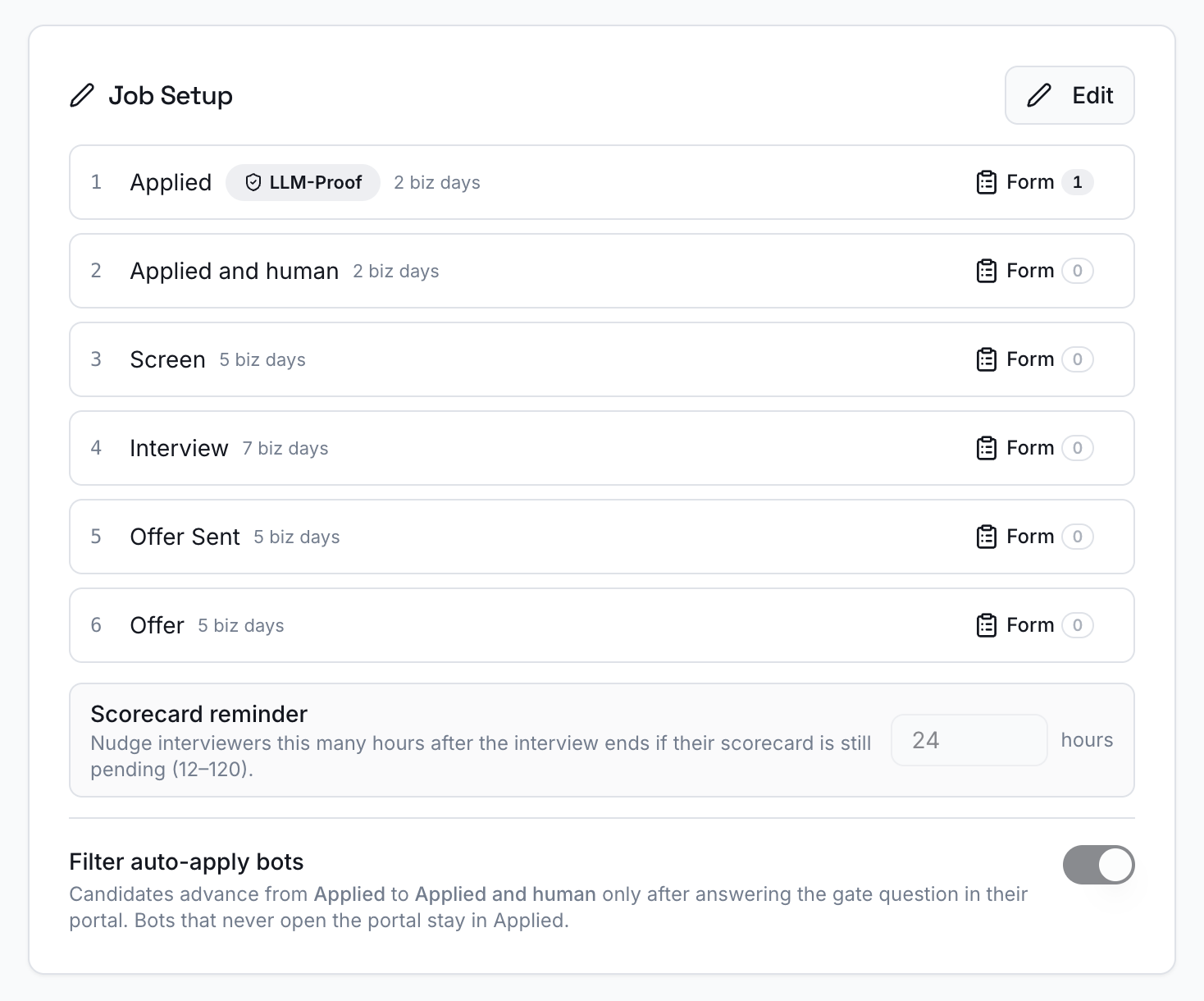
A per-job human-filter gate keeps auto-applied bot and agent submissions out of the real pipeline. Applications land in "Applied" and only advance to "Applied and human" once a real person opens their portal and answers one question, so reviewers spend their time on submissions that cleared the gate.
One application, fully alive
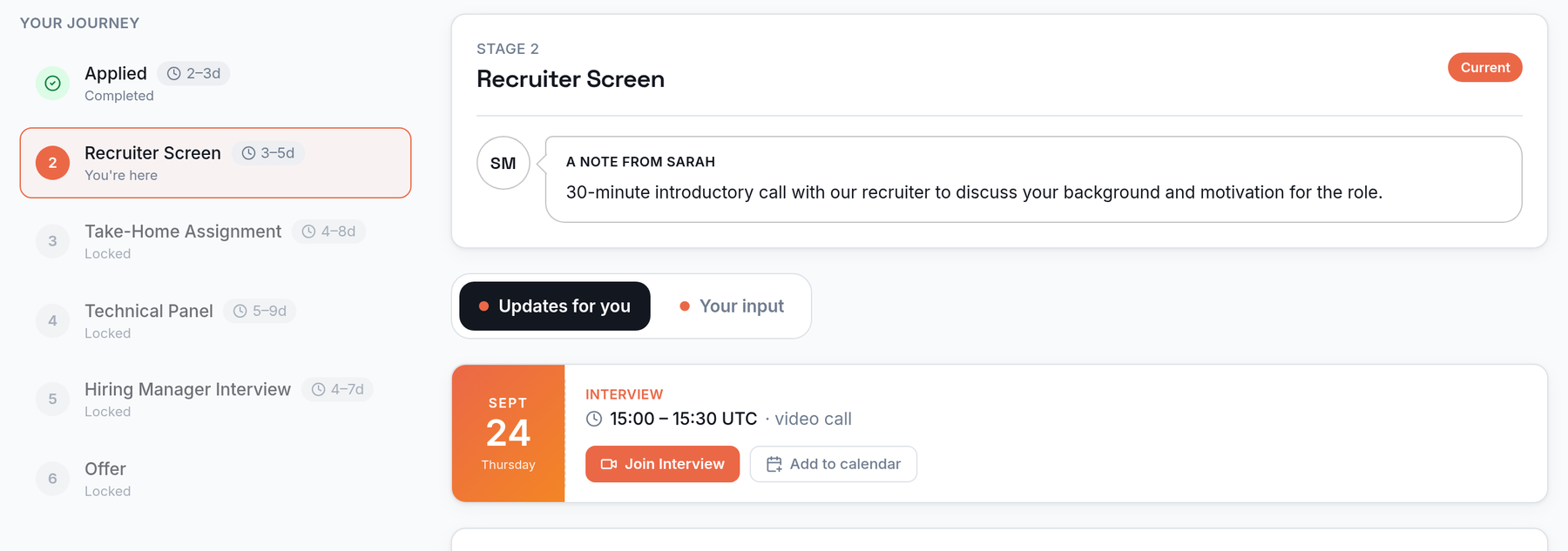
Inside a single application, the candidate sees exactly which stage they're in and what's next, a note from the recruiter, and per-stage documents as they become relevant. Scheduled interviews carry a join link and add-to-calendar, and an "Updates for you" / "Your input" split keeps what they need to read apart from what they need to do.
When Nexus is the better fit
- You need to run the hiring pipeline itself: track inbound applicants, move them through stages, schedule interviews, and manage the candidate relationship, not just source names.
- Candidate experience matters and you want every applicant kept informed through a two-way portal of their own, not one-way cold-email outreach.
- Your top-of-funnel pain is the flood of AI-written, auto-applied submissions, and you want them gated at intake rather than living in an outbound tool that never sees inbound.
When Juicebox is the better fit
- Outbound sourcing is your main need: you want natural-language search across 800M+ public profiles, contact enrichment, and continuous 24/7 sourcing agents.
- You want AI-personalized email sequences to reach passive candidates who aren't applying on their own.
- You already run an ATS and want a sourcing layer on top of it (Juicebox syncs into Greenhouse, Lever, Ashby, and Workday on its Enterprise tier).
Frequently asked questions
Is Nexus a good Juicebox alternative?
They mostly solve different problems, so it depends on what you need. Juicebox is an outbound sourcing tool: it finds passive candidates across 800M+ profiles and reaches them by AI-personalized email. Nexus is a two-sided ATS: it runs the inbound hiring pipeline and the candidate experience, gives every candidate a live portal, and gates auto-applied bots at the top of the funnel. If your gap is managing applicants and candidate experience, Nexus is the better fit; if your gap is sourcing, Juicebox is, and the two can even sit side by side (source in Juicebox, hire in Nexus).
Is Juicebox an ATS?
No. Juicebox (PeopleGPT) is an AI talent-sourcing platform built for outbound: natural-language candidate search, contact enrichment, and email outreach across 800M+ public profiles (as of March 2026). It syncs into applicant tracking systems like Greenhouse, Lever, and Ashby on its Enterprise tier, but it doesn't manage an inbound applicant pipeline itself and makes no disclosures about inbound application management. Nexus is the ATS: it tracks inbound applicants through pipeline stages, schedules interviews, and runs the two-way candidate portal.
Does Juicebox have a candidate portal like Nexus?
No. Juicebox candidates never log into the platform; they receive AI-personalized outreach emails in their own inbox, and there's no candidate portal joined to a hiring pipeline (as of March 2026). Nexus is two-sided by design, so each candidate gets their own live portal that holds their current stage, documents, and interview join link, joined to the hiring team at the handoff, on every account.
Does Juicebox expose an agent or MCP API?
Juicebox documents a REST API (base endpoint api.juicebox.ai/v1) authenticated with bearer tokens and scoped to a workspace, with webhook handlers for events (as of March 2026, reported). It also ships embedded autonomous "Juicebox Agents" inside its web app. But public developer materials do not disclose a public Model Context Protocol (MCP) server endpoint as of May 2026, so there's no open agent interface for external autonomous agents.
How much does Juicebox cost?
Juicebox has a free tier, then Starter at $139/seat/month and Pro at $199/seat/month on annual billing (as of March 2026). Its continuous autonomous sourcing (Juicebox Agents) is an additional $199/seat/month add-on on top of the base seat, and the two-way ATS/CRM integrations require a custom Enterprise plan rather than the Starter or Pro tiers. Nexus is free during early access.