Nexus vs Lever: the two-sided ATS alternative
Lever is a mature ATS-plus-sourcing-CRM. Nexus is built around the candidate handoff, with a live two-sided portal and a human-filter gate for the era of AI-written applications.
Lever is a mature talent-acquisition suite (ATS plus CRM) owned by Employ Inc., strong on outbound sourcing, native HRIS integrations, and enterprise security (SOC 2 Type 2 and ISO/IEC 27001). As of September 2026 its developer docs expose no public agent or MCP surface, and its AI runs inside the recruiter app. Nexus takes a different shape: every candidate gets a live, persistent portal, and a human-filter gate keeps auto-applied bot and agent submissions out of the pipeline. Pick Lever for enterprise sourcing scale and integration depth; pick Nexus for candidate experience and the AI-application era.
Where Lever's shape shows
Lever is a capable, established suite. A few things are worth knowing if you're buying for the way hiring works now, each dated to our September 2026 research.
- Recruiter-centric. Lever's strength is the outbound sourcing and recruiter workflow; candidates get status emails and self-scheduling links rather than a persistent portal of their own.
- No public agent or MCP surface in its developer documentation (as of September 2026); AI features run inside the recruiter application.
- No native mobile app is documented; a recruiter review noted that fetching candidates from a phone was a struggle.
- Pricing is gated behind a sales quote (market analyses estimate roughly $3,000 to $8,000 per month), so you can't self-serve a number.
- Reviewers report the analytics and custom reporting are hard to configure and navigate.
Nexus vs Lever, feature by feature
| Feature | Nexus | Lever |
|---|---|---|
| Two-sided candidate portal (a persistent place for the candidate) | yes | One-way: career sites + status emails |
| Stage-gated candidate content | yes | — |
| Top-of-funnel defense against auto-applied bots and agents | yes | Fraud Signals (flags suspicious applications) |
| Candidate self-scheduling | yes | yes |
| Native HRIS integrations | — | BambooHR, ADP, HiBob, UKG, Rippling |
| Native AI screening / interviewing | —* | AI Screening Companion + AI Interview Companion |
| Outbound sourcing CRM | — | yes |
| Public agent / MCP API | yes† | REST API + webhooks; no public MCP |
| Security certifications | — | SOC 2 Type 2, ISO 27001 |
| Public pricing | Free during early access | Gated |
- *
- By design, not a gap. Rather than pointing AI at the résumé pile — which just pits AI screeners against AI-written applications — Nexus filters auto-generated submissions at the top with its LLM-Proof gate, a human-filter step that lets a real person review only the ones that clear it.
- †
- Read-only in Phase 1: a token-scoped, org-scoped REST API plus an MCP server (Claude-compatible) that lets an external agent read jobs, applications, and pipeline stages. Agents see only the human-verified pipeline, never the auto-applied bot flood the LLM-Proof gate holds back. Write actions are a deliberate later phase.
What Nexus brings to the table
Every candidate gets a home, not a status email
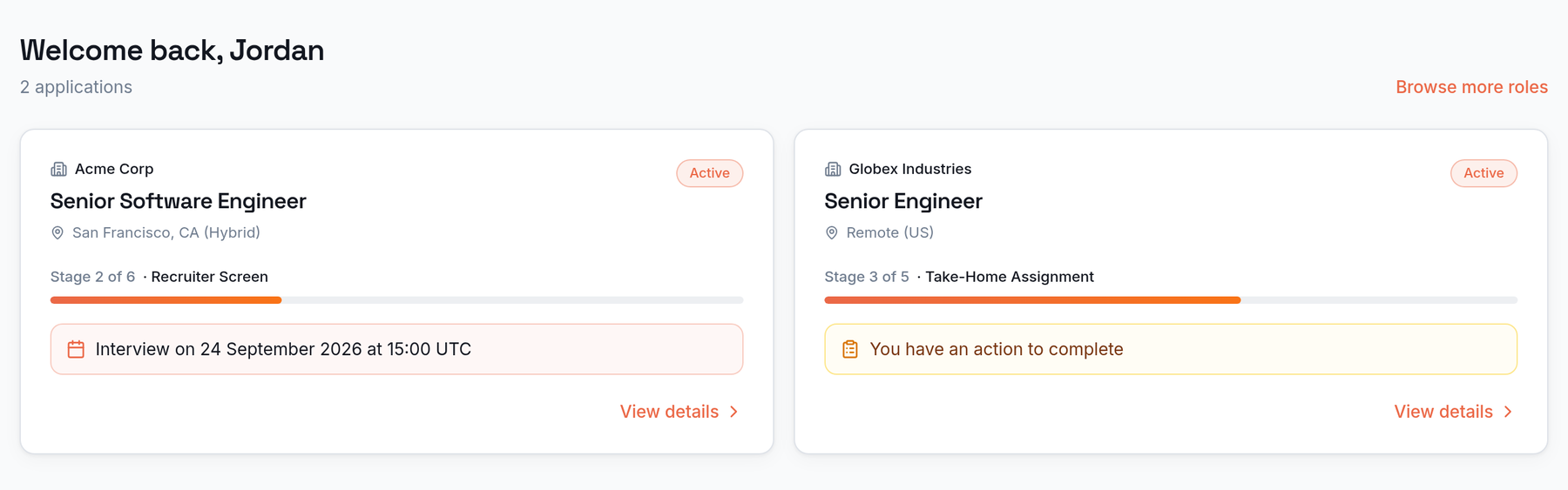
Most ATSes give the candidate status emails and a careers-page link. Nexus gives every applicant a live, persistent portal: each application's current stage, the next action, interview details, and documents in one place they can return to any time, not an inbox they have to search.
A gate built for the AI-application era
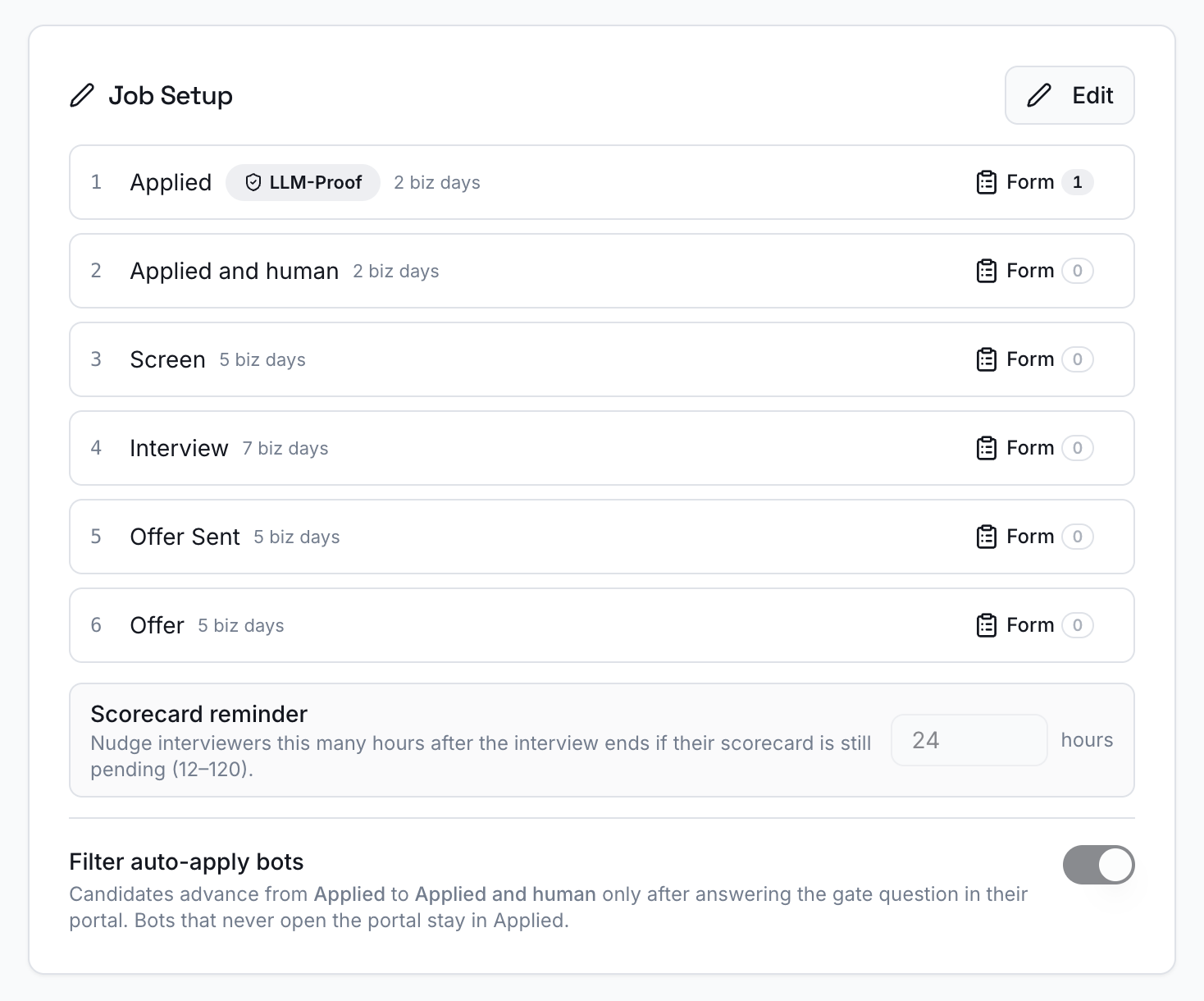
A per-job human-filter gate keeps auto-applied bot and agent submissions out of the real pipeline. Applications land in "Applied" and only advance to "Applied and human" once a real person opens their portal and answers one question, so reviewers spend their time on submissions that cleared the gate.
One application, fully alive
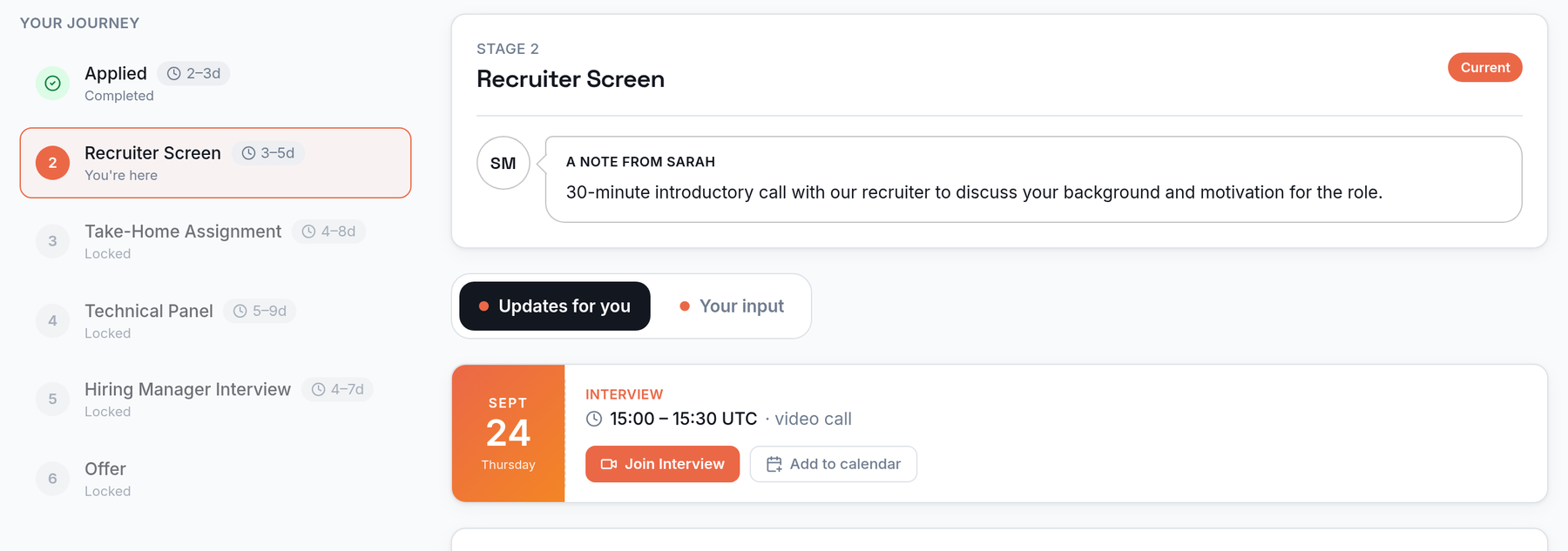
Inside a single application, the candidate sees exactly which stage they're in and what's next, a note from the recruiter, and per-stage documents as they become relevant. Scheduled interviews carry a join link and add-to-calendar, and an "Updates for you" / "Your input" split keeps what they need to read apart from what they need to do.
When Nexus is the better fit
- Candidate experience is a priority and you want people kept informed between stages so they do not feel ghosted.
- Your top-of-funnel pain is the flood of AI-written, auto-applied submissions.
- You want a two-sided model where the candidate has a real place, not just a status email.
When Lever is the better fit
- You need a large outbound sourcing CRM with talent pools and nurture campaigns.
- Deep native HRIS integration (BambooHR, ADP, HiBob, UKG, Rippling) is a hard requirement.
- Enterprise security certifications (SOC 2 Type 2, ISO 27001) are needed to pass procurement today.
Frequently asked questions
Is Nexus a good Lever alternative?
If you're optimizing for candidate experience and filtering the flood of AI-written applications, yes. Nexus gives every candidate a live, persistent portal and gates auto-applied bots at the top of the funnel with its human-filter gate. Lever remains strong if you need a large outbound sourcing CRM with deep native HRIS coverage and enterprise security certifications today.
Does Lever have a candidate portal like Nexus?
Lever is recruiter-centric: candidates receive status notifications and self-scheduling links, but not a persistent portal of their own. Nexus is two-sided by design, so the candidate gets their own live portal that holds their stage, documents, and interview join link, joined to the hiring team at the handoff.
Does Lever expose an agent or MCP API?
As of September 2026, Lever's public developer documentation does not expose a Model Context Protocol server or a dedicated AI agent execution endpoint; its AI features run within the application. Lever does offer a RESTful API and webhooks for integrations.
Does Lever integrate with HRIS systems?
Yes, extensively. Lever ships native HRIS integrations with BambooHR, ADP Workforce Now, HiBob, UKG Pro, Rippling, Namely, and TriNet Zenefits, and supports Workday via a custom webhook. This native HRIS breadth is one of Lever's real strengths.
How much does Lever cost?
Lever does not publish fixed pricing; costs are provided via a custom sales quote based on headcount, hiring volume, and modules. Market analyses estimate mid-market deployments in the range of roughly $3,000 to $8,000 per month (as of 2026). Nexus is free during early access.