Nexus vs Manatal: the two-sided ATS alternative
Manatal is an affordable AI ATS and recruitment CRM for SMBs, agencies, and headhunters. Nexus is built around the candidate handoff, with a live two-sided portal and a human-filter gate for the era of AI-written applications.
Manatal is an AI-powered ATS and recruitment CRM built in Bangkok for SMBs, recruitment agencies, and headhunters. It's notably affordable with published per-user pricing ($15–$55/user/mo), holds SOC 2 Type II, and ships a real agent-readable developer surface (a public REST API and an llms.txt index), though API access, SSO, and its candidate portal are gated to the Enterprise Plus tier. Its candidate experience is one-way status tracking, and its application forms have no native knockout screening. Nexus takes a different shape: every candidate gets a live, two-way portal, and a human-filter gate keeps auto-applied bot and agent submissions out of the pipeline. Pick Manatal for low entry price and agency CRM depth; pick Nexus for candidate experience and the AI-application era. (Comparison as of September 2026, based on Manatal sources dated February 2025.)
Where Manatal's shape shows
Manatal is a capable, affordable suite with a genuine agent-readable API surface. A few things are worth knowing if you're buying for the way hiring works now, each dated to our research (Manatal sources as of February 2025 unless noted).
- One-way candidate experience. Candidates apply through hosted career pages and can register for a Candidate Portal that tracks application status, but it's a one-way status view (available on the Enterprise Plus tier), not a two-way portal joined to the hiring team (as of February 2025).
- No native knockout screening on application forms. Custom forms collect responses, but there's no built-in auto-reject or qualification logic, so high-volume roles still draw large unfiltered application counts (as of February 2025).
- Candidate communication is email-only natively; SMS and WhatsApp outreach require external tools (as of November 2025).
- Video interviewing is available only through a partner integration (Alex), not native (as of February 2025).
- Core surfaces are gated to the top tier: Open API access, SSO, and the candidate and employee portals all require Enterprise Plus ($55/user/mo) or Custom (as of February 2025).
- The entry Professional plan caps an account at 15 active jobs and 10,000 candidate profiles (as of February 2025).
Nexus vs Manatal, feature by feature
| Feature | Nexus | Manatal |
|---|---|---|
| Two-sided candidate portal (a persistent place for the candidate) | yes | One-way Candidate Portal: status tracking (Enterprise Plus) |
| Stage-gated candidate content | yes | — |
| Top-of-funnel defense against auto-applied bots and agents | yes | — |
| Candidate self-scheduling | yes | — |
| Native HRIS integrations | — | Bridged via Open API, Zapier, n8n (no native connectors) |
| Native AI screening / interviewing | —* | AI candidate scoring + AI Copilot (matching, summaries) |
| Public agent / MCP API | yes† | REST API v3 + llms.txt (Enterprise Plus+) |
| Security certifications | — | SOC 2 Type II; ISO 27001 / NIST alignment |
| Public pricing | Free during early access | Published: $15–$55/user/mo |
- *
- By design, not a gap. Rather than pointing AI at the résumé pile — which just pits AI screeners against AI-written applications — Nexus filters auto-generated submissions at the top with its LLM-Proof gate, a human-filter step that lets a real person review only the ones that clear it.
- †
- Read-only in Phase 1: a token-scoped, org-scoped REST API plus an MCP server (Claude-compatible) that lets an external agent read jobs, applications, and pipeline stages. Agents see only the human-verified pipeline, never the auto-applied bot flood the LLM-Proof gate holds back. Write actions are a deliberate later phase.
What Nexus brings to the table
Every candidate gets a home, not a status email
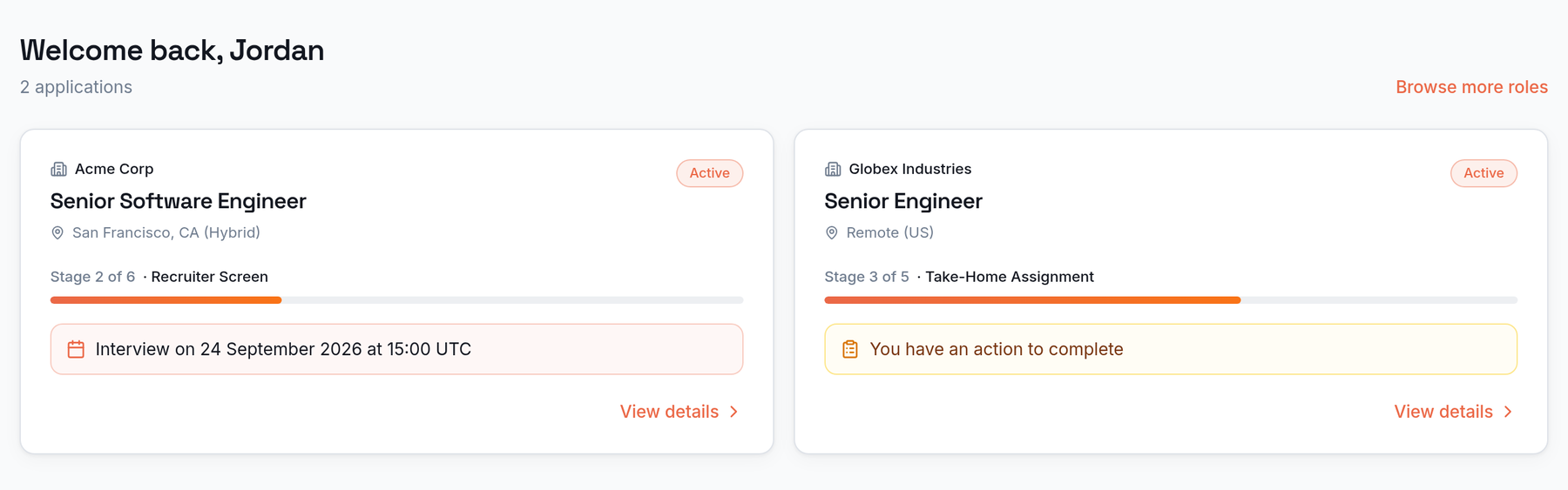
Most ATSes give the candidate status emails and a careers-page link. Nexus gives every applicant a live, persistent portal: each application's current stage, the next action, interview details, and documents in one place they can return to any time, not an inbox they have to search.
A gate built for the AI-application era
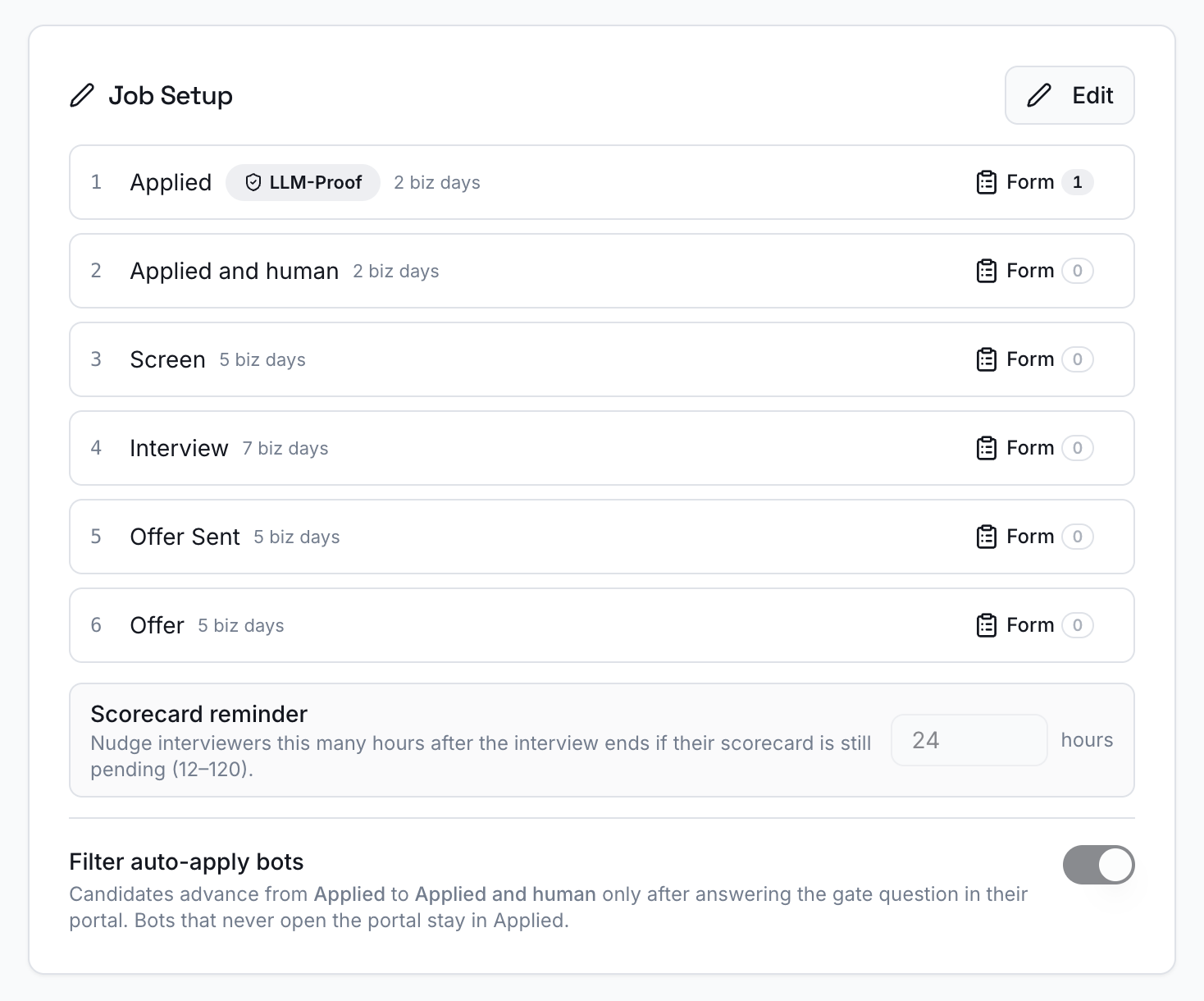
A per-job human-filter gate keeps auto-applied bot and agent submissions out of the real pipeline. Applications land in "Applied" and only advance to "Applied and human" once a real person opens their portal and answers one question, so reviewers spend their time on submissions that cleared the gate.
One application, fully alive
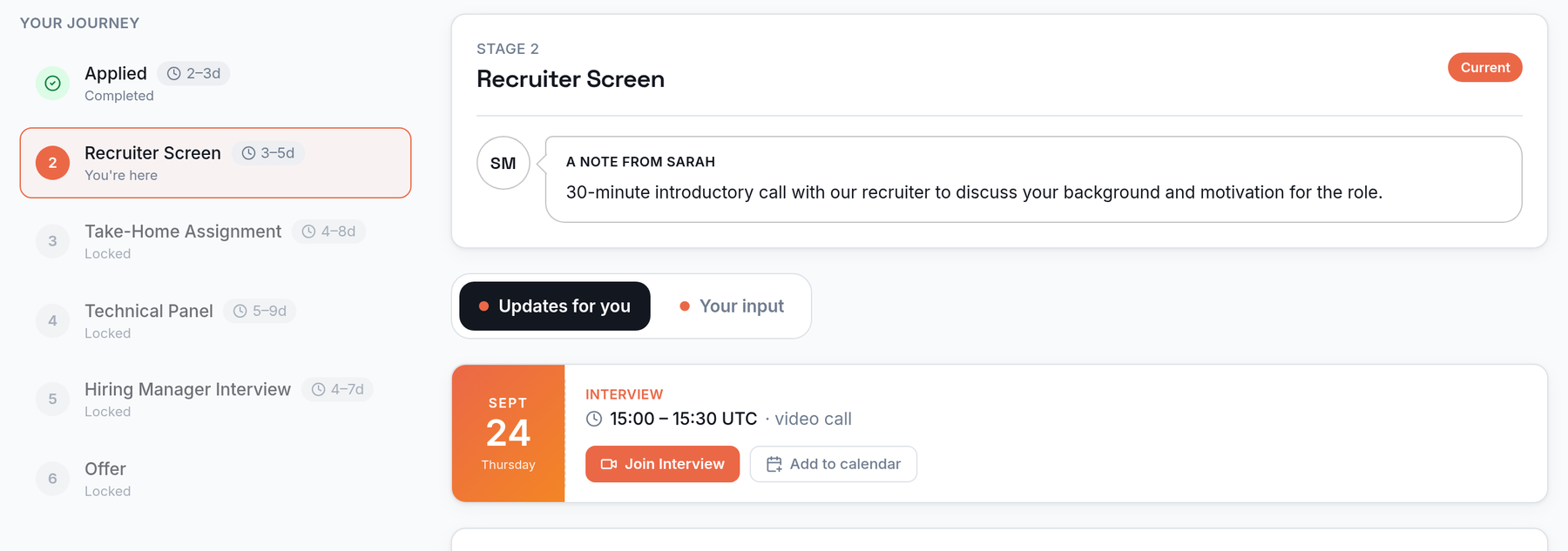
Inside a single application, the candidate sees exactly which stage they're in and what's next, a note from the recruiter, and per-stage documents as they become relevant. Scheduled interviews carry a join link and add-to-calendar, and an "Updates for you" / "Your input" split keeps what they need to read apart from what they need to do.
When Nexus is the better fit
- Candidate experience is a priority and you want people kept informed between stages with a two-way portal of their own, not one-way status tracking.
- Your top-of-funnel pain is the flood of AI-written, auto-applied submissions.
- You want a two-sided model where the candidate has a real place, joined to the hiring team at the handoff.
When Manatal is the better fit
- You want the lowest entry price, with published per-user pricing and hiring-manager and guest seats included on every plan.
- You're a recruitment agency or headhunter that needs a recruitment CRM (client and mandate tracking) alongside the ATS.
- You want a built-in agent-readable API surface (REST v3 plus an llms.txt index) and can commit to the Enterprise Plus tier to unlock API access.
Frequently asked questions
Is Nexus a good Manatal alternative?
If you're optimizing for candidate experience and filtering the flood of AI-written applications, yes. Nexus gives every candidate a live, two-way portal and gates auto-applied bots at the top of the funnel with its human-filter gate. Manatal remains strong if you want the lowest entry price with published per-user pricing, a recruitment CRM for agency and headhunter workflows, and a built-in agent-readable API surface (as of February 2025).
Does Manatal have a candidate portal like Nexus?
Manatal offers a Candidate Portal that applicants can register for to store their information and track the real-time status of their applications, available on the Enterprise Plus tier (as of February 2025). It's a one-way status view rather than a two-way portal. Nexus is two-sided by design, so each candidate gets their own live portal that holds their current stage, documents, and interview join link, joined to the hiring team at the handoff, on every account.
Does Manatal expose an agent or MCP API?
As of February 2025, Manatal publishes a REST API (the Manatal Open API, on v3 endpoints) with an llms.txt index and OpenAPI schemas for AI agents at developers.manatal.com. API access is restricted to the Enterprise Plus and Custom plans and requires a support-issued token. A Model Context Protocol server has been mentioned in community discussion but is not confirmed in Manatal's primary developer documentation.
Does Manatal screen out AI-written or bot applications?
Manatal's application forms are customizable but have no native knockout or auto-reject logic, and native CAPTCHA or anti-bot defenses are not documented in its primary materials (as of February 2025), so high-volume roles can still draw large unfiltered application counts. Nexus takes a structural approach: its human-filter gate keeps auto-applied bot and agent submissions out of the real pipeline at the top of the funnel, on by default for new jobs.
How much does Manatal cost?
Manatal publishes per-user pricing: Professional at $15/user/month (annual) or $19 monthly, Enterprise at $35/$39, and Enterprise Plus at $55/$59, plus a quote-based Custom tier (as of February 2025). There is a 14-day free trial with no credit card, and hiring-manager and guest seats are included on all plans. The Professional plan caps an account at 15 active jobs and 10,000 candidate profiles, and Open API access and SSO require Enterprise Plus or Custom. Nexus is free during early access.