Nexus vs Nodi: the two-sided, candidate-first alternative
Nodi is an AI-native recruiting system that sources, screens, and interviews with autonomous AI agents, and ships a native MCP server and Slack agent. Nexus takes a narrower shape: a live two-sided candidate portal and a human-filter gate for the era of AI-written applications.
Nodi is an AI-native recruiting system from Bogotá that automates the funnel end to end: AI agents source across LinkedIn and GitHub, AI interviewers run first-round video and audio screens, and native psychometric assessments, a Slack agent, and a Model Context Protocol server round it out. Nexus is an early, two-sided ATS: every candidate gets a live, persistent portal, and a human-filter gate keeps auto-applied bots and agents out of the real pipeline. Pick Nodi to point AI at the whole funnel; pick Nexus for a candidate-first experience and a top-of-funnel defense against AI-written applications. (Comparison as of September 2026.)
Where Nodi's shape shows
Nodi is a capable, fast-moving AI-native platform, and on end-to-end AI automation, native HRIS connectors, and its agent surface it is genuinely strong. A few things are worth knowing if you're weighing it, each dated to our September 2026 research.
- The candidate surface is a job-seeker account plus an opt-in matching agent, not a two-way portal joined to each application. Candidates get a free account with resume parsing and the paid "Career Agent" for job-match alerts, but no documented per-application portal showing their live pipeline stage, next step, stage documents, and interview join link (as of September 2026).
- Employer pricing is quote-gated. There are no public numeric tiers; a demo or sales contact is required (as of September 2026).
- The REST API is not openly self-serve. Access and full endpoint documentation require emailing [email protected] for a token, and are provided to approved integration partners (as of September 2026).
- No SOC 2 Type II or ISO 27001 certification is published on its privacy or security pages (as of July 2026).
- There's no native payroll processing of its own; it relies on third-party connectors like Deel, Buk, and Runa (as of September 2026).
- Independent third-party reviews on G2, Capterra, and Trustpilot are limited, so external social proof is thin (as of September 2026).
- Whether Nodi runs a top-of-funnel bot or identity gate on application forms is undocumented (unlisted as of September 2026). Its model leans on AI interviews and fit scoring rather than a documented human-application gate.
Nexus vs Nodi, feature by feature
| Feature | Nexus | Nodi |
|---|---|---|
| Two-sided candidate portal (a persistent place for the candidate) | yes | Free candidate accounts + opt-in Career Agent (job matching, WhatsApp alerts); no per-application pipeline portal |
| Stage-gated candidate content | yes | — |
| Top-of-funnel defense against auto-applied bots and agents | yes | — |
| Candidate self-scheduling | yes | yes |
| Native HRIS integrations | — | Native Workday, SAP SuccessFactors, BambooHR |
| Native AI screening / interviewing | —* | AI video/audio interviews + psychometric & technical assessments + fit scoring |
| Public agent / MCP API | yes† | Native MCP server (Claude/GPT) + REST API (token by request) |
| Security certifications | — | Not published (GCP/Firebase, TLS, RBAC; no SOC 2 / ISO listed) |
| Public pricing | Free during early access | Quote-gated (demo required); unlimited seats |
| Outbound sourcing CRM | — | AI sourcing agents across LinkedIn, GitHub & web + CRM / talent pool |
- *
- By design, not a gap. Rather than pointing AI at the résumé pile — which just pits AI screeners against AI-written applications — Nexus filters auto-generated submissions at the top with its LLM-Proof gate, a human-filter step that lets a real person review only the ones that clear it.
- †
- Read-only in Phase 1: a token-scoped, org-scoped REST API plus an MCP server (Claude-compatible) that lets an external agent read jobs, applications, and pipeline stages. Agents see only the human-verified pipeline, never the auto-applied bot flood the LLM-Proof gate holds back. Write actions are a deliberate later phase.
What Nexus brings to the table
Every candidate gets a home, not a status email
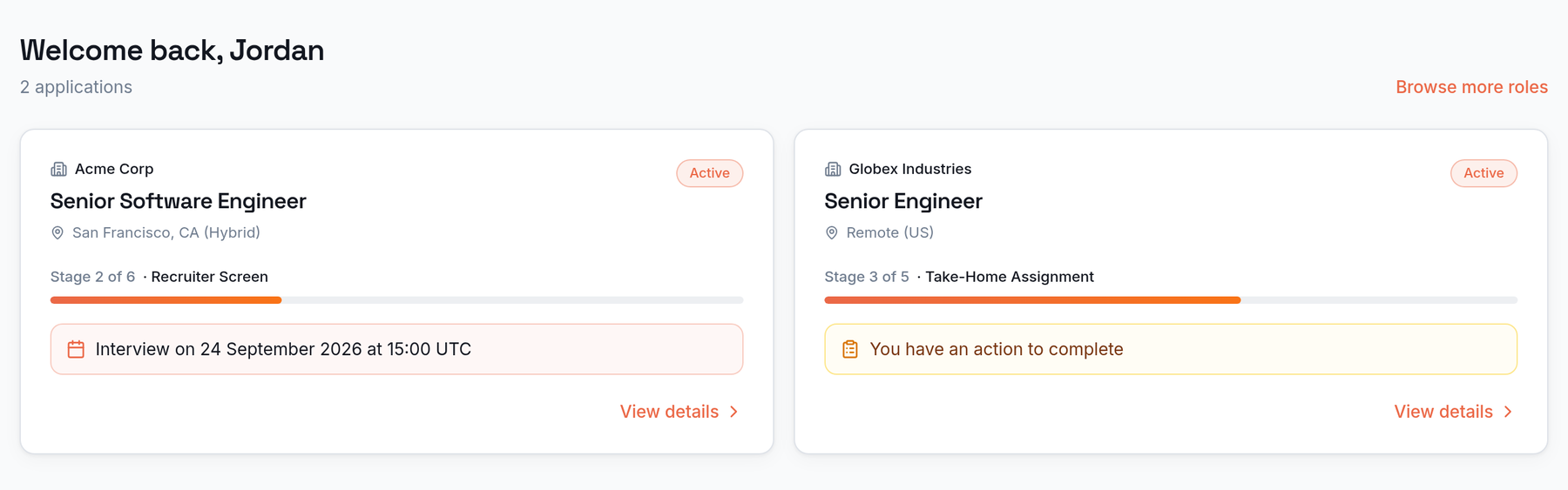
Most ATSes give the candidate status emails and a careers-page link. Nexus gives every applicant a live, persistent portal: each application's current stage, the next action, interview details, and documents in one place they can return to any time, not an inbox they have to search.
A gate built for the AI-application era
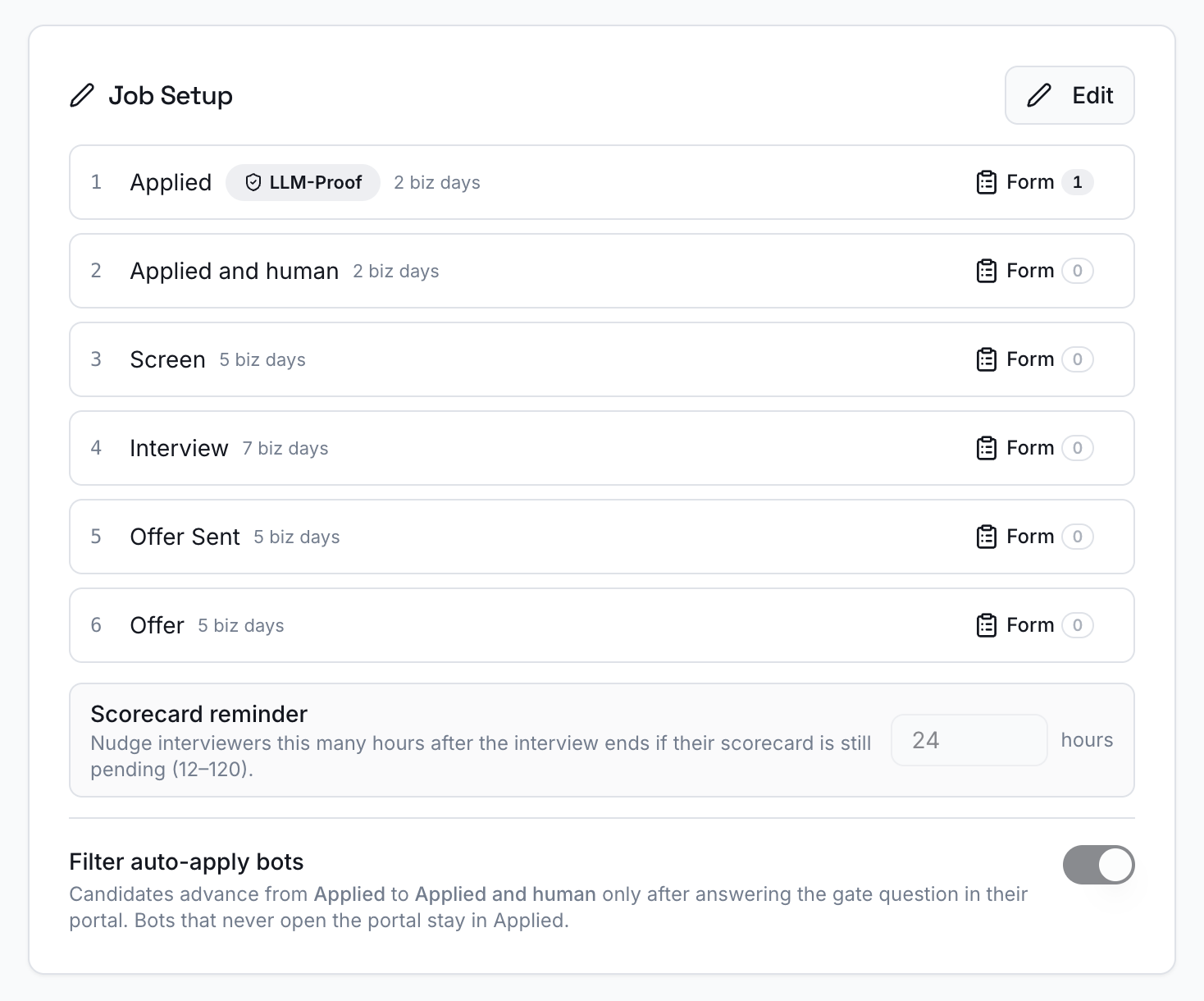
A per-job human-filter gate keeps auto-applied bot and agent submissions out of the real pipeline. Applications land in "Applied" and only advance to "Applied and human" once a real person opens their portal and answers one question, so reviewers spend their time on submissions that cleared the gate.
One application, fully alive
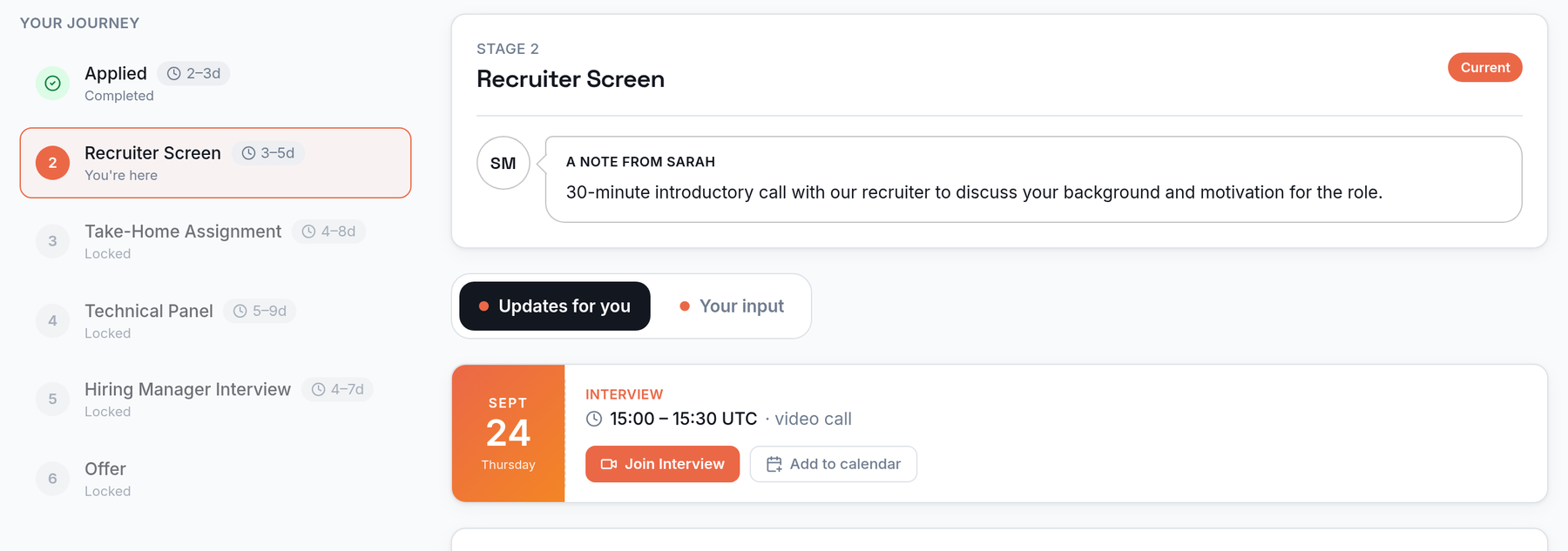
Inside a single application, the candidate sees exactly which stage they're in and what's next, a note from the recruiter, and per-stage documents as they become relevant. Scheduled interviews carry a join link and add-to-calendar, and an "Updates for you" / "Your input" split keeps what they need to read apart from what they need to do.
When Nexus is the better fit
- Candidate experience is the priority and you want every applicant to have a live, two-way portal of their own — current stage, next step, documents, and interview join link in one place — not a job-seeker account plus a matching agent.
- Your top-of-funnel pain is the flood of AI-written, auto-applied submissions, and you want a human-filter gate that keeps them out of the pipeline rather than pointing AI screeners and interviewers at the pile.
- You want stage-gated content that surfaces the right documents to a candidate at the right stage, and org-controlled transition emails in your own voice.
When Nodi is the better fit
- You want AI to run the whole funnel today: autonomous sourcing across LinkedIn and GitHub, AI video and audio first-round interviews, and native psychometric and technical assessments.
- You need native HRIS connectors (Workday, SAP SuccessFactors, BambooHR) and payroll connectors (Deel, Ontop, Buk, Runa) out of the box.
- You want a candidate-facing job-matching agent (the Career Agent) and a broad native integration set spanning Slack, Teams, WhatsApp, Zoom, and Calendly.
Frequently asked questions
Is Nexus a good Nodi alternative?
It depends on what you're optimizing for. Nodi is an AI-native recruiting system that automates the funnel end to end: autonomous AI agents source across LinkedIn and GitHub, AI interviewers run first-round video and audio screens, and native psychometric and technical assessments, a Slack agent, and a Model Context Protocol server round it out (as of September 2026). Nexus is an early, two-sided ATS built around the candidate experience: every applicant gets a live, persistent portal, and a human-filter gate keeps auto-applied bots and agents out of the real pipeline. If your priority is candidate experience and a top-of-funnel defense against AI-written applications, Nexus is the better fit; if it's pointing AI at the whole funnel — sourcing, screening, and interviewing — Nodi is.
Does Nodi have a two-sided candidate portal like Nexus?
Not in the same shape. Nodi gives candidates a free account with automatic resume parsing and an opt-in "Career Agent" that sends proactive job-match alerts by email and WhatsApp, and candidate profiles stay private until an application is submitted (as of September 2026). That's a job-seeker account plus a matching agent, not a persistent portal joined to each application's pipeline. Nexus is two-sided by design: each candidate gets their own live portal holding their current stage, next step, stage documents, and interview join link, joined to the hiring team at the handoff, on every account.
How does Nodi handle AI-written or auto-applied applications?
Nodi leans into AI across the funnel rather than gating applications. Its AI scores and matches applicants with fit percentages and explanations, and AI interviewers run first-round video and audio screens that evaluate responses (as of September 2026). Public documentation on a top-of-funnel bot-defense CAPTCHA or candidate identity check on application forms is unlisted, so whether Nodi runs a human-application gate is undocumented. Nexus takes a different approach: a per-job human-filter gate holds applications in "Applied" until a real person opens their portal and answers a question, so auto-applied bots and agents that never open the portal stay out of the real pipeline instead of being scored or interviewed by an AI.
Does Nodi expose an agent or MCP API?
Yes. Nodi ships a native Model Context Protocol (MCP) server (Claude- and GPT-compatible) at open.nodi.global plus a REST API for job postings, candidate search, and pipeline-stage actions, and a native Slack agent for in-channel pipeline commands (as of September 2026). Note the REST API is not openly self-serve: access and full documentation require requesting a token from [email protected]. Nexus exposes a public agent/MCP API too, read-only in Phase 1: a token-scoped REST API plus a Claude-compatible MCP server that lets an agent read jobs, applications, and pipeline stages, and by design agents see only the human-verified pipeline, never the bot flood the gate holds back.
How much does Nodi cost?
Nodi does not publish numeric pricing for its employer platform; pricing is quote-gated behind a demo or sales contact, though subscriptions include unlimited user seats with no per-user fees (as of September 2026). On the candidate side, basic accounts, resume parsing, and manual applications are free, while the opt-in "Nodi Career Agent" (proactive matching and WhatsApp/email alerts) is a paid candidate subscription. Nexus is free during early access.