Nexus vs Pinpoint: the two-sided ATS vs the AI-governed in-house suite
Pinpoint is a mature, compliance-first ATS for in-house teams: native anonymized screening, a governed AI suite, deep HRIS breadth, and SOC 2 Type II, ISO 27001, and ISO/IEC 42001 certifications. Nexus is a two-sided ATS built around the candidate: every applicant gets a live, persistent portal, and a human-filter gate keeps auto-applied bots and agents out of the real pipeline.
Pinpoint is a mature applicant tracking system for in-house talent teams, serving 1,000+ organizations of 250 to 10,000+ employees. It's strong where an early product isn't: native anonymized (blind) screening, a governed AI suite, 35+ native HRIS integrations, an official MCP server, and SOC 2 Type II, ISO 27001, and ISO/IEC 42001 certifications, all under headcount-based, quote-gated pricing. Nexus is an early, two-sided ATS: every candidate gets a live, persistent portal, and a human-filter gate holds auto-applied bots and agents out of the real pipeline. Pick Pinpoint for compliance depth, blind hiring, and integration breadth; pick Nexus for a candidate-first, two-sided experience with structural top-of-funnel bot defense. (Comparison as of October 2026.)
Where Pinpoint's shape shows
Pinpoint is a capable, well-governed suite, and on certifications, blind screening, HRIS breadth, and AI governance it is genuinely ahead of an early product like Nexus. The thing to understand before comparing is where its energy goes: into in-house workflow, compliance, and AI-assisted triage, less into giving the candidate their own persistent, two-way view of the pipeline and into a structural gate at the top of the funnel. A few points worth knowing, each dated to our October 2026 research.
- The candidate surface is a branded careers site, an AI candidate-companion chatbot, a self-scheduling screen, and a post-hire onboarding portal — candidate-facing, but not a single persistent per-application portal showing live pipeline stage, next step, and stage-gated documents across the whole process (as of October 2026).
- Top-of-funnel defense is AI triage plus abuse controls: automated knock-out questions, AI criteria checklists, and one-way video to triage volume, with spam detection, origin-domain validation, and rate-limiting on public endpoints — not a human-filter gate that holds applications back until a real person acts (as of October 2026).
- No stage-gated candidate content: documents and context aren't surfaced to the candidate stage by stage (as of October 2026).
- Reporting is limited to tabular output and Excel/CSV exports; user community analyses note the absence of native graphical dashboard visualizers (as of 2025).
- No dedicated native mobile apps; the product is delivered as a responsive web application only (as of October 2026).
- Pricing is quote-gated with no free tier or unassisted trial, and scales on total company headcount rather than openings or recruiter seats, so a large-workforce, low-hiring-volume org pays an elevated relative cost (as of October 2026).
- User reviews are mixed on scaling: some rate it a favorite across stakeholders for the value, while one high-growth user described it as clunky for high-volume hiring (Reddit r/recruiting, 2025).
Nexus vs Pinpoint, feature by feature
| Feature | Nexus | Pinpoint |
|---|---|---|
| Two-sided candidate portal (a persistent place for the candidate) | yes | Branded careers site, AI candidate-companion chatbot, self-scheduling, and onboarding portal; candidate-facing but not a persistent per-application pipeline portal |
| Stage-gated candidate content | yes | — |
| Top-of-funnel defense against auto-applied bots and agents | yes | AI knock-out triage + spam detection, domain validation, and rate-limiting (no human-filter gate) |
| Candidate self-scheduling | yes | yes |
| Native HRIS integrations | — | 35+ native HRIS connectors (Workday, BambooHR, HiBob, ADP, Personio, Rippling, UKG…) |
| Native AI screening / interviewing | —* | AI match score, criteria checklist, résumé redaction, one-way video + AI notetaker (human authorizes every decision) |
| Public agent / MCP API | yes† | Official MCP server + public REST API (OpenAPI docs) |
| Security certifications | — | SOC 2 Type II, ISO 27001, ISO/IEC 42001 (AI) |
| Native anonymized (blind) screening | — | yes |
| Pre-hire onboarding (right-to-work, e-sign, compliance) | — | yes |
| Public pricing | Free during early access | Quote-gated; headcount-based (~$4.6k–$15k+/yr, third-party est.) |
- *
- By design, not a gap. Rather than pointing AI at the résumé pile — which just pits AI screeners against AI-written applications — Nexus filters auto-generated submissions at the top with its LLM-Proof gate, a human-filter step that lets a real person review only the ones that clear it.
- †
- Read-only in Phase 1: a token-scoped, org-scoped REST API plus an MCP server (Claude-compatible) that lets an external agent read jobs, applications, and pipeline stages. Agents see only the human-verified pipeline, never the auto-applied bot flood the LLM-Proof gate holds back. Write actions are a deliberate later phase.
What Nexus brings to the table
Every candidate gets a home, not a status email
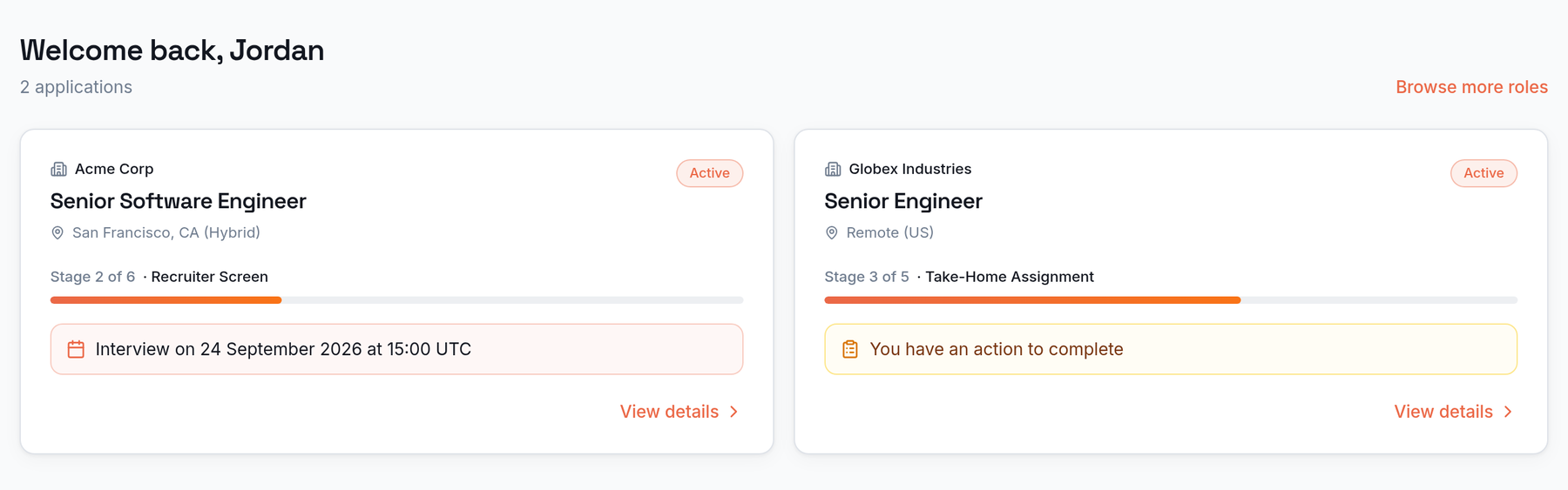
Most ATSes give the candidate status emails and a careers-page link. Nexus gives every applicant a live, persistent portal: each application's current stage, the next action, interview details, and documents in one place they can return to any time, not an inbox they have to search.
A gate built for the AI-application era
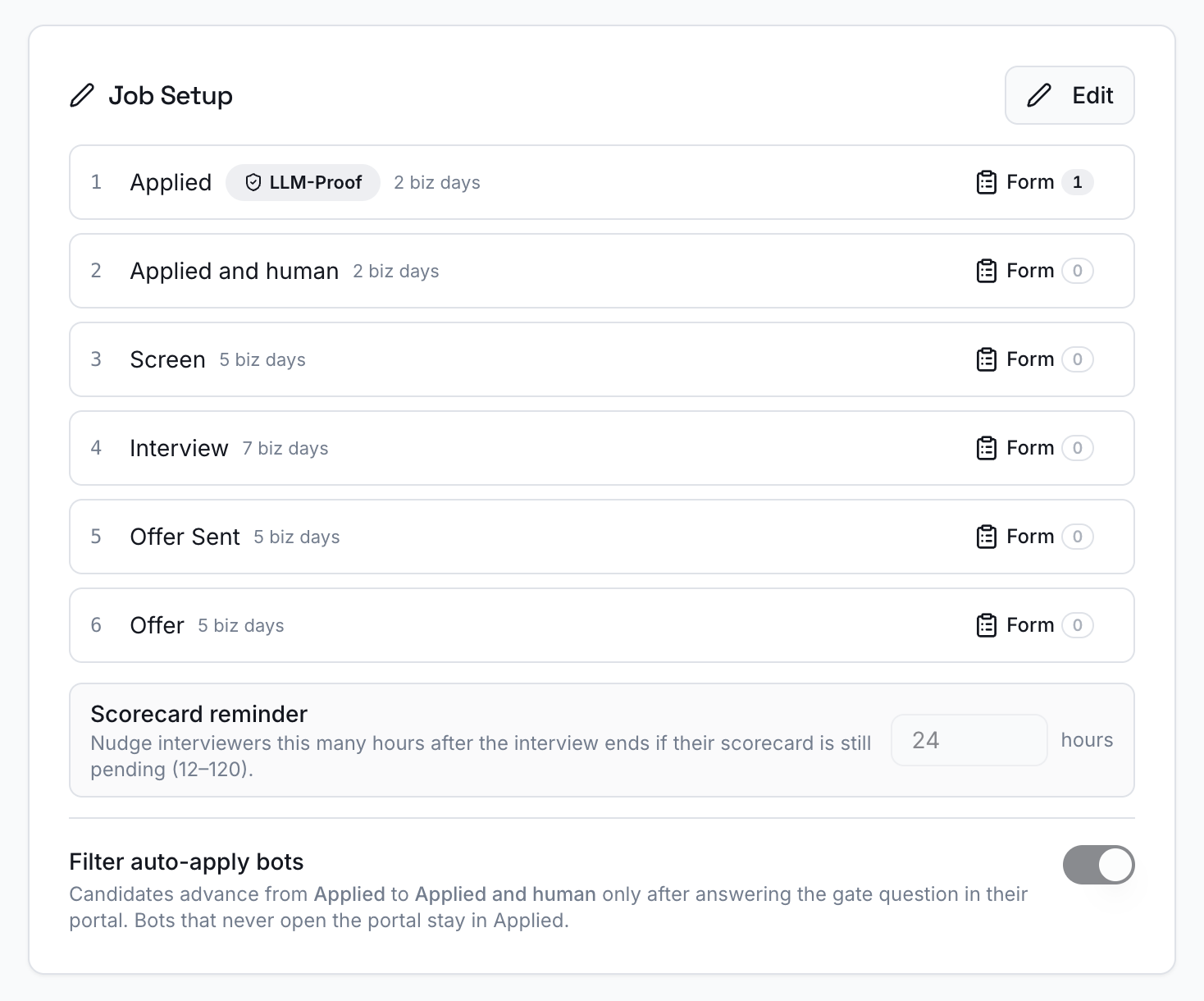
A per-job human-filter gate keeps auto-applied bot and agent submissions out of the real pipeline. Applications land in "Applied" and only advance to "Applied and human" once a real person opens their portal and answers one question, so reviewers spend their time on submissions that cleared the gate.
One application, fully alive
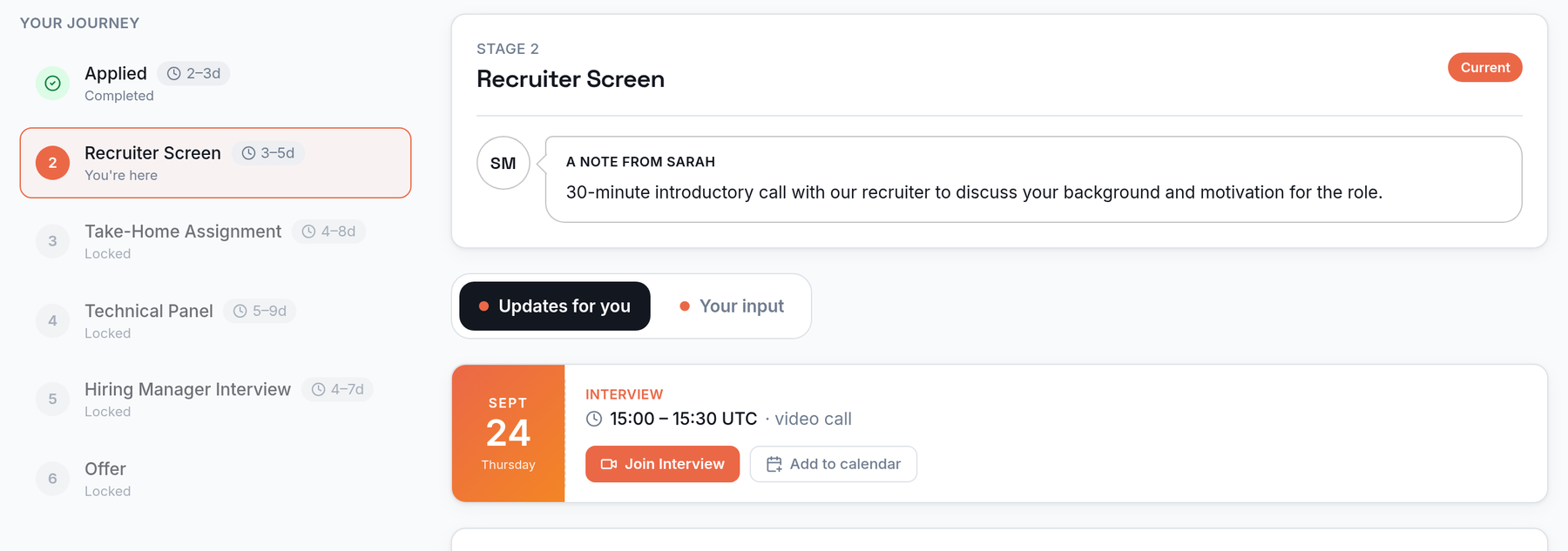
Inside a single application, the candidate sees exactly which stage they're in and what's next, a note from the recruiter, and per-stage documents as they become relevant. Scheduled interviews carry a join link and add-to-calendar, and an "Updates for you" / "Your input" split keeps what they need to read apart from what they need to do.
When Nexus is the better fit
- Candidate experience is the product: you want every applicant to have a live, two-way portal of their own — current stage, next step, documents, and interview join link — not a careers site plus a chatbot and status emails.
- Your top-of-funnel pain is the flood of AI-written, auto-applied submissions, and you want a human-filter gate that keeps them out of the pipeline rather than AI triage and abuse controls.
- You want stage-gated content that surfaces the right documents at the right stage, and org-controlled transition emails in your own voice.
- You're early-stage and want a candidate-first ATS that's free during early access, without a sales call to see pricing.
When Pinpoint is the better fit
- Native anonymized (blind) screening and formal DEI/equality monitoring are hard requirements, and you want them engineered into the core platform.
- Enterprise security and AI-governance certifications — SOC 2 Type II, ISO 27001, and ISO/IEC 42001 — are procurement gates today.
- You need deep native HRIS breadth (Workday, BambooHR, HiBob, ADP, Personio, Rippling, and 30+ more) and pre-hire onboarding with right-to-work verification.
- You're a mid-market or enterprise in-house team of 250–10,000+ and want a mature suite with a governed AI toolkit and predictable headcount-based licensing.
Frequently asked questions
Is Nexus a good Pinpoint alternative?
It depends on what you need. Pinpoint is a mature, compliance-first ATS for in-house teams, with native anonymized screening, a governed AI suite, 35+ native HRIS integrations, and SOC 2 Type II, ISO 27001, and ISO/IEC 42001 certifications (as of October 2026). Nexus is an early, two-sided ATS built around the candidate: every applicant gets a live, persistent portal, and a human-filter gate keeps auto-applied bots and agents out of the real pipeline. If you need certification depth, blind hiring, and integration breadth, Pinpoint is a strong fit; if you want a candidate-first, two-sided experience with structural top-of-funnel bot defense, Nexus is.
Does Pinpoint give every candidate a portal like Nexus?
Not in the same shape. Pinpoint's candidate surface is a branded, mobile-optimized careers site, an AI candidate-companion chatbot for questions and role recommendations, a self-scheduling screen, and a post-hire onboarding portal for document signing and right-to-work checks (as of October 2026). That surface is scoped to applying, scheduling, and onboarding rather than a single persistent view of each application's pipeline stage, next step, and stage-gated documents across the whole process. Nexus is two-sided by design: every candidate gets their own live portal holding their current stage, next step, stage documents, and interview join link, joined to the hiring team at the handoff, on every account.
How does Pinpoint handle auto-applied bots and AI agents?
Mostly through AI triage and abuse controls. Pinpoint combines automated knock-out questions, AI criteria checklists, and one-way video interviews to triage high volume, and it applies automated spam detection, origin-domain validation, and rate-limiting on public endpoints (as of October 2026). Nexus takes a structural approach at the top of the funnel instead: a per-job human-filter gate holds applications in "Applied" until a real person opens their portal and answers a question, so auto-applied bots and agents that never open the portal stay out of the real pipeline.
Does Pinpoint do anonymized or blind screening?
Yes, and it's a genuine Pinpoint strength. Pinpoint's native anonymized screening redacts candidate names, contact details, dates, and gender markers at the job level and assigns persistent pseudonyms, with immutable audit logs recording any unmasking events, plus decoupled equality surveys for UK Article 55 and gender pay gap reporting (as of October 2026). Nexus does not offer native blind screening today; if DEI-driven anonymized review is a hard requirement, Pinpoint is ahead here.
Does Pinpoint expose an agent or MCP API?
Yes. Pinpoint operates an official Model Context Protocol (MCP) server that connects its system of record to external LLM environments such as Claude and ChatGPT, letting authorized agents query hiring context, surface candidate records, generate interview briefs, and prepare stage actions, alongside a public REST API with OpenAPI documentation (as of October 2026). This in-product agent surface is a real Pinpoint strength. Nexus exposes its own public agent/MCP API, read-only in Phase 1: a token-scoped REST API plus a Claude-compatible MCP server that lets an agent read jobs, applications, and pipeline stages — and by design agents see only the human-verified pipeline, never the bot flood the gate holds back.
How much does Pinpoint cost?
Pinpoint does not publish open pricing; access is quote-on-request with no permanent free tier or unassisted trial (as of October 2026). Licensing is an annual flat rate based on total company headcount rather than per-recruiter seats, so every tier includes unlimited users. Third-party procurement research estimates a Growth plan around $4,600–$15,000 per year and Enterprise agreements at $15,000+ per year, scaling by headcount band (as of July–October 2026). Because pricing tracks total workforce, a large organization with low hiring volume can pay an elevated relative cost. Nexus is free during early access.