Nexus vs Screenloop: the two-sided ATS vs the interview-intelligence ATS
Screenloop is an AI-native ATS built around interview intelligence: an AI notetaker, real-time transcription in 35+ languages, scorecard auto-fill, candidate pulse surveys, and automated reference and background checks. Nexus is a two-sided ATS built around the candidate: every applicant gets a live, persistent portal, and a human-filter gate keeps auto-applied bots and agents out of the real pipeline.
Screenloop is an AI-native applicant tracking and talent-operations platform built around interview intelligence: an AI notetaker records and transcribes interviews across 35+ languages, auto-fills scorecards from transcripts, and adds candidate NPS pulse surveys plus automated reference and background checks. It's quote-gated, leans on a third-party iPaaS bridge (StackOne) for HRIS, and documents no top-of-funnel bot or agent defense. Nexus is the ATS from the candidate's side: every applicant gets a live, persistent portal, and a human-filter gate keeps auto-applied bots out of the real pipeline. Pick Screenloop to deepen interview quality and evaluation on one platform; pick Nexus for a candidate-first ATS with built-in top-of-funnel bot defense. (Comparison as of October 2026.)
Where Screenloop's shape shows
Screenloop is a capable AI-native ATS, and on interview intelligence — recording, transcription, scorecard auto-fill — it's genuinely strong. The thing to understand before comparing is where its energy goes: deep into the interview and evaluation stage, less into the candidate's own view of the pipeline and the top of the funnel. A few points worth knowing, each dated to our October 2026 research.
- It's interview-intelligence-first: the candidate surface is a company-branded career portal plus a scheduling screen, not a persistent per-application portal showing live pipeline stage, next step, and stage-gated documents across the whole process (as of September 2025).
- No native top-of-funnel bot defense, application rate-limiting, or applicant identity/fraud verification is documented on its public product pages; top-of-funnel filtering relies on employer-configured screening questions (as of September 2025).
- No stage-gated candidate content: documents and context aren't surfaced to the candidate stage by stage (as of September 2025).
- Direct native HRIS integrations (Workday, BambooHR, HiBob, Personio, ADP) aren't enumerated on its primary marketing pages; HR-system connectivity runs through a third-party iPaaS bridge, StackOne (as of September 2026).
- Formal SOC 2 Type II or ISO 27001 audit certificates aren't published on the main marketing pages; it does ship RBAC, automated PII redaction, and GDPR compliance (as of September 2025).
- Ungated public API documentation and a developer sandbox aren't published; the agent surface runs through StackOne's MCP server (75 actions) rather than a first-party public API (as of October 2023 / September 2026).
- Pricing is quote-gated behind a sales demo; a third-party directory lists a starting price of about £208/month on a flat-rate plan (as of September 2025).
- Some users flag scaling limits: "you'll be quick to outgrow it... migrating off to another ATS will be a challenge" (Reddit r/recruiting, January 2025).
Nexus vs Screenloop, feature by feature
| Feature | Nexus | Screenloop |
|---|---|---|
| Two-sided candidate portal (a persistent place for the candidate) | yes | Company-branded career portal + self-scheduling screen; candidate-facing but not a persistent per-application pipeline portal |
| Stage-gated candidate content | yes | — |
| Top-of-funnel defense against auto-applied bots and agents | yes | Employer-configured screening questions (no bot/agent defense documented) |
| Candidate self-scheduling | yes | yes |
| Native HRIS integrations | — | Not native; HRIS via StackOne iPaaS bridge |
| Native AI screening / interviewing | —* | AI notetaker, transcription, and scorecard auto-fill (analyzes human interviews; no autonomous AI interviewer) |
| Public agent / MCP API | yes† | MCP server via StackOne (75 actions); no ungated public API docs |
| Security certifications | — | GDPR, RBAC, PII redaction (no public SOC 2 Type II / ISO 27001) |
| Public pricing | Free during early access | Quote-gated (directory lists ~£208/mo flat-rate) |
| Candidate pulse (NPS) + automated references & background checks | — | yes |
- *
- By design, not a gap. Rather than pointing AI at the résumé pile — which just pits AI screeners against AI-written applications — Nexus filters auto-generated submissions at the top with its LLM-Proof gate, a human-filter step that lets a real person review only the ones that clear it.
- †
- Read-only in Phase 1: a token-scoped, org-scoped REST API plus an MCP server (Claude-compatible) that lets an external agent read jobs, applications, and pipeline stages. Agents see only the human-verified pipeline, never the auto-applied bot flood the LLM-Proof gate holds back. Write actions are a deliberate later phase.
What Nexus brings to the table
Every candidate gets a home, not a status email
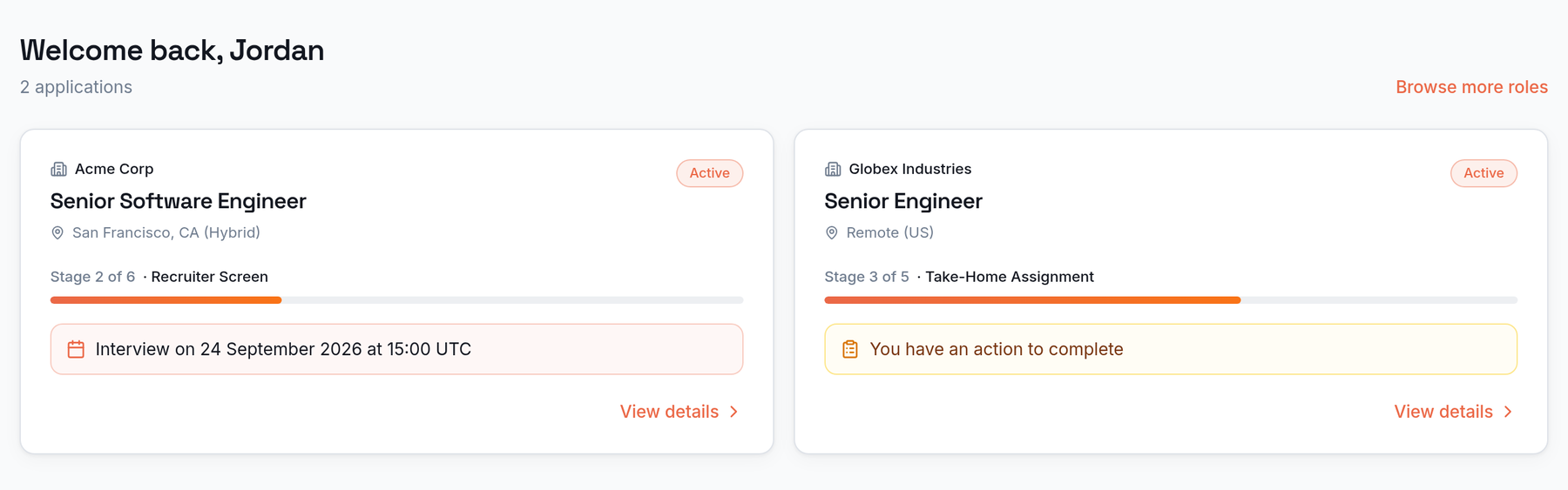
Most ATSes give the candidate status emails and a careers-page link. Nexus gives every applicant a live, persistent portal: each application's current stage, the next action, interview details, and documents in one place they can return to any time, not an inbox they have to search.
A gate built for the AI-application era
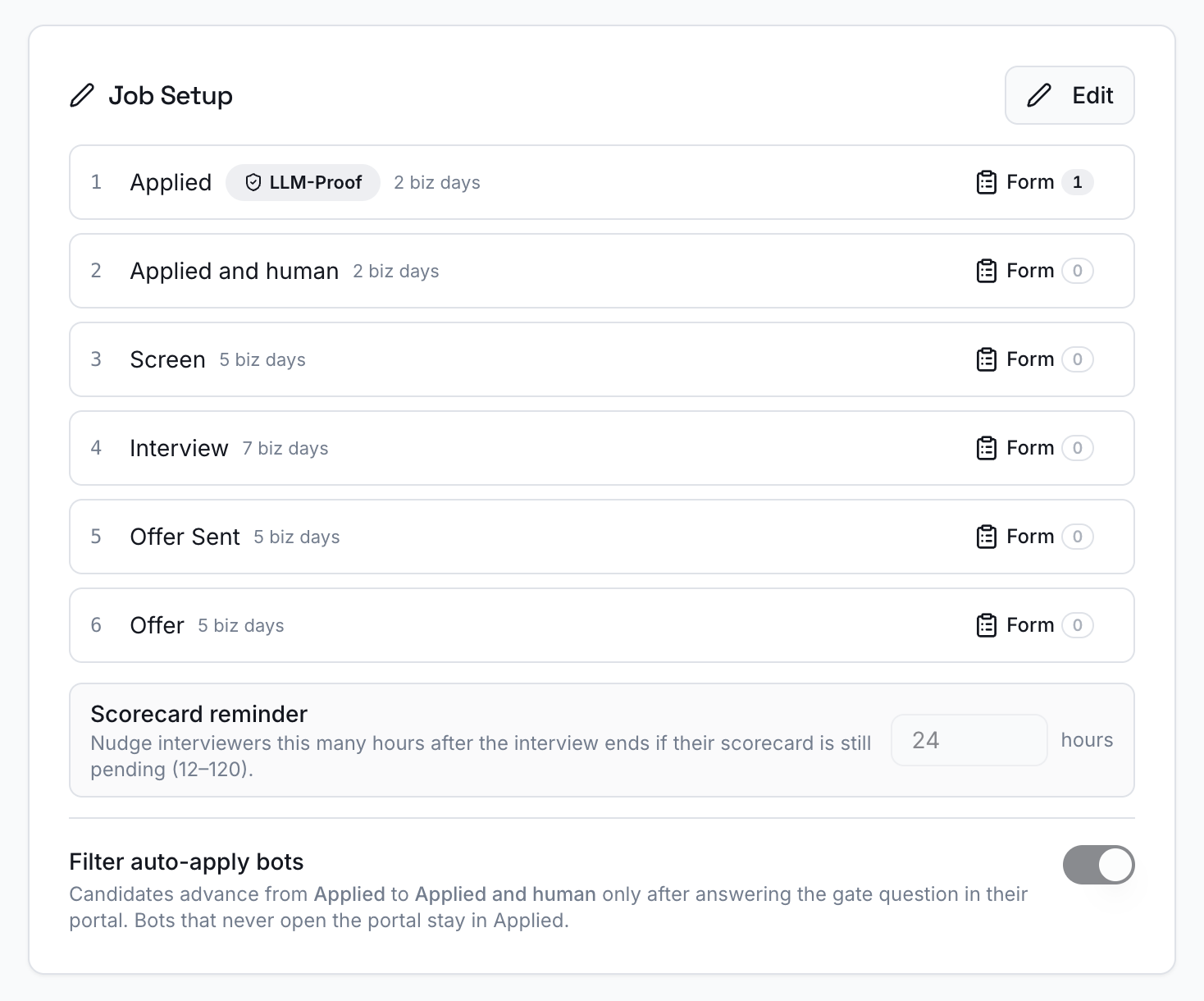
A per-job human-filter gate keeps auto-applied bot and agent submissions out of the real pipeline. Applications land in "Applied" and only advance to "Applied and human" once a real person opens their portal and answers one question, so reviewers spend their time on submissions that cleared the gate.
One application, fully alive
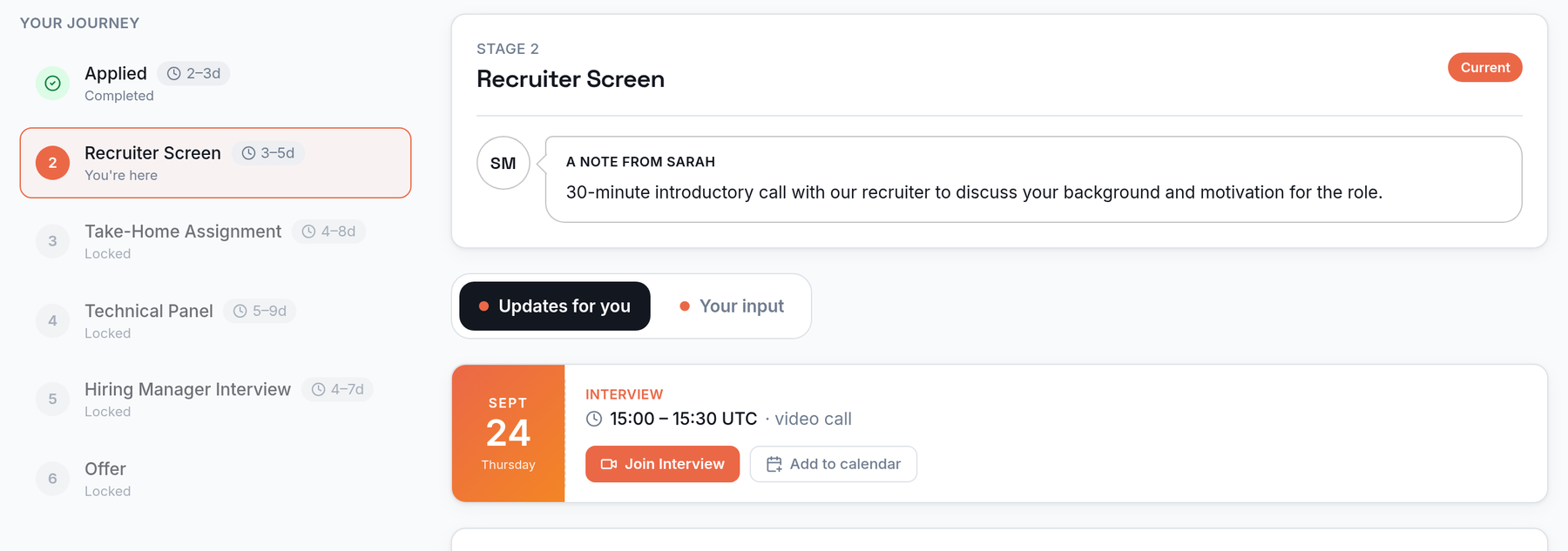
Inside a single application, the candidate sees exactly which stage they're in and what's next, a note from the recruiter, and per-stage documents as they become relevant. Scheduled interviews carry a join link and add-to-calendar, and an "Updates for you" / "Your input" split keeps what they need to read apart from what they need to do.
When Nexus is the better fit
- Candidate experience is the product: you want every applicant to have a live, two-way portal of their own — current stage, next step, documents, and interview join link — not just a career-site application and a scheduling screen.
- Your top-of-funnel pain is the flood of AI-written, auto-applied submissions, and you want a human-filter gate that keeps them out of the pipeline rather than screening questions alone.
- You want stage-gated content that surfaces the right documents at the right stage, and org-controlled transition emails in your own voice.
- You're early-stage and want a candidate-first ATS that's free during early access, without a sales call to see pricing.
When Screenloop is the better fit
- Interview quality is your priority: you want an AI notetaker, real-time transcription, and scorecard auto-fill to make evaluations more consistent and cut manual note-taking.
- You hire across languages and need interview recording, transcription, and analysis in 35+ languages.
- You want references, background checks, and candidate NPS pulse surveys bundled into one platform rather than bought separately.
- You want interviewer coaching analytics (talk ratios, speaking speed, sentiment) and are comfortable with quote-gated pricing.
Frequently asked questions
Is Nexus a good Screenloop alternative?
It depends on what you need. Screenloop is an AI-native ATS and talent-operations platform built around interview intelligence: an AI notetaker records and transcribes interviews across 35+ languages, auto-fills scorecards from transcripts, and layers on candidate NPS pulse surveys plus automated reference and background checks (as of September 2025). Nexus is the ATS from the candidate's side — a two-sided system where every applicant gets a live, persistent portal and a human-filter gate keeps auto-applied bots and agents out of the real pipeline. If you want to deepen interview quality and evaluation on a single platform, Screenloop is a strong fit; if you want a candidate-first ATS with built-in top-of-funnel bot defense, Nexus is.
Is Screenloop an ATS?
Yes. Screenloop describes itself as AI-native applicant tracking software and an all-in-one Talent Operations Platform: it runs the candidate pipeline — requisition posting, customizable stages, application tracking, and status progression — and bundles interview intelligence, candidate pulse surveys, reference automation, background checks, and hiring analytics on top (as of September 2025). It's a full ATS, with its distinctive weight on the interview and evaluation stage. Nexus is also a full ATS, built around a two-sided candidate portal and a top-of-funnel human-filter gate instead.
Does Screenloop have a two-sided candidate portal like Nexus?
Not in the same shape. Screenloop gives candidates a company-branded career portal to apply through and a self-scheduling screen to book interview slots against interviewer availability, and it sends automated pulse surveys and reference requests after interviews (as of September 2025). That surface is scoped to applying, scheduling, and feedback rather than a persistent view of each application's pipeline stage, next step, and stage-gated documents across the whole process. Nexus is two-sided by design: every candidate gets their own live portal holding their current stage, next step, stage documents, and interview join link, joined to the hiring team at the handoff, on every account.
How does Screenloop handle AI-written or auto-applied applications?
Mostly through employer-configured screening questions on the application form. Screenloop's public product pages document no specialized bot-defense system, application submission rate limits, or automated applicant identity/fraud verification at the top of the funnel (as of September 2025); its AI strength is downstream, in interview recording and evaluation. Nexus takes the opposite approach at the top of the funnel: a per-job human-filter gate holds applications in "Applied" until a real person opens their portal and answers a question, so auto-applied bots and agents that never open the portal stay out of the real pipeline.
Does Screenloop expose an agent or MCP API?
Yes, through a third party. Screenloop has an agent-facing surface implemented via StackOne's Model Context Protocol (MCP) server, which exposes 75 programmatic actions across create, read, update, and delete on candidate and pipeline objects, letting agents such as Claude Desktop, Claude Code, Goose, and Intercom Fin act on Screenloop data under user authentication (as of September 2026). Ungated first-party public API documentation and a developer sandbox aren't published on open pages (as of October 2023). Nexus exposes its own public agent/MCP API, read-only in Phase 1: a token-scoped REST API plus a Claude-compatible MCP server that lets an agent read jobs, applications, and pipeline stages — and by design agents see only the human-verified pipeline, never the bot flood the gate holds back.
How much does Screenloop cost?
Screenloop does not publish pricing tiers or seat costs on its website; subscription pricing is gated behind a sales demo (as of September 2025). Software directory aggregators list a baseline starting price of about £208 per month on a flat-rate plan, and the product is packaged as a single Talent Operations Platform subscription that bundles the ATS with interview intelligence, pulse surveys, reference automation, and analytics rather than charging separately for interview recording (as of September 2025). Nexus is free during early access.