Nexus vs Workable: the two-sided, candidate-first alternative
Workable is a mature all-in-one talent-acquisition and HR suite with a 400M-profile AI sourcing agent, native MCP support, and full security certifications. Nexus takes a narrower shape: a live two-sided candidate portal and a human-filter gate for the era of AI-written applications.
Workable is a cloud talent-acquisition and HR suite serving 30,000+ organizations, known for all-in-one breadth (ATS plus HRIS, onboarding, time tracking, and payroll prep), an AI agent that sources across 400M+ passive profiles and screens applicants against up to 14 criteria, native Model Context Protocol support, and ISO 27001 / SOC 2 Type II certifications. Nexus is an early, two-sided ATS: every candidate gets a live, persistent portal, and a human-filter gate keeps auto-applied bots and agents out of the real pipeline. Pick Workable for all-in-one breadth and AI sourcing depth; pick Nexus for a candidate-first, two-sided experience. (Comparison as of September 2026, based on Workable sources dated March 2026.)
Where Workable's shape shows
Workable is a capable, mature suite, and on all-in-one breadth, AI sourcing, native MCP, and security certifications it is genuinely strong. A few things are worth knowing if you're weighing it, each dated to our September 2026 research (Workable sources as of March 2026).
- The candidate surface is one-way. Applicants apply through mobile-responsive forms and branded careers pages and get status updates and scheduling links; there's no persistent, two-way candidate portal joined to the pipeline (as of March 2026).
- Candidate profiles are isolated per job pipeline, so someone who applies to multiple roles becomes multiple separate records unless a recruiter manually merges them (as of March 2026).
- The platform emits no native webhooks when a job is published, updated, or closed, so keeping an external careers site or CMS in sync means polling the Jobs API rather than reacting to an event (as of March 2026).
- Standard self-serve API tokens are rate-limited to 10 requests per 10 seconds (60/minute) and return HTTP 429 under bulk extraction (as of March 2026).
- The core HRIS module lacks native US Form I-9 employment-eligibility verification (as of March 2026).
- Real recruiters on Reddit describe the AI features as "still very much in beta" (May 2025) and "lagging behind" (June 2025), and Workable Agent AI credits expire 12 months after purchase and are non-refundable (as of March 2026).
Nexus vs Workable, feature by feature
| Feature | Nexus | Workable |
|---|---|---|
| Two-sided candidate portal (a persistent place for the candidate) | yes | One-way: branded careers pages + application status & scheduling; no persistent candidate portal |
| Stage-gated candidate content | yes | — |
| Top-of-funnel defense against auto-applied bots and agents | yes | AI qualification chat (Workable Agent) + anonymized screening |
| Candidate self-scheduling | yes | yes |
| Native HRIS integrations | — | Built-in HRIS + native ADP, BambooHR, Personio syncs |
| Native AI screening / interviewing | —* | AI screening: 0–100 fit scores vs up to 14 criteria (Workable Agent) |
| Public agent / MCP API | yes† | Public REST API (v3) + candidate-event webhooks + native MCP support |
| Security certifications | — | ISO 27001, ISO 27017, SOC 2 Type II, SOC 3 |
| Public pricing | Free during early access | Published: from $299/mo (Standard, 1–20 employees) |
| Outbound sourcing CRM | — | AI passive sourcing across 400M+ profiles (Workable Agent) |
- *
- By design, not a gap. Rather than pointing AI at the résumé pile — which just pits AI screeners against AI-written applications — Nexus filters auto-generated submissions at the top with its LLM-Proof gate, a human-filter step that lets a real person review only the ones that clear it.
- †
- Read-only in Phase 1: a token-scoped, org-scoped REST API plus an MCP server (Claude-compatible) that lets an external agent read jobs, applications, and pipeline stages. Agents see only the human-verified pipeline, never the auto-applied bot flood the LLM-Proof gate holds back. Write actions are a deliberate later phase.
What Nexus brings to the table
Every candidate gets a home, not a status email
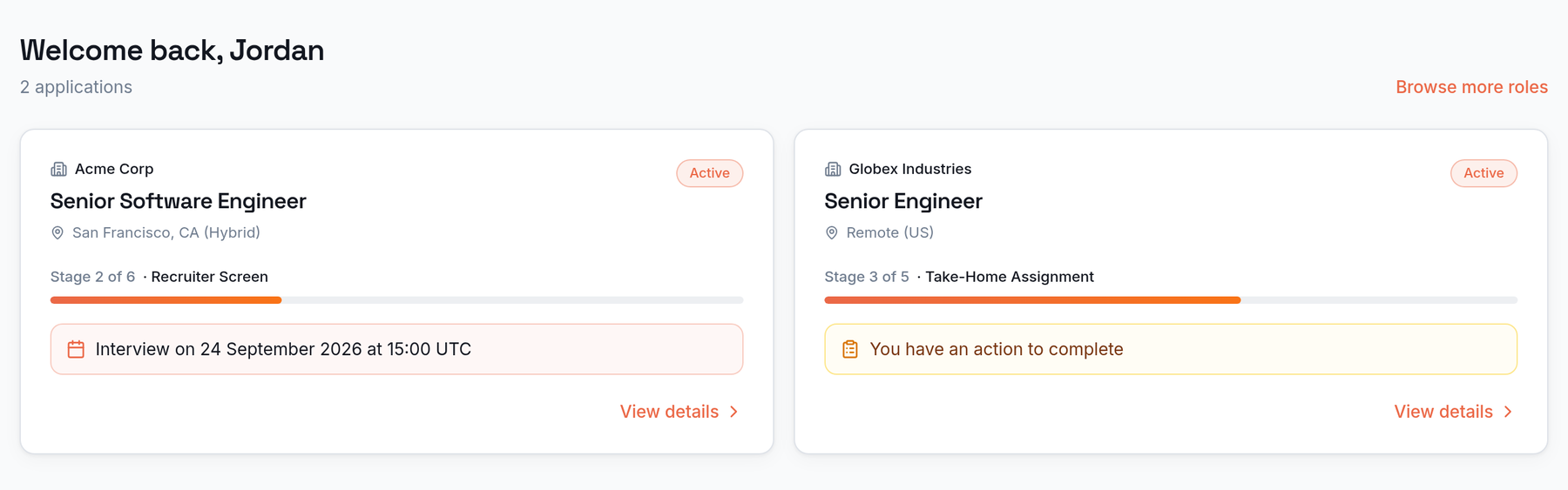
Most ATSes give the candidate status emails and a careers-page link. Nexus gives every applicant a live, persistent portal: each application's current stage, the next action, interview details, and documents in one place they can return to any time, not an inbox they have to search.
A gate built for the AI-application era
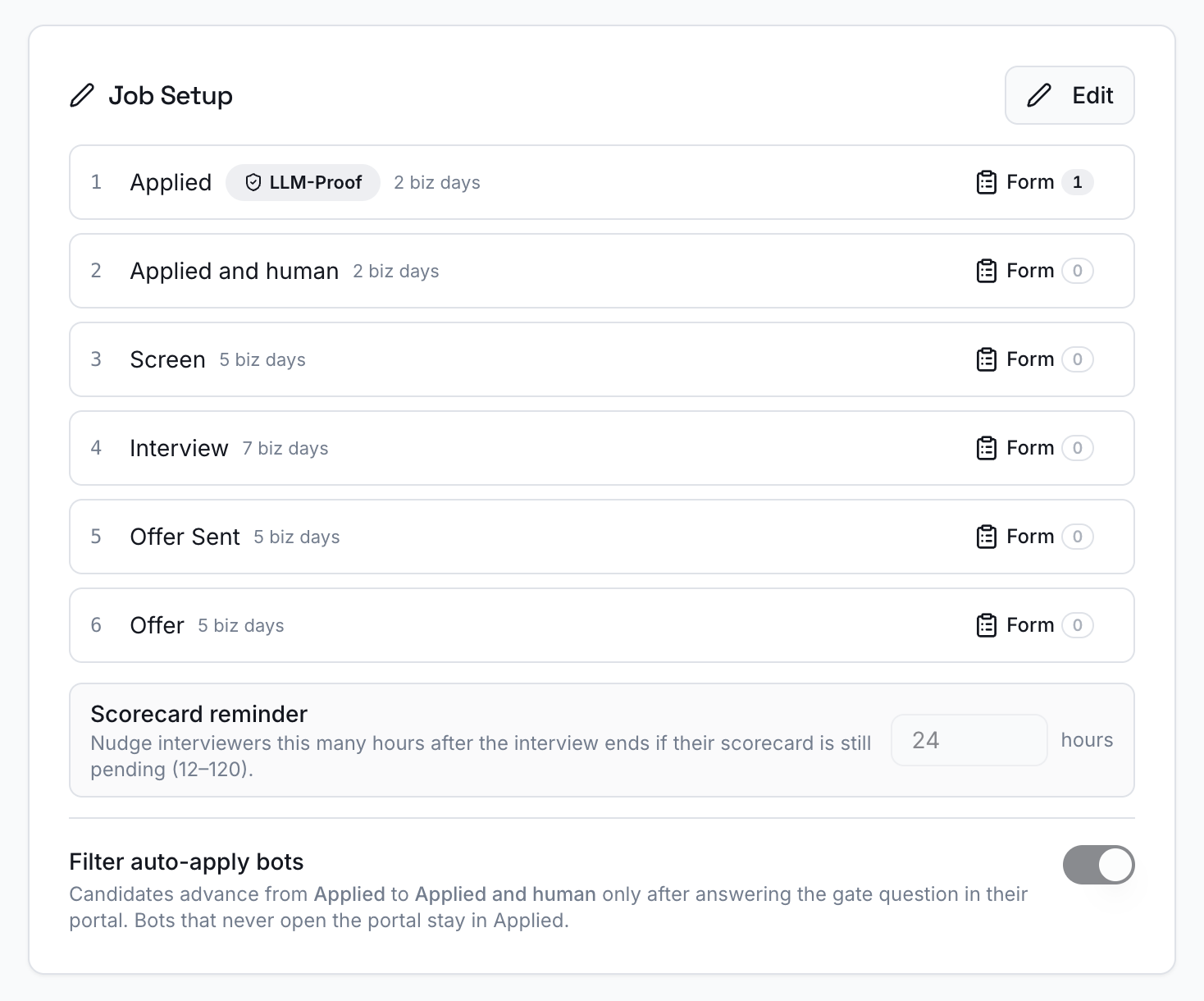
A per-job human-filter gate keeps auto-applied bot and agent submissions out of the real pipeline. Applications land in "Applied" and only advance to "Applied and human" once a real person opens their portal and answers one question, so reviewers spend their time on submissions that cleared the gate.
One application, fully alive
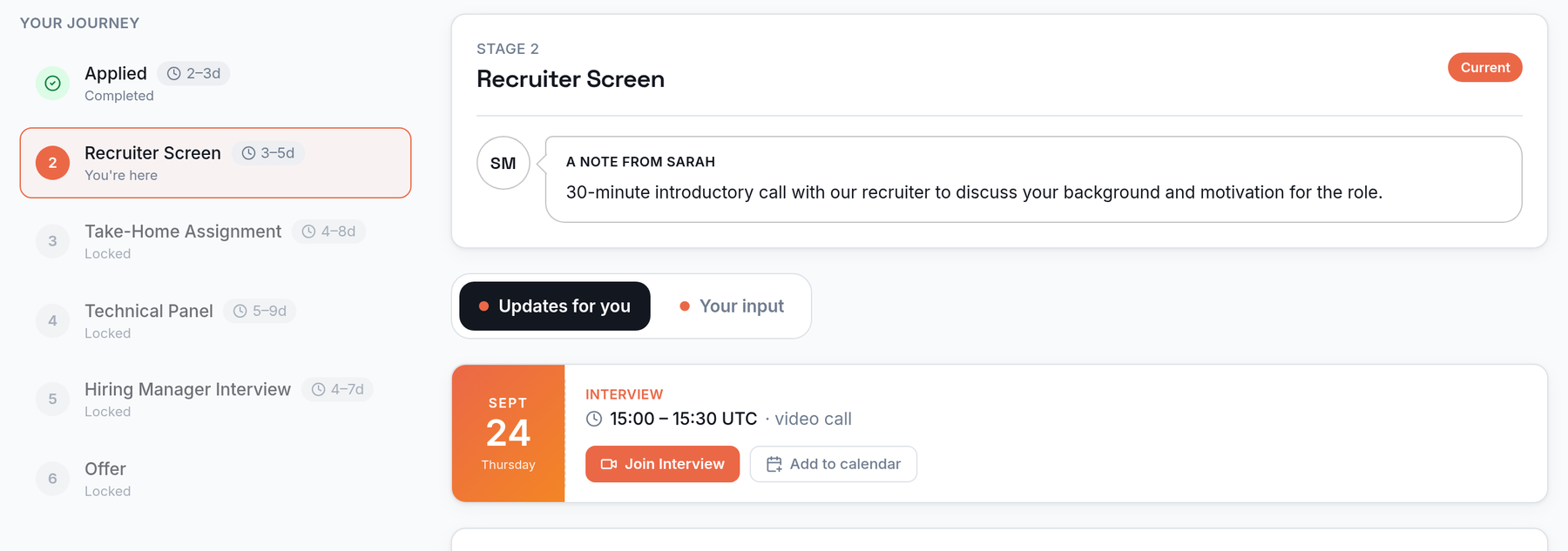
Inside a single application, the candidate sees exactly which stage they're in and what's next, a note from the recruiter, and per-stage documents as they become relevant. Scheduled interviews carry a join link and add-to-calendar, and an "Updates for you" / "Your input" split keeps what they need to read apart from what they need to do.
When Nexus is the better fit
- Candidate experience is the priority and you want every applicant to have a live, two-way portal of their own — current stage, next step, documents, and interview join link in one place — not one-way status updates and a careers page.
- Your top-of-funnel pain is the flood of AI-written, auto-applied submissions, and you want a human-filter gate that keeps them out of the pipeline rather than pointing an AI screener at the pile.
- You want stage-gated content that surfaces the right documents to a candidate at the right stage, and org-controlled transition emails in your own voice.
When Workable is the better fit
- You want one all-in-one suite spanning ATS, HRIS, onboarding, time tracking, and payroll prep, with published pricing from $299/month.
- You need AI sourcing across 400M+ passive profiles and AI screening that scores applicants against your job criteria today.
- You need mature security certifications (ISO 27001, ISO 27017, SOC 2 Type II, SOC 3) and deep native HRIS and job-board integrations right now.
Frequently asked questions
Is Nexus a good Workable alternative?
It depends on what you're optimizing for. Workable is a mature all-in-one talent-acquisition and HR suite: ATS plus HRIS, onboarding, time tracking, and payroll prep, an AI agent that sources across 400M+ passive profiles and screens applicants against up to 14 criteria, native Model Context Protocol support, and ISO 27001 / SOC 2 Type II certifications (as of March 2026). Nexus is an early, two-sided ATS built around the candidate experience: every applicant gets a live, persistent portal, and a human-filter gate keeps auto-applied bots and agents out of the real pipeline. If your priority is candidate experience and a top-of-funnel defense against AI-written applications, Nexus is the better fit; if it's all-in-one breadth and AI sourcing depth, Workable is.
Does Workable have a two-sided candidate portal like Nexus?
Not in the same shape. Workable candidates apply through mobile-responsive forms and branded careers pages, then receive status updates, messaging, and self-scheduling links (as of March 2026). It's a one-way candidate surface rather than a persistent portal joined to the pipeline, and candidate profiles are isolated per job pipeline, so applying to multiple roles creates separate records unless a recruiter merges them. Nexus is two-sided by design: each candidate gets their own live portal holding their current stage, documents, and interview join link, joined to the hiring team at the handoff, on every account.
How does Workable handle AI-written or auto-applied applications?
Workable leans on its AI agent. Workable Agent runs interactive qualification chats with applicants to verify details before shortlisting, screens inbound applications against up to 14 job criteria with 0–100 fit scores, and offers anonymized screening that redacts identifying details from reviewer forms (as of March 2026). That's AI screening rather than a human-application gate. Nexus takes a different approach: a per-job human-filter gate holds applications in "Applied" until a real person opens their portal and answers a question, so auto-applied bots and agents that never open the portal stay out of the real pipeline instead of being scored by an AI.
Does Workable expose an agent or MCP API?
Yes. Workable maintains a public v3 REST API with Bearer-token and OAuth 2.0 auth, webhooks for candidate lifecycle events, and native Model Context Protocol (MCP) support that lets external AI agents such as Claude or ChatGPT read, write, and execute recruiting tasks under defined permissions with audit logging (as of March 2026). Note the standard token rate limit of 10 requests per 10 seconds and the absence of native job-publish/update/close webhooks. Nexus exposes a public agent/MCP API too, read-only in Phase 1: a token-scoped REST API plus a Claude-compatible MCP server that lets an agent read jobs, applications, and pipeline stages, and by design agents see only the human-verified pipeline, never the bot flood the gate holds back.
How much does Workable cost?
Workable publishes pricing based on employee-size tiers. For the 1–20 employee base tier billed annually, the Standard plan is $299/month, Premier is $599/month, and Enterprise is $719/month; Standard add-ons include Texting+ ($89/mo), Video interviews+ ($109/mo), Assessments+ ($59/mo), and Performance & Engagement+ ($39/mo) (as of March 2026). Workable Agent AI is metered in credits: paid accounts include 3,000 free credits, with packages from $600 for 5,000 credits, and credits expire 12 months after purchase. Pricing for tiers above 20 employees isn't published. There's a 15-day free trial with no credit card required (Workable Agent credits excluded). Nexus is free during early access.