Nexus vs Bullhorn: a two-sided ATS vs a staffing-agency ATS + CRM
Bullhorn is a mature ATS + CRM suite built for staffing and recruitment agencies, strong on a unified candidate/client database, back-office pay & bill, automation, and enterprise security. Nexus is a two-sided ATS for companies hiring their own team: a live candidate portal and a human-filter gate for the era of AI-written applications.
Bullhorn is a staffing-agency operating system out of Boston: a unified ATS and CRM on one database, plus VMS sync, digital onboarding, back-office pay & bill, the Bullhorn Amplify AI assistant, and the Bullhorn Automation engine, carrying SOC 1 / SOC 2 Type 2 / ISO 27001 and a 300+ app Marketplace. It is built for agencies placing candidates into client companies, not for a company hiring its own employees; its candidate surface is self-service onboarding and timesheet portals plus automated status messaging, and its API is REST with no public MCP. Nexus takes a different shape: every candidate gets a live, persistent two-way portal, and a human-filter gate keeps auto-applied bots and agents out of the real pipeline. Pick Bullhorn to run a staffing or recruiting agency at scale; pick Nexus for in-house candidate experience and the AI-application era. (Comparison as of October 2026.)
Where Bullhorn's shape shows
Bullhorn is a deep, established platform, and for running a staffing or recruiting agency it is genuinely strong. The things to weigh are who it is built for and how it treats the candidate side and the top of the funnel, each point dated to our October 2026 research.
- It is built for staffing agencies, not in-house hiring. Bullhorn's core is a unified ATS + CRM that pairs recruiter delivery with client business development, aimed at agencies placing candidates into client companies — a different job than a company hiring its own team (as of October 2026).
- The candidate surface is one-way and ops-oriented. Candidates engage through self-service portals to complete onboarding documents, upload credentials, submit timesheets, and review schedules, plus automated SMS/email status messages; no persistent two-way candidate portal joined to the hiring pipeline is described (as of October 2026).
- No disclosed top-of-funnel bot defense. Public sources describe AI Search & Match ranking and Automation database hygiene, but no CAPTCHA, application rate limit, or anti-fraud identity check on public application forms (as of October 2026).
- No public agent or MCP surface. The REST API (OAuth 2.0, 1,500 calls/min per client ID, ~100k calls/month) plus webhooks and event streaming are the integration surface; no public Model Context Protocol server is documented, and custom REST API access is excluded from the entry-level ATS Growth tier (as of October 2026).
- Reviewers cite a high total cost of ownership (add-ons for automation, analytics, and custom API access), interface density and click-depth, and occasional performance lag with session timeouts that can lose uncommitted notes — Capterra 4.0/5 overall, Value for Money 3.7/5 (as of October 2026).
Nexus vs Bullhorn, feature by feature
| Feature | Nexus | Bullhorn |
|---|---|---|
| Two-sided candidate portal (a persistent place for the candidate) | yes | One-way: self-service onboarding/timesheet portals + automated SMS/email status |
| Stage-gated candidate content | yes | — |
| Top-of-funnel defense against auto-applied bots and agents | yes | No CAPTCHA / bot gate disclosed; AI Search & Match ranks, Automation keeps DB hygiene |
| Knock-out / pre-screening questions | yes | — (AI ranking / semantic match; no native knock-out auto-reject disclosed) |
| Candidate self-scheduling | yes | Interview self-scheduling from recruiter calendars |
| Native HRIS integrations | — | Native back-office pay & bill; 300+ Marketplace connectors; no named HRIS connector list |
| Native AI screening / interviewing | —* | Bullhorn Amplify LLM assistant + AI Search & Match auto-ranking |
| Outbound sourcing CRM | — | Unified ATS + CRM with AI Search & Match passive-candidate sourcing |
| Silver-medalist discovery | yes† | AI Search & Match re-surfaces database candidates for new requisitions |
| Public agent / MCP API | Read + governed write (MCP + REST)‡ | REST API (OAuth 2.0, 1,500 calls/min) + webhooks + event streaming; no public MCP |
| Offer letter + e-signature | Authored in-app, e-signed in the candidate's portal, PDF download§ | Digital e-signatures (onboarding / back-office) |
| Reference checks (native referee workflow) | Native referee surface — self-scheduled call + HM reference scorecard* | Background checks via Marketplace providers |
| Security certifications | — | SOC 1, SOC 2 Type 2, ISO/IEC 27001:2013 |
| Public pricing | Free during early access | Gated; benchmarks from ~$99/user/mo, higher for enterprise; API gated off entry tier |
- *
- By design, not a gap. Rather than pointing AI at the résumé pile — which just pits AI screeners against AI-written applications — Nexus filters auto-generated submissions at the top with its LLM-Proof gate, a human-filter step that lets a real person review only the ones that clear it.
- †
- Strictly your own pipeline: Nexus re-matches people who already applied to you — a strong finalist for one role, surfaced for the next — never external scraping or a bought database. Org-scoped and consent-respecting, with a one-click opt-out on every re-invite. The humane opposite of ghosting a good candidate, not an outbound sourcing CRM.
- ‡
- Read plus governed write, with one guarantee no 1-sided ATS can make: an agent can advance, reject, note, and score real candidates — each action scoped per key and attributed to a named person — but it can never move an applicant past the human-filter gate. That step clears only when a real person answers in the portal. The agent surface enforces the same humanity check as the rest of Nexus, so final hiring authority always stays with a human.
- §
- The offer lands where the candidate already lives: their persistent Nexus portal, right beside every stage of the application they've been following, not a separate e-sign link dropped in their inbox. Internal authors the letter (compensation, start date, expiry, terms), the candidate reviews and signs it with a typed-name e-signature, and both sides keep a downloadable PDF of the executed offer.
- *
- The referee is the one participant in a hire who still lives entirely in email: a cold request, a back-and-forth to find a time, notes pasted somewhere afterward. Nexus gives them the fourth side of the product — a dignified, token-gated surface. The candidate names their referees from their own portal, each referee self-schedules the call against the hiring manager's calendar, and the reference lands on a scorecard inside the pipeline. A native workflow for the people vouching for a candidate, not a third-party background-check bolt-on and not a Google Form.
Worried about the switch itself? Moving from Bullhorn to Nexus brings your jobs and the candidates on them across, each landing at the stage they were already in. See how migration works.
What Nexus brings to the table
Every candidate gets a home, not a status email
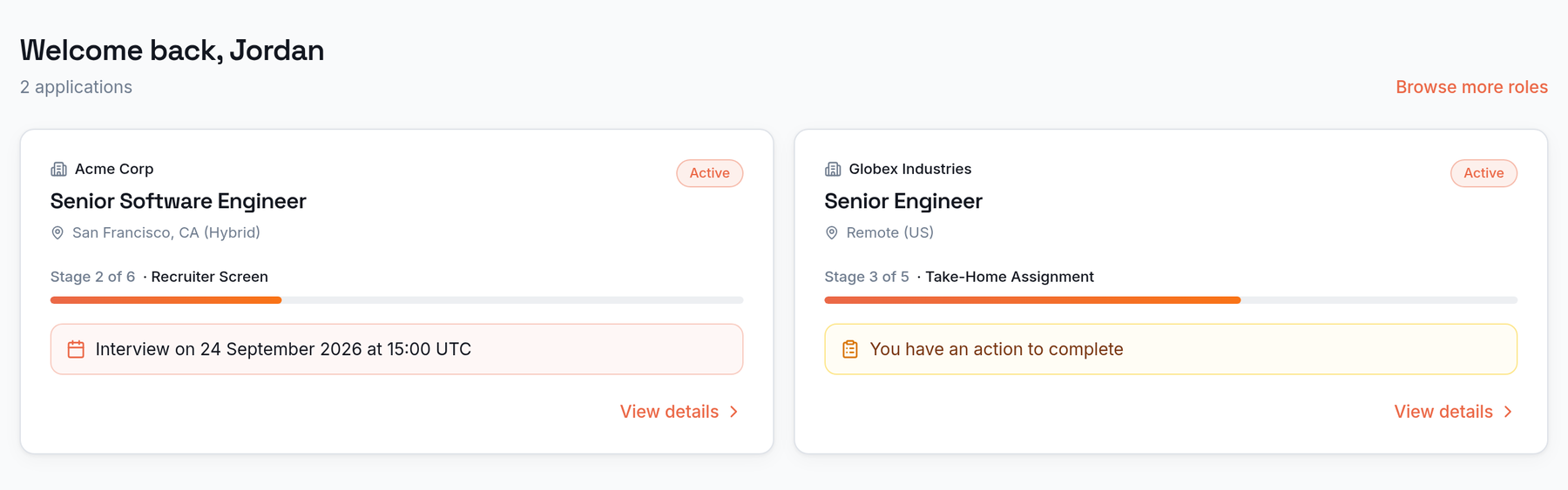
Most ATSes give the candidate status emails and a careers-page link. Nexus gives every applicant a live, persistent portal: each application's current stage, the next action, interview details, and documents in one place they can return to any time, not an inbox they have to search.
A gate built for the AI-application era
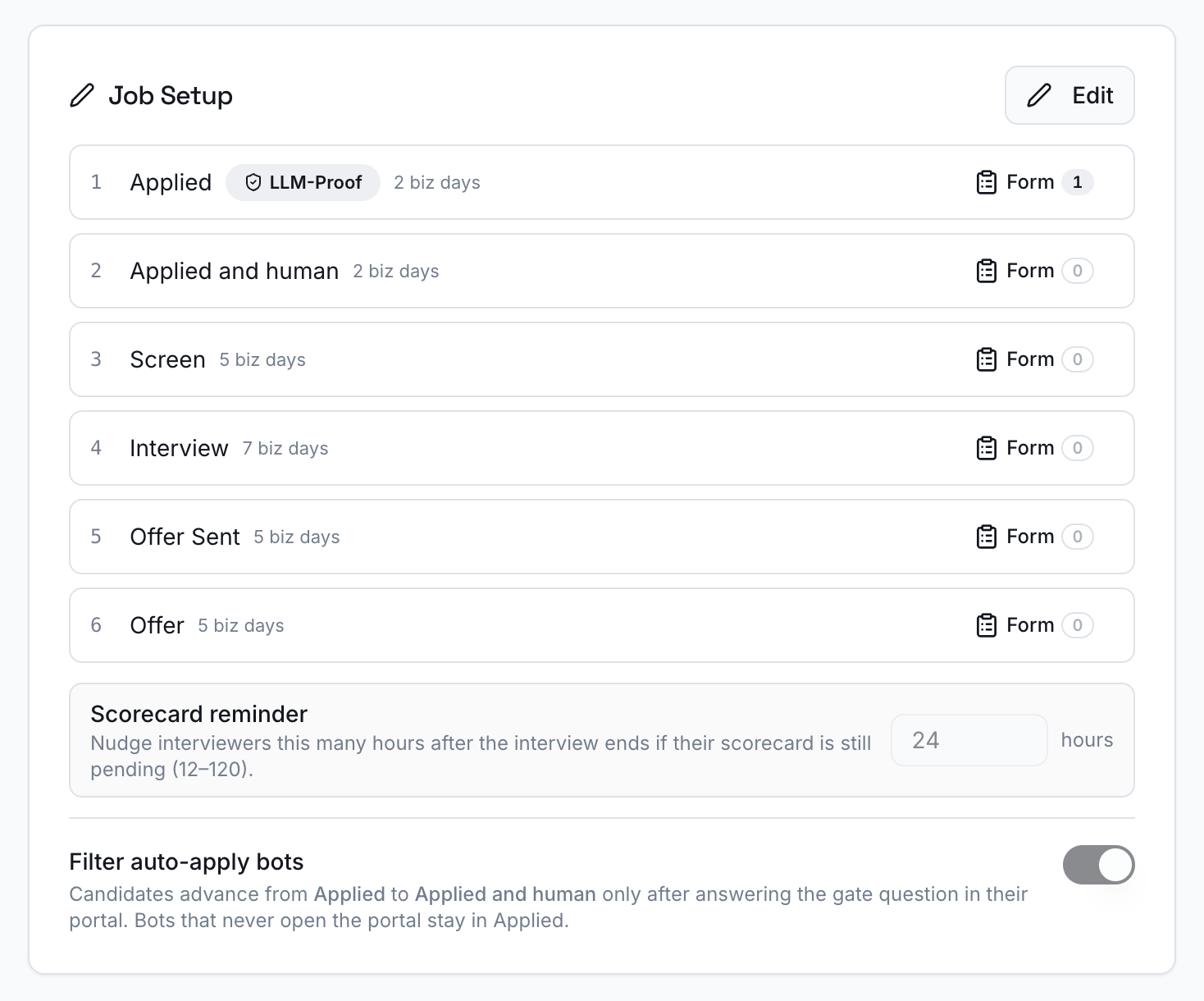
A per-job human-filter gate keeps auto-applied bot and agent submissions out of the real pipeline. Applications land in "Applied" and only advance to "Applied and human" once a real person opens their portal and answers one question, so reviewers spend their time on submissions that cleared the gate.
One application, fully alive
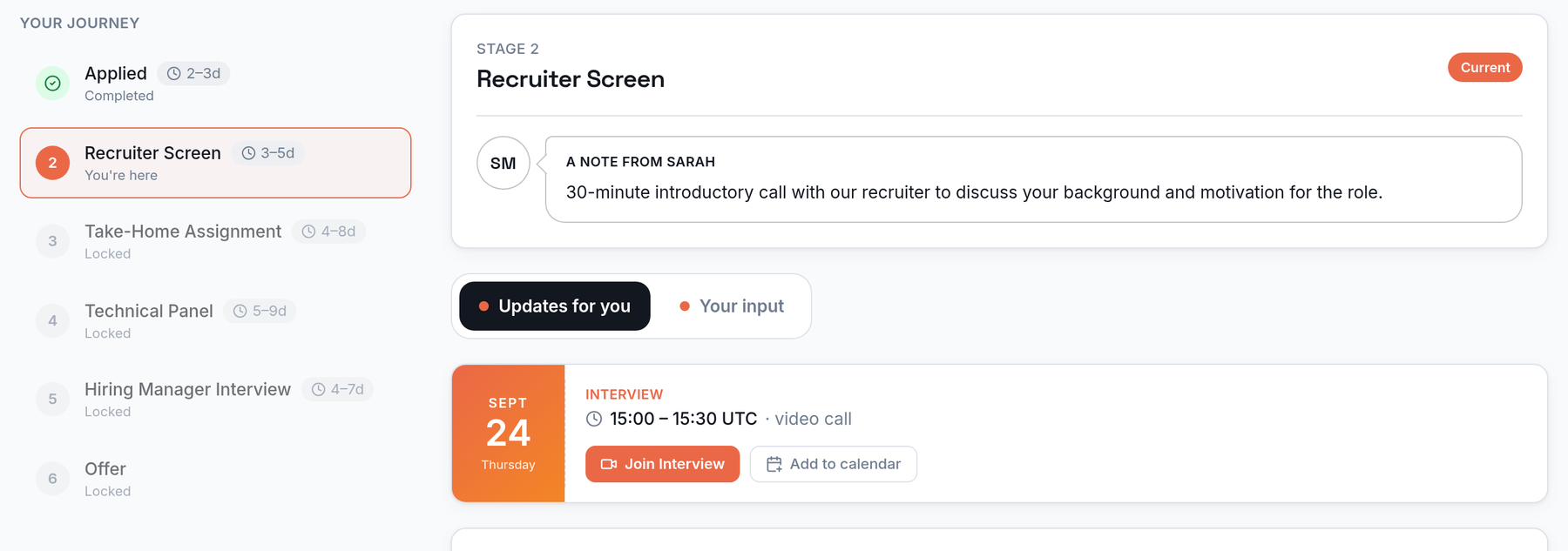
Inside a single application, the candidate sees exactly which stage they're in and what's next, a note from the recruiter, and per-stage documents as they become relevant. Scheduled interviews carry a join link and add-to-calendar, and an "Updates for you" / "Your input" split keeps what they need to read apart from what they need to do.
When Nexus is the better fit
- You are a company hiring your own employees and want an ATS built around the candidate handoff, not a staffing-agency platform built around placing candidates into client companies.
- Candidate experience is the priority and you want every applicant to have a live, two-way portal of their own — current stage, next step, documents, and interview join link in one place — not onboarding/timesheet self-service plus status messages.
- Your top-of-funnel pain is the flood of AI-written, auto-applied submissions, and you want a human-filter gate that keeps bots and agents out of the pipeline, not AI ranking of the pile.
- You want an agent/MCP API with governed write, where an agent can act on real candidates but can never move an applicant past the human-filter gate.
When Bullhorn is the better fit
- You run a staffing or recruitment agency and need a unified ATS + CRM on one database, where recruiter delivery and client business development share the same records.
- You need the full agency lifecycle: VMS sync, digital onboarding, shift management, timesheets, and back-office pay & bill connected to placements and client billing.
- Enterprise security certifications (SOC 1, SOC 2 Type 2, ISO/IEC 27001) and a 300+ app Marketplace (job boards, telephony, background checks, accounting) are hard requirements today.
- You want native, embedded recruitment AI (Bullhorn Amplify) and a mature trigger-based automation engine (Bullhorn Automation) running SMS/email nurture and database hygiene at scale.
Frequently asked questions
Is Nexus a good Bullhorn alternative?
It depends on what you're hiring for. Bullhorn is a staffing-agency operating system: a unified ATS and CRM on one database, plus VMS sync, onboarding, back-office pay & bill, the Bullhorn Amplify AI assistant, and the Bullhorn Automation engine, with SOC 1 / SOC 2 Type 2 / ISO 27001 and a 300+ app Marketplace (as of October 2026). It is built for agencies placing candidates into client companies. Nexus is an early, two-sided ATS for a company hiring its own team: every candidate gets a live, persistent portal, and a human-filter gate keeps auto-applied bots and agents out of the real pipeline. If you run a staffing or recruiting agency at scale, Bullhorn fits; if you are hiring in-house and candidate experience and defending the top of the funnel against AI-written applications are the priority, Nexus is the better fit.
Does Bullhorn have a two-sided candidate portal like Nexus?
Not in the same shape. Bullhorn candidates engage mainly through self-service web portals to complete pre-employment documents, upload credentials, submit timesheets, and review placement schedules, plus automated SMS/email notifications about status changes and assignments (as of October 2026). That is an onboarding-and-operations self-service surface for placed staffing workers, not a persistent two-way candidate portal joined to a hiring pipeline. Nexus is two-sided by design: each candidate gets their own live portal holding their current stage, what's next, documents, and the interview join link, joined to the hiring team at the handoff, on every account.
How does Bullhorn handle AI-written or auto-applied applications?
Bullhorn's disclosed AI is pointed at ranking and surfacing candidates (AI Search & Match evaluates skills, history, and proximity to rank database candidates against open requisitions) and at nurture and database hygiene via Bullhorn Automation (as of October 2026). Public sources do not disclose a CAPTCHA, application rate limit, or anti-fraud identity check on public application forms. Nexus takes a structural approach instead: a per-job human-filter gate holds applications in "Applied" until a real person opens their portal and answers a question, so auto-applied bots and agents that never open the portal stay out of the real pipeline.
Does Bullhorn expose an agent or MCP API?
Bullhorn exposes a RESTful API authenticated with OAuth 2.0 (a four-step login yielding a dynamic BhRestToken), rate-limited to 1,500 calls per minute per client ID with a ~100,000-calls-per-month standard allowance, plus native webhook steps in Bullhorn Automation and event-streaming subscriptions (as of October 2026). Legacy SOAP is still supported, and custom REST API access is excluded from the entry-level ATS Growth tier. No public Model Context Protocol (MCP) server or developer-facing autonomous-agent protocol is documented. Nexus exposes a public agent/MCP API with read plus governed write: an agent can advance, reject, note, and score real candidates, each action scoped per key and attributed to a named person, but it can never move an applicant past the human-filter gate — that step clears only when a real person answers in the portal.
How much does Bullhorn cost?
Bullhorn does not publish fixed pricing; it uses per-user, per-month seat licensing quoted through consultative sales based on scale, tier, add-on modules, and contract term (as of October 2026). Third-party benchmark data puts entry seats at roughly $99 per user per month, rising to several hundred per user per month for advanced enterprise subscriptions, with Automation, Analytics, Back Office Pay & Bill, and Amplify AI credits frequently sold as add-ons and contracts typically annual or multi-year. Reviewers note a high total cost of ownership relative to SMB-focused tools (Capterra Value for Money 3.7/5). Nexus is free during early access.
What is Bullhorn best known for?
Bullhorn is best known as the category platform for staffing and recruitment agencies: a unified ATS + CRM on a single database so recruiter delivery and client business development share real-time records, extended with VMS sync, digital onboarding, back-office pay & bill, the Bullhorn Amplify AI suite, and the Bullhorn Automation engine (from its Herefish acquisition), on Microsoft Azure with SOC 1 / SOC 2 Type 2 / ISO 27001 certifications and a 300+ app Marketplace (as of October 2026). Its reviewers most consistently praise the single-database ATS/CRM model and the automation engine. Nexus is not a staffing-agency suite; it is a two-sided ATS for in-house hiring, focused on the candidate portal and a human-filter gate for the AI-application era.