Nexus vs TalentLyft: a two-sided ATS vs an all-in-one recruitment-marketing suite
TalentLyft is an all-in-one European recruitment-marketing and ATS suite with strong GDPR posture, published pricing, and deep regional job boards. Nexus is a two-sided ATS: a live candidate portal and a human-filter gate for the era of AI-written applications.
TalentLyft is an all-in-one talent-acquisition platform out of Zagreb, Croatia (operating under CROZ d.o.o.), unifying sourcing, recruitment marketing, employer branding, applicant tracking, and a talent CRM. It leans on EU Azure hosting and a strong GDPR posture, publishes tiered pricing with unlimited seats, syndicates to 3,000+ job boards with deep Central/Eastern-European coverage, ships knockout questions, and uses AI only for resume summarization. Nexus takes a different shape: every candidate gets a live, persistent two-way portal, and a human-filter gate keeps auto-applied bots and agents out of the real pipeline. Pick TalentLyft for all-in-one recruitment marketing and regional reach across Europe; pick Nexus for candidate experience and the AI-application era. (Comparison as of October 2026.)
Where TalentLyft's shape shows
TalentLyft is a capable, well-priced European suite, and for all-in-one recruitment marketing with regional reach it is genuinely strong. The thing to weigh is how it treats the candidate side and the top of the funnel, each point dated to our October 2026 research.
- The candidate surface is one-way. Applicants apply through branded career and event pages and receive automated status communications; no persistent, logged-in two-way candidate portal joined to the pipeline is described (as of October 2026).
- Top-of-funnel defense is knockout questions only. Customizable knockout questions screen on stated requirements at submission, but public documentation discloses no CAPTCHA, application rate limits, or anti-fraud identity checks on public job forms (as of October 2026).
- No public agent or MCP surface. The Customer Private API is a REST API with bearer tokens; AI is scoped to resume summarization inside the product, not exposed as an agent surface, and no public MCP server is documented (as of October 2026).
- Reviewers note the reporting is basic for complex BI needs and the career-site builder is limited for teams wanting deep design control (as of October 2026).
- No SOC 2 or ISO/IEC 27001 certification is claimed in the sources reviewed, though the GDPR posture (EU Azure, AES-256 / TLS 1.3, consent and retention tooling) is strong (as of October 2026).
Nexus vs TalentLyft, feature by feature
| Feature | Nexus | TalentLyft |
|---|---|---|
| Two-sided candidate portal (a persistent place for the candidate) | yes | One-way: branded career/event pages + automated status emails |
| Stage-gated candidate content | yes | — |
| Top-of-funnel defense against auto-applied bots and agents | yes | Knockout questions only; no CAPTCHA / rate-limit / identity check disclosed |
| Knock-out / pre-screening questions | yes | yes |
| Candidate self-scheduling | yes | 1:1, round-robin, and collective self-scheduling |
| Native HRIS integrations | — | BambooHR, HiBob, HR Cloud, Sage HR, Deel |
| Native AI screening / interviewing | —* | AI resume summarization only; no autonomous ranking (GDPR Art. 22) |
| Outbound sourcing CRM | — | Sourcing extension + talent CRM + 3,000+ job boards |
| Silver-medalist discovery | yes† | Boolean re-engagement of past-pipeline candidates in the CRM |
| Public agent / MCP API | Read + governed write (MCP + REST)‡ | REST Customer Private API + bearer tokens; no public MCP server |
| Offer letter + e-signature | Authored in-app, e-signed in the candidate's portal, PDF download§ | Requisition & offer management + e-signature integrations |
| Security certifications | — | None claimed; EU Azure hosting, AES-256 / TLS 1.3, GDPR tooling |
| Public pricing | Free during early access | Published: Essential ~$73.50/mo, Growth ~$148.50/mo (billed annually); Enterprise custom |
- *
- By design, not a gap. Rather than pointing AI at the résumé pile — which just pits AI screeners against AI-written applications — Nexus filters auto-generated submissions at the top with its LLM-Proof gate, a human-filter step that lets a real person review only the ones that clear it.
- †
- Strictly your own pipeline: Nexus re-matches people who already applied to you — a strong finalist for one role, surfaced for the next — never external scraping or a bought database. Org-scoped and consent-respecting, with a one-click opt-out on every re-invite. The humane opposite of ghosting a good candidate, not an outbound sourcing CRM.
- ‡
- Read plus governed write, with one guarantee no 1-sided ATS can make: an agent can advance, reject, note, and score real candidates — each action scoped per key and attributed to a named person — but it can never move an applicant past the human-filter gate. That step clears only when a real person answers in the portal. The agent surface enforces the same humanity check as the rest of Nexus, so final hiring authority always stays with a human.
- §
- The offer lands where the candidate already lives: their persistent Nexus portal, right beside every stage of the application they've been following, not a separate e-sign link dropped in their inbox. Internal authors the letter (compensation, start date, expiry, terms), the candidate reviews and signs it with a typed-name e-signature, and both sides keep a downloadable PDF of the executed offer.
Worried about the switch itself? Moving from TalentLyft to Nexus brings your jobs and the candidates on them across, each landing at the stage they were already in. See how migration works.
What Nexus brings to the table
Every candidate gets a home, not a status email
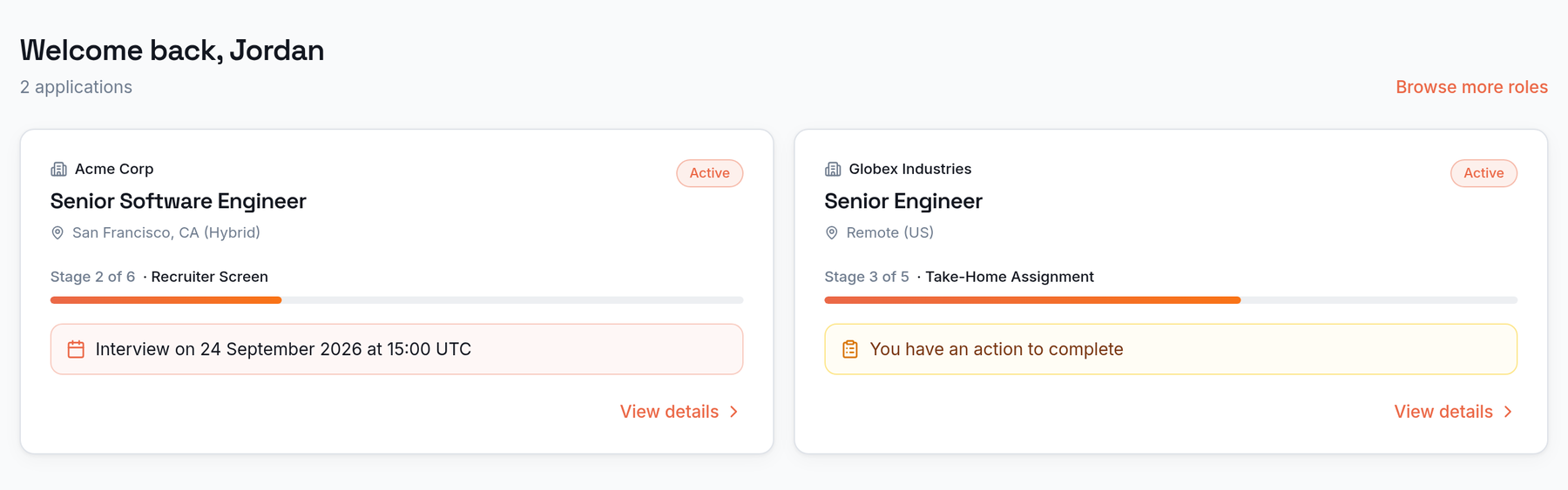
Most ATSes give the candidate status emails and a careers-page link. Nexus gives every applicant a live, persistent portal: each application's current stage, the next action, interview details, and documents in one place they can return to any time, not an inbox they have to search.
A gate built for the AI-application era
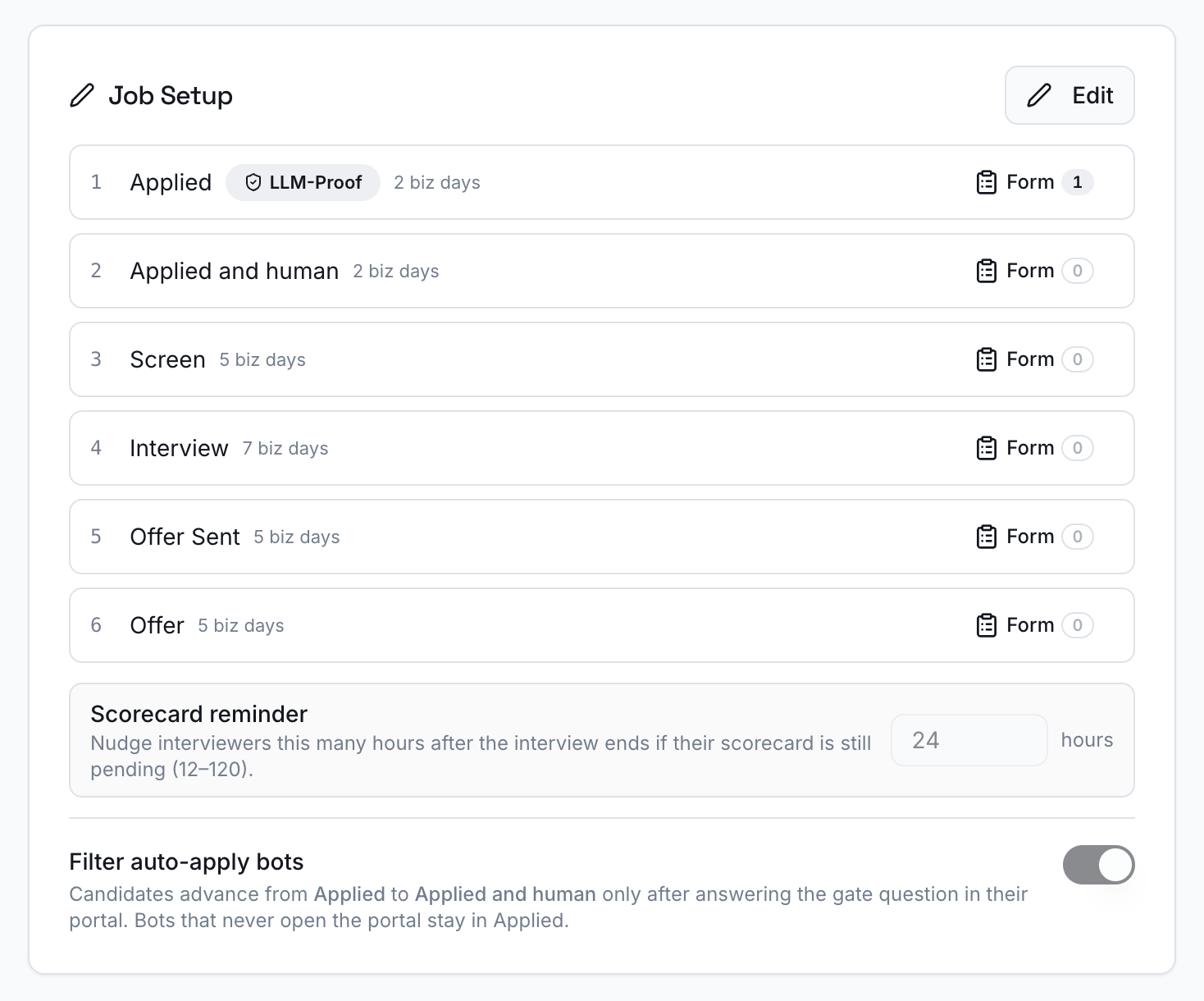
A per-job human-filter gate keeps auto-applied bot and agent submissions out of the real pipeline. Applications land in "Applied" and only advance to "Applied and human" once a real person opens their portal and answers one question, so reviewers spend their time on submissions that cleared the gate.
One application, fully alive
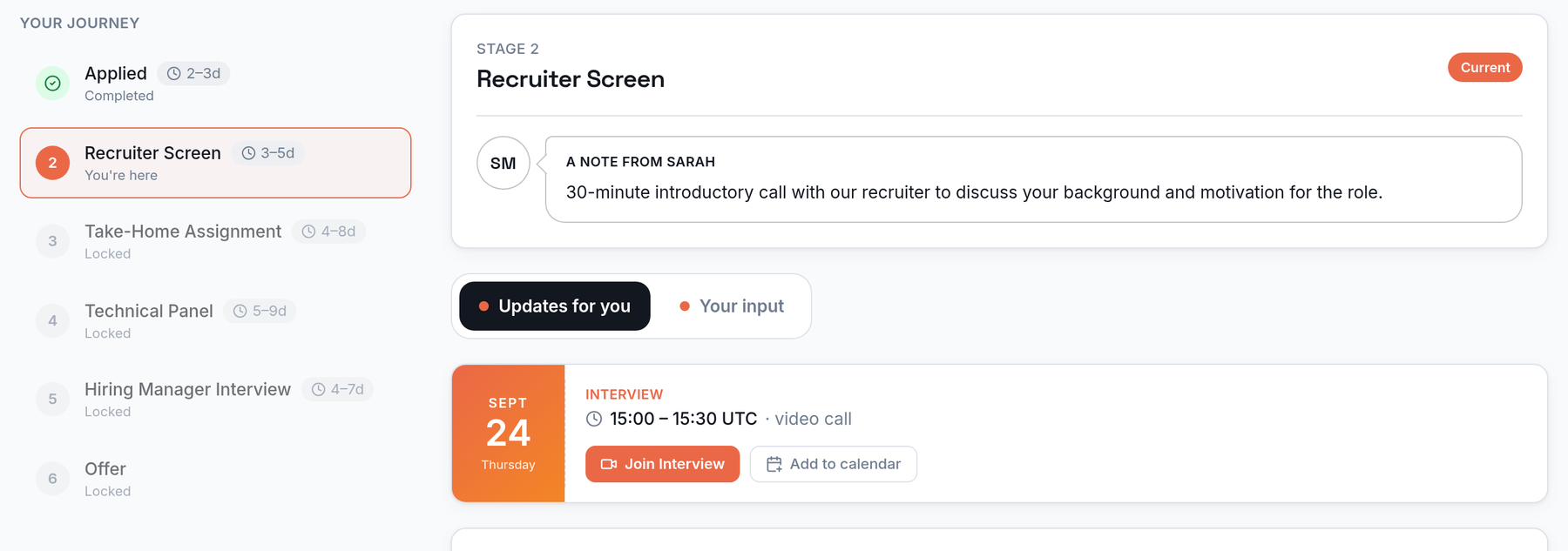
Inside a single application, the candidate sees exactly which stage they're in and what's next, a note from the recruiter, and per-stage documents as they become relevant. Scheduled interviews carry a join link and add-to-calendar, and an "Updates for you" / "Your input" split keeps what they need to read apart from what they need to do.
When Nexus is the better fit
- Candidate experience is the priority and you want every applicant to have a live, two-way portal of their own — current stage, next step, documents, and interview join link in one place — not one-way status emails.
- Your top-of-funnel pain is the flood of AI-written, auto-applied submissions, and you want a human-filter gate that keeps bots and agents out of the pipeline, not just knockout questions.
- You want stage-gated content that surfaces the right documents to a candidate at the right stage, and org-controlled transition emails in your own voice.
- You want an agent/MCP API with governed write, where an agent can act on real candidates but can never move an applicant past the human-filter gate.
When TalentLyft is the better fit
- You want one all-in-one suite covering sourcing, recruitment marketing, employer branding, ATS, and a talent CRM, with unlimited user seats on every tier.
- You hire across Europe and value deep regional job-board coverage (Indeed, Profession.hu, MojeDelo, Joberty, Optius, Profesia) plus syndication across 3,000+ boards.
- Published, low-entry pricing and native HRIS exports (BambooHR, HiBob, HR Cloud, Sage HR, Deel) on "Hired" are hard requirements today.
- A strong GDPR posture — EU Azure hosting, consent and retention tooling, Right-to-be-Forgotten workflows, and no autonomous candidate ranking — is central to your buying decision.
Frequently asked questions
Is Nexus a good TalentLyft alternative?
It depends on what you're optimizing for. TalentLyft is an all-in-one European recruitment-marketing and applicant-tracking suite: sourcing, employer branding, an ATS, and a talent CRM in one product, with EU Azure hosting, a strong GDPR posture, published tiered pricing, and syndication across 3,000+ job boards (as of October 2026). Nexus is an early, two-sided ATS: every candidate gets a live, persistent portal, and a human-filter gate keeps auto-applied bots and agents out of the real pipeline. If you want an all-in-one recruitment-marketing suite with deep regional reach across Europe, TalentLyft fits; if candidate experience and defending the top of the funnel against AI-written applications are the priority, Nexus is the better fit.
Does TalentLyft have a two-sided candidate portal like Nexus?
Not in the same shape. TalentLyft candidates apply through branded, mobile-optimized career and event pages without creating an account, and then receive automated status communications (as of October 2026). That's a deliberately low-friction, one-way candidate surface; no persistent, logged-in, two-way candidate portal joined to the hiring pipeline is described in TalentLyft's sources. Nexus is two-sided by design: each candidate gets their own live portal holding their current stage, documents, and interview join link, joined to the hiring team at the handoff, on every account.
How does TalentLyft handle AI-written or auto-applied applications?
TalentLyft's disclosed top-of-funnel mechanism is customizable knockout questions that screen applicants against minimum requirements at submission, and it deliberately avoids autonomous AI ranking of candidates to stay compliant with GDPR Article 22 (as of October 2026). Public documentation does not disclose CAPTCHA, application rate limits, or anti-fraud identity checks on public job forms. Nexus takes a structural approach instead: a per-job human-filter gate holds applications in "Applied" until a real person opens their portal and answers a question, so auto-applied bots and agents that never open the portal stay out of the real pipeline.
Does TalentLyft expose an agent or MCP API?
TalentLyft offers a Customer Private API — a REST API authenticated with bearer tokens that can query, create, and update requisitions, candidate files, applications, and pipeline stages (rate-limited to 500 calls/minute), plus a Partner Public API capped at 100 requests/minute and an embeddable JavaScript career-site widget (as of October 2026). Its AI is scoped to resume summarization inside the product; no public Model Context Protocol (MCP) server or developer-facing autonomous-agent protocol is documented. Nexus exposes a public agent/MCP API with read plus governed write: an agent can advance, reject, note, and score real candidates, each action scoped per key and attributed to a named person, but it can never move an applicant past the human-filter gate — that step clears only when a real person answers in the portal.
How much does TalentLyft cost?
TalentLyft publishes transparent, tiered pricing based on active job slots, with unlimited user seats on every tier: Essential at about $73.50/month and Growth at about $148.50/month (both billed annually, starting at 2 job slots), and a custom-quote Enterprise tier that adds unlimited slots and SAML 2.0 SSO (as of October 2026). Annual billing is ~16.7% off, with larger multi-year, startup, and non-profit discounts, and a 14-day free trial with no credit card. Nexus is free during early access.
Is TalentLyft GDPR-compliant and where is data hosted?
TalentLyft hosts on Microsoft Azure servers within the EU, under the governance of CROZ d.o.o., with AES-256 encryption at rest and TLS 1.3 in transit (as of October 2026). It ships native GDPR tooling: automated consent collection, customizable data-retention timers, and Right-to-be-Forgotten erasure workflows, plus SAML 2.0 SSO and role-based access control, a 90-day audit log, and no-extra-cost data export on termination. It deliberately avoids autonomous AI ranking of candidates to stay within GDPR Article 22. Nexus supports data-subject rights and publishes its Privacy and Security pages, with a DPA available on request.